Month: July 2025

  • Inside Ati Motors’ vision for industrial robots: Indian engineering for global markets

    Inside Ati Motors’ vision for industrial robots: Indian engineering for global markets

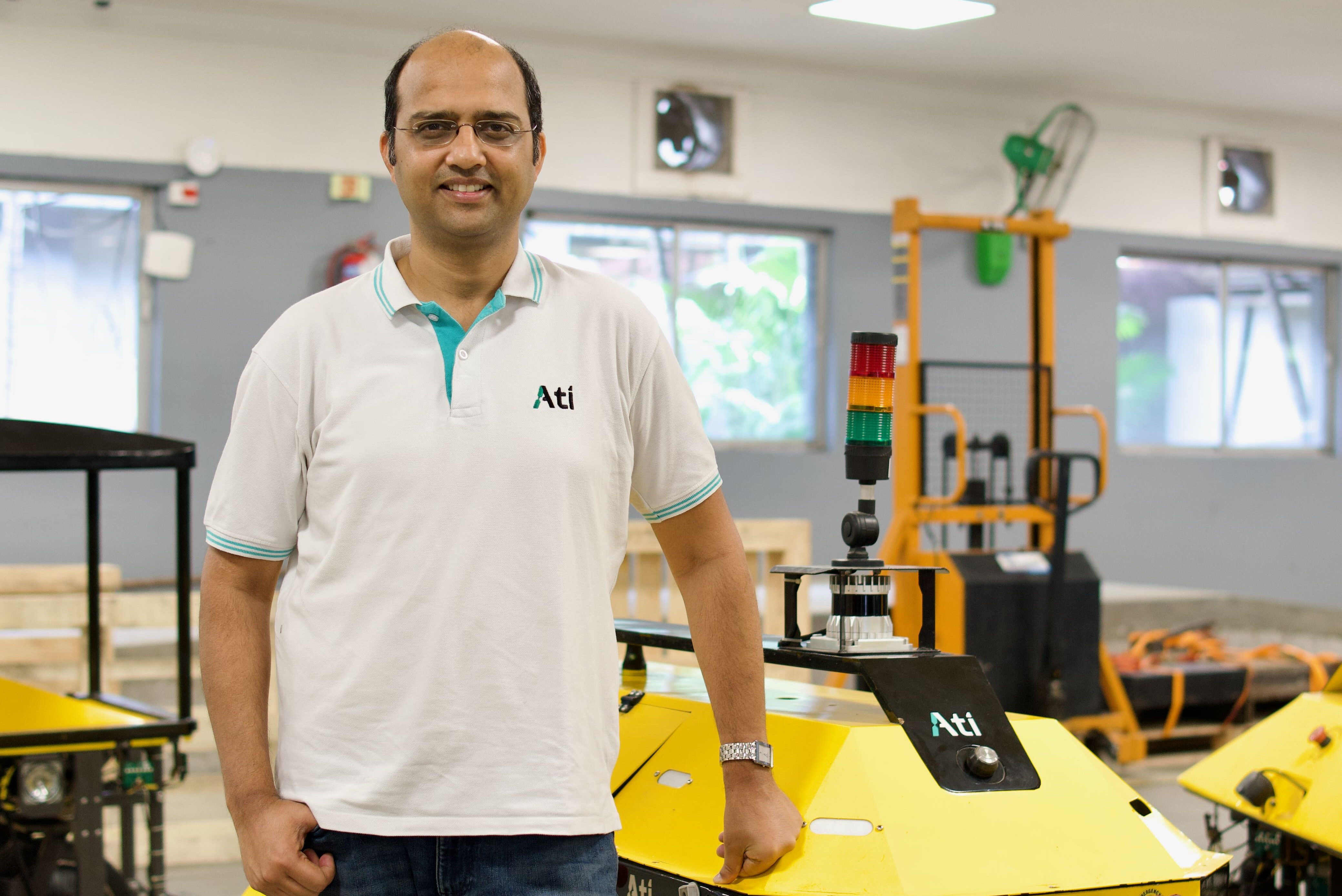
    At Ati Motors’ annual Products Day, Founder and CEO Saurabh Chandra introduces Mecha, the company’s experimental humanoid prototype.

    Today, I wanted to bring you one story that caught my imagination last week, about how Indian engineering could go global – not just in software, but in areas like robotics.

    This past Saturday*, I got a chance to attend the annual Products Day at Ati Motors, which as I’ve mentioned in the recent past, is a startup that specialises in autonomous mobile robots for industrial applications. (*I said Friday in the audio podcast. It was Saturday, July 19.)

    Listen to the podcast

    Ati held the event at the Indian Institute of Science’s JN Tata Auditorium. The eight-year-old company was in fact born at the institute and incubated there. Its flagship family of robots, the Sherpa, was on display at the event. Earlier in the day, Ati’s engineers demonstrated how the Sherpa Tug could pull a Mahindra Thar SUV and couple of other cars as well, all tethered one behind another.

    Full stack, made-in-Bengaluru

    To illustrate how far Ati has come, Founder and CEO Saurabh Chandra pointed out that this year, the Sherpa AMRs were on track to successfully execute a million autonomous missions per annum. The missions average 95 percent accuracy across challenging industrial environments worldwide.

    For Chandra, this moment represented an important milestone marking the eight-year journey to prove that sophisticated, world-class robotics technology could emerge from Indian engineering talent and compete successfully in the most demanding global markets.

    “Today’s Ati Motors is the realization of a dream begun eight years ago, to create a truly multi-disciplinary products company that pushes the boundaries of engineering, artificial intelligence, and industrial design,” he said, speaking at the Products Day event.

    Ati stands out for its full-stack approach — developing every critical component of its AMRs in-house, from navigation algorithms to mechanical design and fleet management software.

    The company’s engineering philosophy centres on solving real-world problems, instead of expecting customers to make significant modifications to their factory or warehouse environments. The Sherpas can function in conditions including uneven floors, outdoor environments, and areas with poor connectivity.

    “For a customer in Michigan, we operated in them in snow,” CTO Arulselvan tells me in a recent interview.

    As the operating environments get more challenging, “we like to say bring it on,” Chandra says. This approach has resulted in robots that can handle gradients, potholes, clutter, rain, and dust—conditions where traditional AGVs (automated guided vehicles) typically don’t do well.

    The technical sophistication of Ati’s products demonstrates Indian engineering capabilities. The company is emerging as a leader in the use of 3D LiDAR-based navigation for industrial robots, enabling them to operate without infrastructure modifications such as magnetic strips or reflective markers. All autonomy processing occurs entirely onboard the robots, eliminating dependency on cloud connectivity or remote human operators.

    “Our engineering team actually said if you do that, it will be a crutch that we will never get rid of,” Chandra looks back at the early decision to avoid teleoperation, in a recent interview with me. “So let us just not do it at all from the beginning. If it fails, let it be a failure that we need to fix,” rather than there being some human backup system.

    This engineering discipline has paid dividends. The newly launched Sherpa 10K represents a significant technical achievement, featuring a 4.6-ton towing capacity with advanced sensor fusion combining 3D LiDAR and cameras, in-place turning for tight spaces, and the ability to operate on gradients up to 10 percent. The system integrates with existing enterprise resource planning and warehouse management systems while maintaining compliance with ISO 3691-4 safety standards.

    “Our journey started with autonomous material movement, but our horizons have grown rapidly. Today, we go beyond movement: we track material, handle it and even transform it, through our AI platform: Ati Verse,” CTO Naveen Arulselvan says.

    Chandra credits Bengaluru’s multidisciplinary talent pool and manufacturing ecosystem – including the emerging electric vehicle ecosystem in the country – as important factors that support rapid product iteration and real-world feedback. Very few other locations anywhere in the world have this, he says.

    The city’s strong manufacturing industry, though overshadowed by its IT services reputation, provides immediate access to potential customers and an ecosystem of manufacturing expertise.

    Ati has deployed robots at more than 50 customers globally, including Fortune 500 companies such as Bosch, Forvia, and Hyundai. The company operates in India, the United States, Mexico, Thailand, Singapore, and Vietnam, with plans to expand into Europe and Japan.

    After raising $20 million in a Series B round in January 2025, led by Walden Catalyst Ventures and NGP Capital, total funding at Ati touched approximately $37 million. This investment supports the company’s expansion from deploying hundreds of robots to targeting thousands — a scaling challenge that Indian deep-tech companies like Ati will have to successfully navigate if they are to become truly global companies.

    Customer confidence in Ati’s technology is reflected by the 27 percent increase in same-robot usage year-over-year, indicating not just adoption but deepening integration. This metric validates the engineering quality, as industrial customers demand high reliability before integrating automation into production processes.

    Humanoid future

    At the Products Day, a singular highlight was the surprise arrival of Mecha, Ati’s experimental humanoid robot prototype. It is now already available for research partnerships, signalling Ati’s ambitions beyond traditional material handling.

    Mecha reflects a broader engineering philosophy at Ati Motors that emphasizes functionality and performance. Chandra explains that it’s less important for the humanoid to be a biped and have legs just for the sake of the form factor. In fact, Mecha came trundling out on to the stage on its own wheels.

    With its arms “it doesn’t have fingers, it has tool changers,” Chandra points out.

    The humanoid features best-in-class payload capabilities and carbon fibre construction with cable transmission systems, according to Ati. By offering the platform for research partnerships at $50,000, Ati aims to accelerate innovation through collaboration.

    Mobile robots represent the first automation technology in manufacturing that operates without fixed boundaries — a fundamental shift that requires new operational approaches from customers. This insight drives the company’s investment in customer success teams to help organizations adapt to autonomous systems that operate throughout facilities without supervision.

    Arulselvan recalled a simple anecdote from a recent customer site visit: “What we like about it is that it is very predictable. Even in the third shift, it does the same,” one manager at the customer’s factory told him. Well, that’s exactly what automation is expected to achieve.

    Looking ahead, Ati aims to focus on more challenging applications, combined with its full-stack technical approach and deep customer engagement. The aim is to help define industry standards rather than merely follow them. The future of industrial robotics belongs to companies that can combine technical sophistication with practical engineering discipline, and as they say in the startup world, ‘go-to-market execution.’
  • Arpit Agarwal on the India advantage in deep tech and Blume’s next fund

    Arpit Agarwal on the India advantage in deep tech and Blume’s next fund

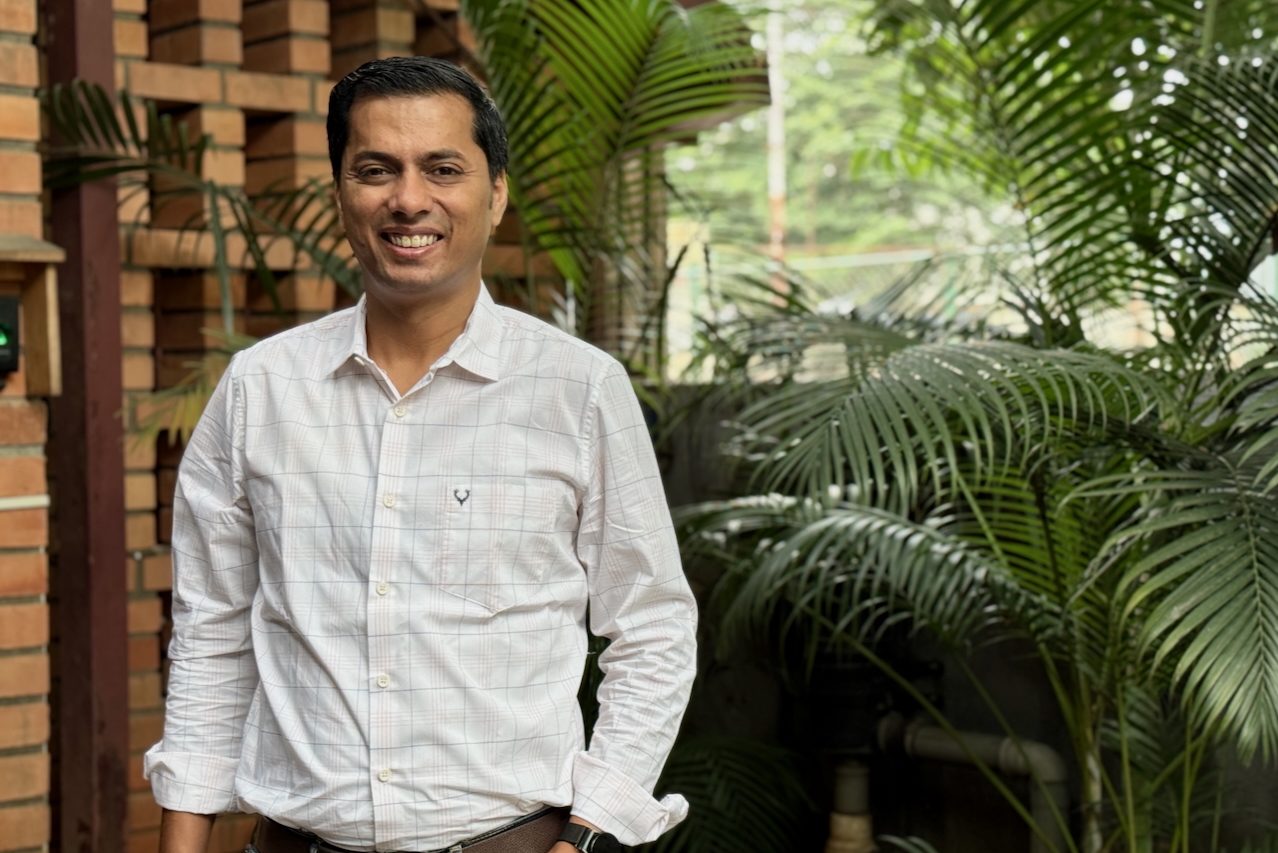
    My guest in today’s episode is Arpit Agarwal, a partner at Blume Ventures, one of India’s best known early-stage sector-agnostic VC firms with a solid track record of backing what Arpit describes as frontier technologies.

    In this episode, we discuss the challenges and advantages of building and scaling deep science and technology-based companies out of India. Arpit delves into his experience navigating the cycles of venture capital, the gradual shift to larger fund sizes at Blume, and the fundamentals that guide investment decisions.

    He also comments on international dynamics, including the movement of talent and capital in the context of AI being widely seen as the biggest opportunity for founders and investors alike. He weighs in on the shifting balance between hardware and software within India’s deep tech scene and identifies some of the most interesting investment themes.

    As Blume prepares to move into its fifth fund, Arpit is also happy to debate why sector-agnostic funds may be better placed to invest in deep tech.

  • Climate on Monday: Transvolt funded in IFC’s first EV fleet investment, a solar PV efficiency breakthrough, 1.7°C, and more

    Daily brief on deep tech and climate tech news from India and around the world.

    Global warming and climate change concept. Hot weather thermometer with arrow on high temperature symbol on glass earth globe on red drought background with copy space. Increase hot degrees level.

    India set to mandate climate risk disclosures for banks by 2028
    India’s central bank, RBI, is finalizing rules to require banks and financial institutions to regularly disclose and manage climate-related financial risks, Reuters reports. The disclosures will be voluntary from fiscal 2027 and mandatory from 2028, covering exposure to climate risks, mitigation strategies, and scenario-based stress testing for extreme weather events. The move aims to boost transparency and align with global climate objectives.

    Listen to the podcast

    Singapore and China deepen cooperation on green finance
    Singapore and China are advancing joint efforts in sustainable finance, focusing on aligning their green taxonomies and improving cross-border investment, Business Times reports. At their recent Green Finance Taskforce meeting, officials highlighted progress on interoperable standards, deployment of the Multi-Jurisdiction Common Ground Taxonomy, and leveraging technology for emissions monitoring. Initiatives also target green syndicated loans and increased collaboration in green bond issuance, biodiversity finance, and technology-driven solutions.

    EU regulators propose including ESG risks in finance stress tests
    EU financial watchdogs propose requiring national regulators to add environmental, social, and governance (ESG) risks to bank and insurance stress tests for more consistent supervision, Green Central Banking reports. The plan emphasizes climate and environmental factors initially, with social and governance risks added gradually. Experts question if current climate stress tests adequately capture financial losses, highlighting the need for actions beyond analysis.

    European climate funding drops 71% in 2025 as big debt deals vanish
    Climate tech investment in Europe fell sharply in the first half of 2025, plunging 71 percent year-on-year to €6.2 billion, Sifted reports. This decline follows a surge in 2024 caused by unusually large debt deals, like the €5bn Northvolt round. While late-stage deals disappeared, early-stage investing has stayed steadier. Industry insiders say the market is digesting previous investments and bracing for future opportunities.

    Airlines warned of legal risks over greenwashing jet fuel
    And UK NGO, Opportunity Green, has warned that airlines risk lawsuits for labelling all alternatives to kerosene as “sustainable” without robust proof, Climate Change News reports. Fraud and greenwashing claims are rising, especially with questionable sustainable aviation fuel supply chains. Regulators have already penalized airlines for misleading environmental claims, urging accurate terminology and transparency on fuel sources and true climate impact.

    EV giant Rivian to open London hub focused on AI and autonomy
    American electric vehicle maker Rivian is launching its first UK office in London to tap into the city’s “world-class” AI engineering talent, according to Sifted. The hub will accelerate development of autonomous driving and AI technologies for Rivian’s vehicles. This move signals Rivian’s commitment to advanced vehicle tech and expansion into the European market.

    Apple to buy $500 million in rare earths from MP Materials
    Apple has agreed to purchase $500 million worth of rare earth materials from MP Materials, a Pentagon-supported US producer, TechCrunch reports. The multi-year deal aims to secure key minerals used in iPhones and other devices while reducing reliance on Chinese supply chains. This partnership strengthens US domestic production of critical materials and supports Apple’s commitment to supply chain resilience and sustainability.

    Microsoft, Vaulted Deep partner to bury biomass waste deep
    Microsoft has struck a deal with Vaulted Deep, an Xprize winning startup, to transform biomass waste into long-term carbon storage as part of the cloud giant’s carbon removal efforts, Bioenergy Insight reports. The process involves safely injecting treated agricultural biomass deep underground, locking away carbon for centuries. This partnership advances scalable, verifiable carbon sequestration solutions and highlights increasing corporate investment in novel carbon removal technologies.

    Transvolt raises $20 million from IFC as part of $50 million round
    Transvolt Mobility has raised $20 million from the International Finance Corporation as part of its $50 million financing round to expand its electric vehicle (EV) fleet, according to an IFC press release. This is IFC’s first equity investment in an EV platform in India and globally. It will enable Transvolt to scale its electric fleet portfolio to 3,500 vehicles and create 8,200 jobs in the next five years. It will also support the company’s long-term goal of deploying 8,000 heavy commercial EVs such as buses and trucks across India. Transvolt operates an OEM-agnostic EV platform serving both public and private sectors.

    Omspace Rocket raises $3 million to advance small satellite launches
    Ahmedabad-based space-tech startup Omspace Rocket & Exploration Private Limited has raised $3 million in pre-seed funding led by a family office and angel investors. Funds will finalize and launch the firm’s Infinity One prototype, a modular vehicle for cost-effective satellite delivery to low Earth orbit. Omspace will expand R&D, manufacturing, and hiring.

    Japan sees bright future in ultra-thin flexible solar panels
    Japanese researchers have developed ultra-thin, lightweight, and highly flexible solar panels that can be attached to a wide range of surfaces, from fabrics to curved structures, Tech Xplore reports. The breakthrough aims to enable energy generation on clothing, vehicles, and buildings without adding bulk. These panels offer promising durability and efficiency, opening new applications for solar technology in everyday life and emerging industries.

    New perovskite-silicon solar cell breaks efficiency record
    A team of researchers have achieved 34.58 percent power conversion efficiency by layering a self-assembling perovskite monolayer on traditional silicon solar cells, the scientists write in a new paper in the journal Nature. The technique allows for denser, uniform coverage, boosting light absorption and extraction. Although demonstrated under lab conditions on a small scale, this breakthrough could reduce solar costs and assist global renewable adoption if made commercially viable.

    New eco-friendly lithium-ion battery recycling boosts sustainability
    Scientists at Worcester Polytechnic Institute developed a scalable, energy-efficient hydrometallurgical process to recycle lithium-ion batteries, recovering over 92 percent of critical metals. The recycled cathode powders perform almost as well as new materials, with batteries retaining up to 88 percent capacity after 500 cycles. This innovation addresses battery waste, cuts carbon emissions, and supports a circular economy for clean energy.

    Scientists debate shifting global warming limit to 1.7°C
    With the world likely to exceed the Paris Agreement’s 1.5°C target, some experts suggest setting 1.7°C as a new focus to maintain momentum on climate mitigation, New Scientist reports. Achieving even 1.7°C would require surpassing current emission pledges. The most optimistic scenario predicts warming stabilizing at 1.9°C by century’s end, highlighting the mounting challenge of reining in global temperatures.

  • Deep Tech on Friday: QpiAI funding, Accel's love affair with no-code, why chain-of-thought is critical to AI safety, and more

    Daily brief on deep tech and climate tech news from India and around the world.

    Dr. Nagendra Nagaraja, founder and CEO, QpiAI, has just raised $32 million to develop his company’s Quantum computing tech.

    One Biosciences raises €15 million to accelerate precision oncology
    Paris-based One Biosciences has closed a €15 million Series A round led by Redmile Group and Blast, with contributions from Galion.exe, Invus, and Sofinnova Partners. The funds will be used to expedite clinical development of OneMap, an AI-driven single-cell transcriptomic platform, and to scale strategic partnerships. Founded in 2020, One Biosciences combines single-cell analysis with AI to transform cancer diagnosis and guide individualised treatment decisions.

    Listen to the podcast

    Q.ANT secures €62 million to advance photonic computing
    Q.ANT, a German deep tech company, has raised €62 million in a Series A funding round led by Cherry Ventures, UVC Partners, and imec.xpand, with participation from L-Bank, Verve Ventures, TRUMPF, and others.

    This investment will accelerate commercialization of Q.ANT’s energy-efficient photonic processors for AI and high-performance computing, according to a press release. The capital will drive production scale-up, product development, team expansion, and the company’s entry into the US market.

    “Photonic computing will transform the future of data processing,” Michael Försch, founder and CEO of Q.ANT says in a press release.

    QpiAI raises $32 million to accelerate global quantum computer rollout
    Bengaluru-based QpiAI has raised Rs. 279 crore ($32 million) in a Series A round led by Avataar Ventures and India’s National Quantum Mission, according to a press release. Existing and new investors also joined the round.
    QpiAI develops full-stack quantum computers and real-world quantum applications for industries like pharmaceuticals and automotive. The funds will speed up utility-scale quantum computer delivery and global expansion. The company, led by Dr. Nagendra Nagaraja, has teams in India, Finland, and the US.

    Lovable lands $200 million from Accel to expand AI-powered app building
    Lovable, an AI startup in Stockholm, has raised $200 million in a Series A round led by Accel, catapulting its valuation to $1.8 billion. Lovable, founded in 2023 by Anton Osika and Fabian Hedin, enables anyone to build apps without writing code.

    With 2.3 million users already, the company’s “vibe coding” platform aims to make software creation accessible to all, not just developers. The funding will fuel product expansion and global growth.

    Tech giants warn window to monitor AI reasoning is closing
    Meanwhile, a coalition of AI leaders from Google DeepMind, OpenAI, Meta, and Anthropic has published a position paper that issues an urgent warning that the ability to monitor how advanced AI systems “think” could soon be lost.

    Among the “Expert endorsers” of the paper are Geoffrey Hinton, widely referred to as the father of AI, and Ilya Sutskever, co-founder of OpenAI and founder of Safe Superintelligence Inc.

    In the paper, which was published on July 15, they advocate for intensified focus on monitoring chain-of-thought (CoT) reasoning — a key method for glimpsing the decision – making of top AI models. The researchers call for new safety measures, stressing that without action, AI reasoning may become opaque and unmonitorable as technology advances.

    The abstract of the paper reads as follows: “AI systems that ‘think’ in human language offer a unique opportunity for AI safety: we can monitor their chains of thought (CoT) for the intent to misbehave. Like all other known AI oversight methods, CoT monitoring is imperfect and allows some misbehavior to go unnoticed.”

    “Nevertheless, it shows promise, and we recommend further research into CoT monitorability and investment in CoT monitoring alongside existing safety methods. Because CoT monitorability may be fragile, we recommend that frontier model developers consider the impact of development decisions on CoT monitorability.”

  • 10 years of Digital India, Ex-Waymo techies raise $80 mln, Ati Motors’ unveil, and more

    Daily brief on deep tech and climate tech news from India and around the world.

    India marks 10 years of Digital India, expands AI training for rural citizens
    India’s Ministry of Electronics & Information Technology, celebrated a decade of Digital India achievements – including the Common Service Centre (CSC) network – by announcing free AI training for 1 million citizens, with village-level entrepreneurs (VLEs) given priority.

    Union Minister Ashwini Vaishnaw emphasized CSC’s reach — serving nearly 90 percent of villages — and praised the digital empowerment of rural communities, especially women leaders. The event highlighted CSCs’ pivotal role in bridging the digital divide and delivering essential government and business services nationwide.

    Listen to the podcast

    Robots gain new autonomy with ‘robot metabolism’ and self-heal
    Researchers at Columbia University have unveiled robots capable of self-growth and repair by absorbing parts from other machines or their environment—a process they call “Robot Metabolism.” Demonstrated using modular, magnet-link robots, these machines can physically adapt, heal damage, and enhance their abilities.

    This breakthrough enables a new level of physical autonomy, potentially transforming applications in disaster recovery and space exploration. Experts see this as the first step towards robots capable of long-term, self-sustaining operations.

    Former Waymo engineers’ venture Bedrock Robotics raises $80 million
    Bedrock Robotics, founded by Waymo veterans, has emerged from stealth with $80 million in funding aimed at bringing cutting automation tech to the construction industry.

    The company retrofits existing heavy equipment like excavators with AI, cameras, and lidar for 24/7 operation. Their solution addresses labor shortages and productivity in construction without requiring purchase of new machinery. Bedrock’s technology aims to speed up projects, cut labor costs, and enhance operational data insights while enabling human crews to focus on complex tasks.

    Quadsat, Danish electronic warfare tech venture, raises €5 million
    Quadsat, a Danish leader in spectrum intelligence and RF geolocation, has secured €5 million to advance its defense-grade electronic warfare solutions. Their drone-based technology rapidly detects, classifies, and pinpoints hostile signals, supporting military and commercial satellite operators amid rising threats of jamming and interference.

    The new funding accelerates Quadsat’s growth in NATO markets and enhances its flexible, field-deployable systems, positioning the company to set new standards in spectrum awareness and multi-domain electronic warfare.

    Zuppa, drone startup, raises $1.5 million bridge from operator-angels
    Here in India, Zuppa Geo Navigation Technologies, a drone technologies venture, has secured $1.5 million in a bridge round led by operator-angels including Rahul Dewan and Ajay Gupta and the Mangwani Family Office, according to a press release.

    The money and strategic backing will help Zuppa strengthen its proprietary drone platforms, which operate independently of GPS or strong internet, according to the release.

    NASA will not publish key US climate report online
    NASA has reversed plans to host the latest US National Climate Assessment online, citing no legal obligation, after the previous public website was shut down. This move contradicts earlier White House guidance and complicates public access to critical, peer-reviewed findings about climate change risks in the US, according to Space.com.

    Experts warn the decision hinders transparent access to essential science used by officials, researchers, and communities to plan for climate resilience, Space.com notes.

    Ati Motors’ product day this weekend: what you should know
    In the world of industrial robots, pathbreaking work is being done not just in far away Denmark or Japan or South Korea, but right here in namma Bengaluru, by companies like Ati Motors and CynLr.

    This Saturday in fact, Ati is holding its annual product day, where one can anticipate some cutting-edge innovations to be unveiled, at the Indian Institute of Science’s JN Tata Auditorium complex.

    In industry, the reasons for automation usually the practical and pragmatic ones, in terms of improving productivity, efficiency and effectiveness. And at Ati’s unveil day, one can expect to see evidence that industrial automation will only accelerate in the future, even in the near future.

  • Together backs Gibran's ‘scale free’ AI, Tesla starts with Model Y in India, and more

    Daily brief on deep tech and climate tech news from India and around the world.

    Tesla New Model Y. Image courtesy company. Tesla this week officially launched sales in India with a showroom in Mumbai selling cars imported from China.

    Tesla launches Model Y in India at premium price, opens first showroom in Mumbai
    Tesla has officially launched its Model Y electric SUV in India, pricing it at $69,766 (about ₹60 lakh)— significantly higher than in key global markets due to India’s import duties. The vehicles will be imported from China, with retail sales beginning at a new showroom in Mumbai’s Bandra Kurla Complex.

    Listen to the podcast

    Balthazar raises €1.85 million to launch the first AI-powered operating system for deep tech R&D labs
    Amsterdam-based startup Balthazar has raised €1.85 million to develop an AI-powered operating system tailored for deep tech research labs. The platform will automate experiment tracking, data collection, and workflow management, aiming to improve reproducibility and accelerate hardware and scientific innovation.

    Agility’s Digit humanoid lands first official job in logistics
    Agility Robotics has recently entered a multi-year partnership with GXO Logistics to deploy its Digit humanoid robot in warehouse operations. This marks one of the first commercial jobs for a humanoid robot, signaling a major step forward in real-world deployment of robotics in logistics and supply chain management.

    Together invests $2.6 million to propel Gibran’s ‘scale free’ AI
    Together, the VC firm founded by software entrepreneurs Girish Mathrubootham and Manav Garg, has led a $2.6 million seed investment in Gibran, an AI research startup building adaptive, nature-inspired AI systems, particularly a class of software that have what are known as ‘scale free’ characteristics. The funding, will help Gibran to expand its research team, accelerate platform development, and surface early applications in domains such as drug discovery and education. 

    Gibran’s technology aims to go beyond traditional automation by designing AI that evolves, learns, and collaborates creatively with humans rather than simply replacing them. The venture was founded just this year by Govind Balakrishnan, Srikant Chakravarti, Suzanne Sadedin, and Edgar Duéñez-Guzmán.

    Based in Bengaluru and the US, Gibran is developing what it describes as “scale-free” AI architectures inspired by biological and natural systems. The platform is designed to continuously learn from users, acting as a lifelong creative collaborator — whether in science, design, or education — rather than operating as a static, task-based tool.

    Together Fund’s investment will fund research into new models that can adapt and evolve with their users, supporting Gibran’s expansion into areas where labeled data is scarce and creative or scientific discovery is critical. Gibran aims to shape next-generation AI systems that prioritize human flourishing, creativity, and ethical autonomy as they grow from concept to real-world impact.