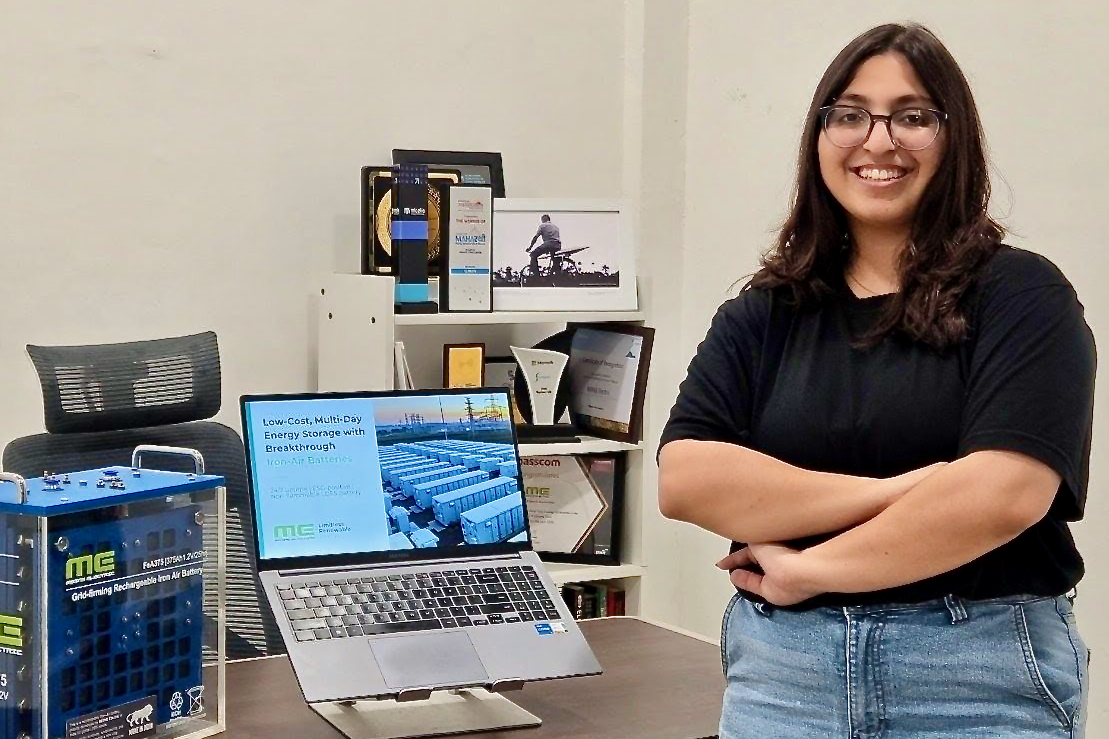
In this episode, Stuti Kakkar, co-founder of MEINE Electric, a battery energy storage tech startup, unpacks the government’s proposed Approved List of Battery Manufacturers (ALBM) that is reportedly in the works as part of its ambitious $38 billion push to deploy 47 gigawatts of battery storage.
Similar to the solar industry’s ALMM framework, this list aims to mandate localised supply chains for government projects, reducing a heavy reliance on imports, particularly from China, which currently controls over 90 percent of the supply chain. Stuti explains why this move is a game-changer for hardware startups.
While traditional lithium-ion batteries face domestic mineral shortages, alternative chemistries like Iron-Air can be up to 95 percent indigenous from day zero, she says.
Stuti also touches upon how these policy shifts provide the demand visibility for hardware-centric startups, which is needed to scale India’s deep-tech ecosystem.
Far from the romance and glamour of humanoids, autonomous mobile robots (AMRs) such as tuggers and pallet lifters that don’t evoke any excitement — unless you’re an engineer, perhaps — are quietly trundling around factory floors, changing how things are made. But the transformation is nascent and factory executives still scratch their heads about what the real RoI (return on investment) might be from robots.
Saurabh Chandra, founder and CEO at Ati Motors, a Bengaluru robotics venture that makes AMRs for material movement in factories, explains his perspective on this here. He also offers a couple of micro case studies of implementations that Ati has executed for its customers and the encouraging results they’ve seen. You can catch the full conversation I had with Saurabh recently via the related post link below.
‘Where should I put my robots?’ This is a question top manufacturing executives at some of the biggest industrial complexes around the world are asking, says Saurabh Chandra, founder and CEO at Ati Motors, a Bengaluru robotics venture that makes autonomous mobile robots for factories. Data holds the key to unlocking this solution, and often while manufacturers have a good intuitive view of what’s happening, they don’t yet have a quantified view, clearly based on data, of their factory processes, he says. Here’s two minutes on how Ati is helping its customers change this scenario, with its AI-led materials movement orchestration platform. You can catch the full conversation with Saurabh via the related post link below.
In this episode, I catch up with Saurabh Chandra, founder and CEO at Ati Motors, to discuss his views on how factory automation is evolving in the era of physical AI, as robots finally begin to “break out of the yellow cages” of safety zones.
Ati Motors makes autonomous mobile robots for materials movement in factories, and its customers include several Fortune 500 companies. As Ati expands its footprint into the US market, Saurabh outlines a future where Physical AI and software agents work in tandem to redefine the “Digital Assembly Line.”
The idea of a “lights out” factory or a “dark factory” is decades old. Engineers dreamed of fully automated installations where robots and machines took over — without human intervention — and made useful things for us. Cars, for example.
But a combination of both technical challenges and real-world non-engineering problems ensured that such factories remained more science fiction and less reality. Until recently. Today, many experts in the industry and advanced manufacturing believe that we’re approaching a tipping point with respect to automation and robotics technologies.
In this conversation, Saurabh outlines the idea of an AI-led materials movement orchestration platform that Ati has already deployed with some early customers. The idea is that factory executives are beginning to realize that the real value on the shop floor isn’t the robot itself, but the material it moves.
Saurabh explains why traditional ERP systems often fail to track Work-in-Progress (WIP) inventory, leaving a visibility problem as SKU complexity has multiplied manifold over the last 15 years. By creating a “spatial system of record” that tracks every trolley, bin, and staging area in real-time, Ati Motors is helping global giants move from intuitive management to quantified, data-driven orchestration.
Global manufacturing is currently caught in a pincer movement of structural labour shortages across advanced economies and a geopolitical push to reshore production closer to end consumers. As the “factory of the world” model decentralises away from China, the future of Western industrial hubs depends on their ability to integrate “physical AI” that can handle the hyper-personalised, high-SKU demands of modern commerce.
This manufacturing arms race, increasingly prioritized by the boards of Fortune 500 companies, is turning autonomous orchestration from an experimental project into the essential infrastructure of 21st-century industrial sovereignty.
“A lot of people in large companies, for whom status quo was their friend, find that situation is now absolutely in the past,” Saurabh notes during the interview. And at Ati, “we have really transformed into an organization where the robots are the means to the end, which is finally making sure that the factory runs in the way it’s supposed to. The goal is to create a system of record for the shop floor — integrating physical agents, software agents, and humans into a single, intelligent orchestration layer.”
The platform, Ati Flow, also considers how physical AI or robots, software AI agents and humans will all interact making factories of the future more efficient and sustainable. And Saurabh gives us a sense of how the journey to the dark factory will likely involve three phases and how he thinks Ati can catalyse and facilitate that transformation.
The idea of a “lights out” factory or a “dark factory” is decades old. Engineers dreamed of fully automated installations where robots and machines took over — without human intervention — and made useful things for us. Cars, for example.
But a combination of both technical challenges and real-world non-engineering problems ensured that such factories remained more science fiction and less reality. Until recently. Today, many experts in industry and advanced manufacturing believe that we’re approaching an “inflection point” — yes, that cliche, but it might be true — with respect to automation and robotics technologies.
Saurabh Chandra, founder and CEO at Ati Motors, discussed his views on some of these points with me earlier this week. Ati makes autonomous mobile robots for materials movement in factories, and it’s customers include several Fortune 500 companies.
Saurabh spoke about how Ati is preparing for the “Future Factory” where robots will no longer stay in the safety zones of “yellow cages” but mix with humans and other robots. He outlined the idea of a materials (and robots and even human) movement orchestration, which Ati has already developed an early platform for, envisioning the physical AI, software AI agents and humans all interacting with one another in making factories more efficient and sustainable.
Catch the full conversation right here on Friday, April 10, or wherever you get your podcasts. Here’s a one-minute preview, with Saurabh explaining how we’ll rendezvous with robots.
In any field, and especially in deep tech, India’s startups don’t get the type of funding that Silicon Valley ventures command. In fact even a modest Series A fund raise takes a long time and represents a solid achievement for Indian startups.
Therefore how can they make a dent, globally, in a field like robotics that is extremely hardware intensive and integrating the physical robot and its “intelligence” is a daunting task. Especially for any entrepreneurs looking to build humanoids.
In a recent conversation with me, Arjun Dutt, a partner at Bain & Company, and a former tech entrepreneur himself, offered his views on what and how Indian robotics startups can do to strategically position themselves.
You can find the full conversation via the related post link below. Here’s two minutes on the four priorities that Arjun suggests: “going narrow,” taking hybrid approaches to the form factor, building partnerships, and offering the best technical solutions to specific layers of the tech stack that currently are universal pain points that everyone in the field is dealing with.