Friday Deep Tech Wrap: Varda Space raises $187 million, Airalo a unicorn, and more
/07:03/E31
Daily brief on deep tech and climate tech news from India and around the world.
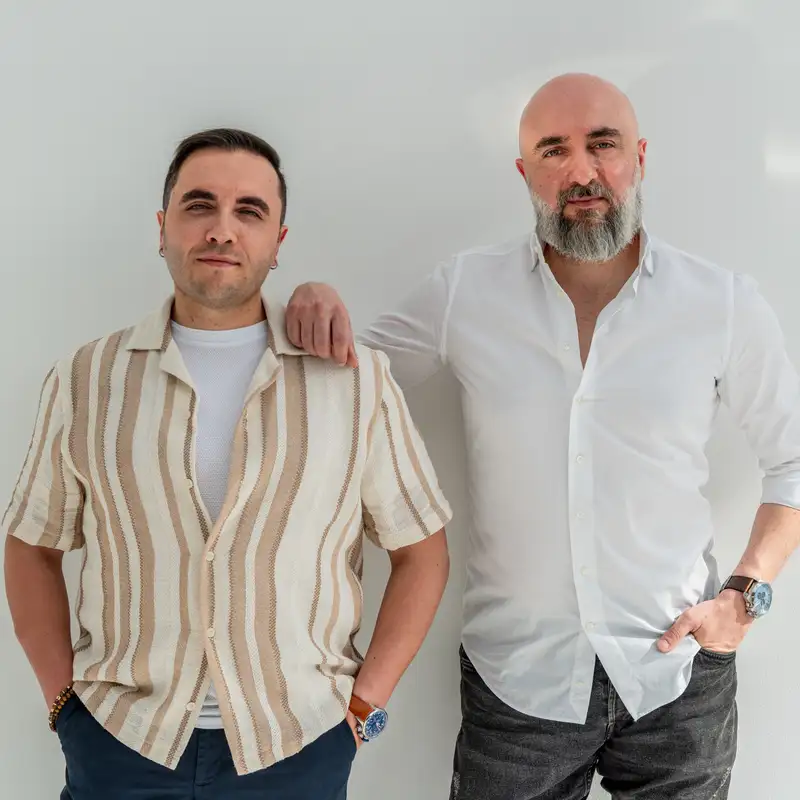
Airalo’s founders Abraham Burak and Ahmet Bahadir Ozdemir. The eSIM provider has just raised $220 million in an investment that values it at $1 billion. Image courtesy company.
India launches ₹10,000 crore second tranche of deep tech fund
Union Minister Piyush Goyal announced a ₹10,000 crore second tranche under the government’s ‘Fund of Funds’ at Sangam 2025, aiming to strengthen India’s deep tech ecosystem. The fund will support the entire technology lifecycle, from research to commercial deployment, focusing on AI, machine learning, and data analytics. Guidelines for capital deployment are being finalized, and the initiative complements the recent ₹1 lakh crore RDI for science and technology.
Listen to the podcast
Deep tech policy initiative #100DesiDeepTechs launched in India
A new multi-stakeholder initiative called #100DesiDeepTechs has been launched to identify and support 100 leading deep-tech startups in India. Developed with Startup India, MEITY Startup Hub, and IIT Madras, the program will facilitate closed-door policy dialogues, culminating in a whitepaper with sectoral recommendations. Focus areas include semiconductors, defence, quantum tech, green hydrogen, and advanced manufacturing.
Professors turn founders boosting India’s deep tech ecosystem
At IIT Madras’s annual alumni meet, a ₹200 crore venture capital fund was announced to back startups emerging from the institute. This reflects a growing trend of technology professors becoming founders, contributing to India’s deep tech gold rush. The move is expected to accelerate commercialization of academic research and foster a robust innovation ecosystem.
Varda Space raises $187 million to accelerate drug manufacturing in space
Varda Space Industries has secured $187 million in a Series C funding round led by Natural Capital and Shrug Capital, bringing its total raised to $329 million. The funds will scale up robotic drug production in microgravity, where pharmaceuticals crystallize differently, enabling novel formulations. Varda has completed three successful space missions, expanded its lab facilities, and aims to deliver the world’s first microgravity-enabled drug formulation for research and improved drug development.
MIT researchers’ Foundation EGI raises $23 million for AI-powered engineering
MIT researchers have secured $23 million for Foundation EGI, a startup aiming to improve engineering with AI. Their platform seeks to streamline manufacturing by addressing fragmented specifications and outdated processes, promising efficiency gains for industries struggling with legacy systems and siloed knowledge.
QuiX Quantum secures €15 million to build universal photonic quantum computer
QuiX Quantum, a Dutch startup, has raised €15 million in Series A funding to deliver the world’s first single-photon-based universal quantum computer by 2026. The investment, led by Invest-NL and the EIC Fund, will support development of a scalable, energy-efficient system based on silicon-nitride chips. QuiX aims for compatibility with data centers and applications in chemical engineering, drug development, and machine learning, reinforcing Europe’s leadership in quantum technology.
EU unveils draft code to help firms comply with AI rules
The European Commission released a draft code of practice to help companies adhere to new AI regulations. The code emphasizes copyright protection, systemic risk mitigation, and safety, aiming to guide firms as they navigate the evolving landscape of artificial intelligence compliance in the EU.
AI slows experienced software developers in familiar codebases, study finds
Contrary to expectations, a recent METR study found that advanced AI tools can actually slow down experienced software developers when working on codebases they know well, challenging the assumption that AI universally boosts productivity in software engineering.
Global end-user spending on generative AI models forecast to reach $14.2 billion in 2025
A new report projects that worldwide end-user spending on generative AI models will hit $14.2 billion in 2025. The surge is driven by rapid enterprise adoption and integration of GenAI into products and services, with significant investments from tech giants. The trend signals a major shift in how businesses use AI for productivity and innovation.
Humanoid robot startup Diligent Robotics recruits Cruise execs for expansion
Diligent Robotics, known for its hospital logistics robots, has hired two senior executives from robotaxi company Cruise. This move signals the company’s ambition to expand beyond healthcare and scale its humanoid robotics platform for broader commercial applications.
Airalo lands $220 million to become the world’s first eSIM unicorn
Airalo, a global eSIM provider, has raised $220 million in a funding round led by CVC, pushing its valuation past $1 billion. Founded in 2019 by Ahmet Bahadir Ozdemir, and backed by investors including Peak XV Partners, Rakuten Capital, Singtel Innov8 and Antler, Airalo addresses the pain points of international travel connectivity by offering affordable, instant eSIM activation in over 200 countries.
The company’s user-centric approach includes flexible data, text, and voice plans, and a new omnichannel app experience. With 20 million users, Airalo plans to expand its enterprise solutions and global reach, aiming to make connectivity simple and accessible for travelers and businesses worldwide.
In Conversation
In-depth conversations with entrepreneurs, investors, industry leaders and other stakeholders building India’s deep tech and climate tech ecosystems.
Takeaways from conversations with entrepreneurs, investors, industry leaders, and other stakeholders building India’s deep tech and climate tech ecosystems.