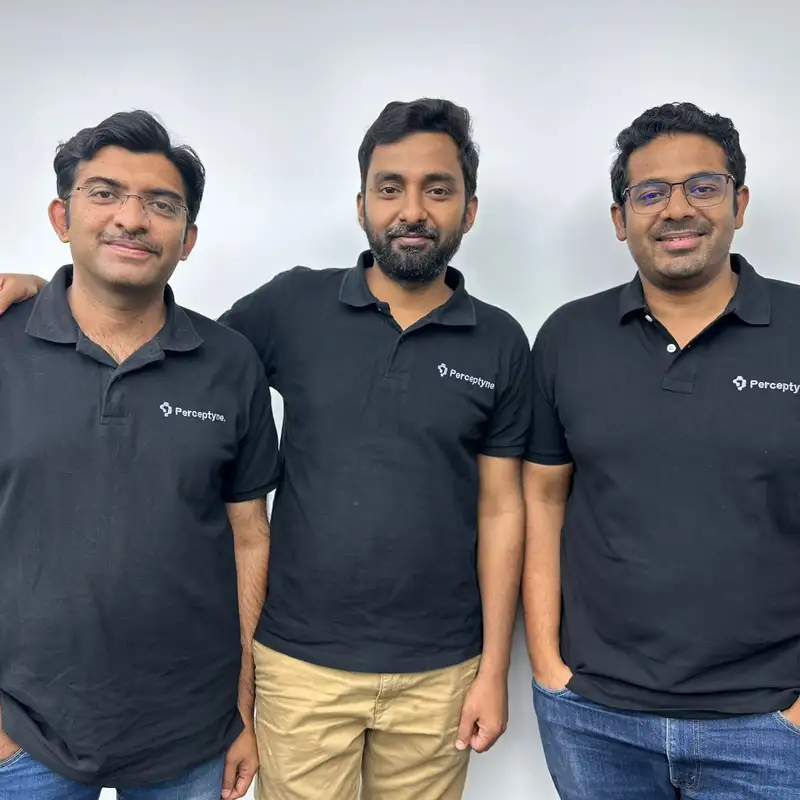
Perceptyne’s founders on why 2026 could be the year of deployment of robots
In this year’s first episode, I’m joined by Mrutyunjaya N, Raviteja Chivukala and Jagga Raju N to unpack why and how they started Perceptyne Robots, and what it takes to build an AI-native robotic system out of India.
Perceptyne is a Hyderabad-based company building dexterous, dual-arm, intelligent robots for industrial automation, currently focused on automotive and electronics manufacturing lines.
The founders explain the gap they saw on real shop floors, where many assembly stations still rely on manual work because traditional approaches cannot handle unstructured inputs, fine force control, or frequent product changes.
The conversation goes into their vertically integrated hardware, including mobile configurations, and their PR-PhI “physical intelligence” software layer that orchestrates perception, control, and imitation-learning–based skills like visual servo, slip-free grasping, and force-based assembly.
You will also hear their take on the state of India’s robotics ecosystem, the evolution of robots as a combined hardware-and-software challenge, and how they are moving from pilots with global automotive and electronics manufacturers toward larger deployments. Perceptyne, which turns four this year, is backed by two well-known deep-tech VC firms, Yali Capital and Endiya Partners.
Chapters
(00:00) The promise of robotics in industrial automation
(09:55) Building Perceptyne: founders’ journey and vision
(20:05) Innovative robotics: products and capabilities
(30:02) Challenges in automation: technical limitations and solutions
(40:01) The robotics ecosystem in India: opportunities and challenges
(49:54) Future of robotics: trends and expectations