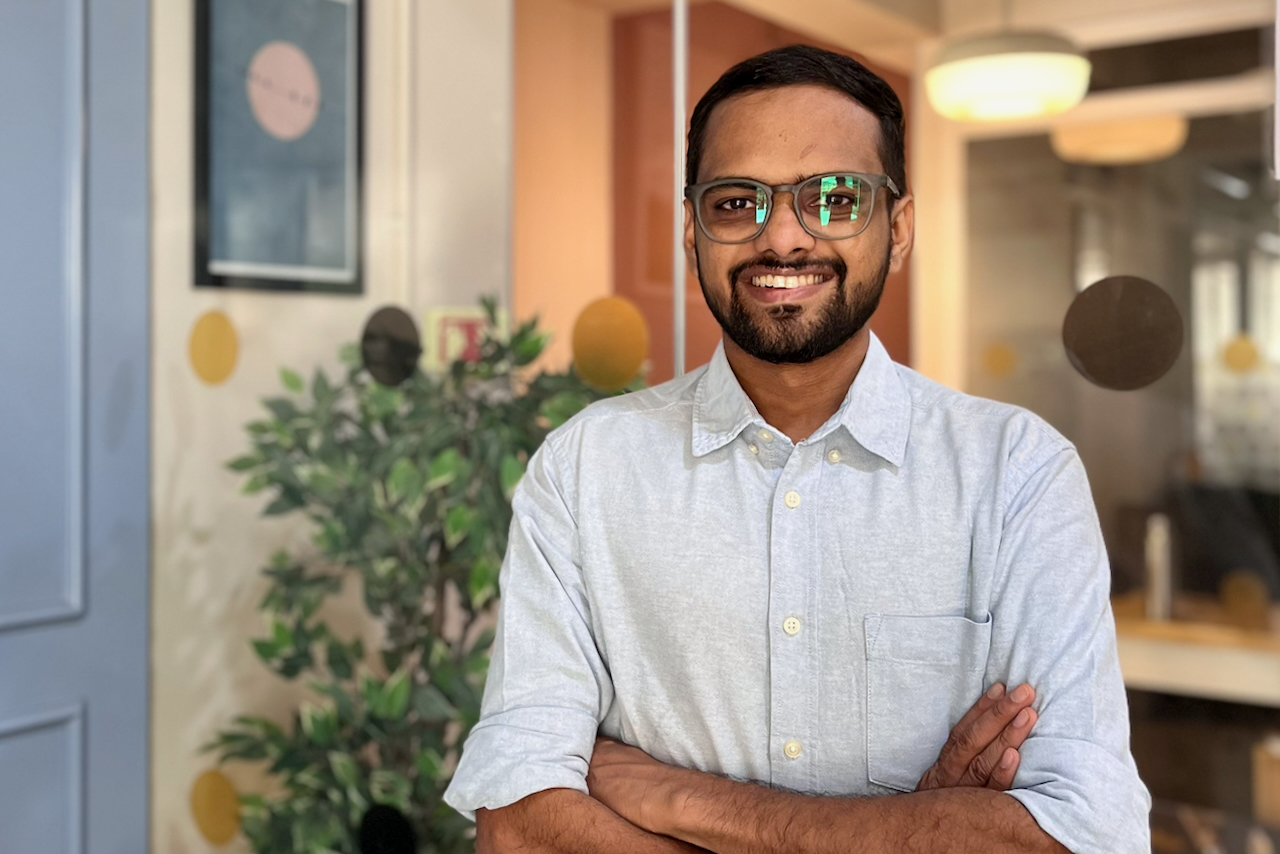
In this episode, I’m joined by Mredul Sarda, an operator-investor in early-stage deep tech and now a cybersecurity entrepreneur.
Mredul’s experience-packed journey began at IIT Bombay, where he earned a BTech in electrical engineering, and an MTech in deep learning. While at the institute, he was also a member of the team that designed and launched Pratham, widely thought of as India’s first student-led satellite.
After a stint in strategy consulting, his tryst with Indian startups started not with deep tech but via a vital role at the fintech company Slice, where he played an important role in scaling the venture to unicorn valuation.
Mredul, who was already an angel investor, co-founded Riceberg Ventures with Ankit Anand, Lino Gandola, and Shubham Raj. The firm launched its flagship $20 million Riceberg Ventures Premier Fund I in early 2025 to back global pre-seed deep tech ventures. Even as they expand Riceberg into Silicon Valley, Mredul and Shubham have also kicked off their own entrepreneurial venture in the area of AI-led cybersecurity, with their startup Causal Security.
Causal Security offers an AI-based platform building autonomous “AI hackers” to surface and defend vulnerabilities in enterprise infrastructure. Join us as to get a glimpse into Mredul’s vision for India’s sovereign technical capabilities and his own evolution from operator to investor to investor-entrepreneur.
In August last year, a little known semiconductor startup (at the time) founded by two industry veterans from India, announced a small, but historic milestone. Not just for themselves, but the country.
The startup, HrdWyr Ventures, now more popularly, just HrdWyr, had struck two partnerships, one with Tata Electronics for the packaging of its first chip, and the other with boAt, the consumer electronics company, as an anchor customer for the new processor.
boAt would use their chip, named Indus 1011, in its truly wireless stereo earbuds charging cases, the companies had announced. Earlier this month, HrdWyr announced the successful close of its Series A funding round, raising $13 million in an investment led by the well known Bengaluru deep tech VC firm Ideaspring Capital.
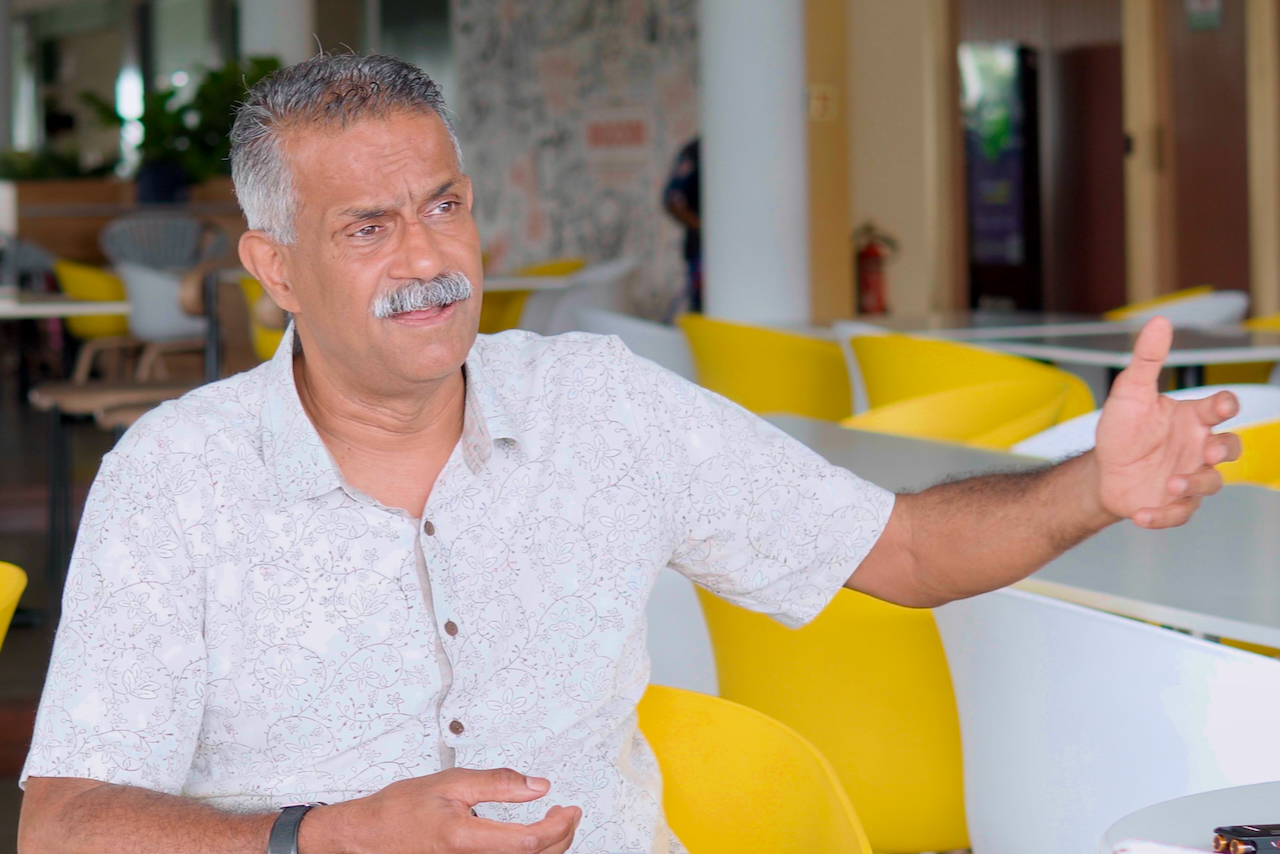
Last week, I got a chance to sit down with Ramamurthy Sivakumar, co-founder and CEO of HrdWyr to get a sense of what next for him, Ganesh Guruswamy, and their team of 18 engineers.
Catch the full interview right here tomorrow, 6 a.m. IST. Here’s a quick preview, in which Siva talks about the practical decisions semiconductor entrepreneurs have to make, especially when they decide to go build in a nascent ecosystem such as the one in India.
HrdWyr, a Bengaluru-based semiconductor startup, recently secured $13 million in Series A funding led by Ideaspring Capital to advance its AI-native chip technology. The company specializes in System-on-Chip (AISoC) designs tailored for edge computing and real-world applications like electric vehicles and industrial equipment.
A significant milestone for the firm is its partnership with boAt and Tata Electronics to produce the Indus 1011, a locally designed chip for audio wearables.
Companies such as HrdWyr are getting funded in the time of a broader national push for semiconductor self-reliance, supported by significant government investment and rising market demand.
Yesterday, I spoke to Co-founder and CEO Ramamurthy Sivakumar, an Intel Corp veteran, on HrdWyr’s plans. Catch the full interview right here on Tuesday, June 16th. Here’s a 90 second preview, with Siva talking about the massive influence of AI.
Eka Robotics has emerged from stealth with a Vision-Force-Action model that it says can push robots beyond the long-standing trade-off between generality and speed in manipulation tasks. The Cambridge, Massachusetts startup was co-founded in 2025 by MIT’s Pulkit Agrawal and former DeepMind researcher Tuomas Haarnoja. The deep tech entrepreneurs are pitching force sensing and simulation as the route to more capable machines.
In robotics, much of the recent excitement has centred on vision-language-action systems, which treat language as a bridge to physical control. Eka says that is too indirect for the contact-rich realities of the physical world. Its approach instead tries to make robots learn mass, friction and inertia through practice in high-fidelity simulation, then transfer those skills to the messier settings of factories and homes.
Across the robotics industry, the race is on to build foundation models that can scale across tasks, rather than brittle systems tuned for one environment, and the prize is a larger share of warehouse work, light manufacturing and household assistance. The strategic question is whether the winning path is imitation from human data, reinforcement learning in the real world, or simulation-first training that seeks to compress years of trial and error into computational time.
“We’re building intelligence for the physical world in its native language: forces,” Pulkit Agrawal wrote on LinkedIn. In the same post, he added that robotics has long faced a trade-off between “generality” and “speed,” and that “the real world requires both”.
Eka’s presentation suggests confidence that force-aware control can do more than sort objects or pick up toys. The company has highlighted tasks such as screwing in a light bulb and handling slippery items, small feats that still define the frontier of robotic manipulation. For now, the message is as important as the model: the next leap in robotics, Eka is arguing, will come not from making machines more verbal, but from making them more physical.
Ati Motors has renamed itself Ati Robotics to better reflect its evolution into a “material orchestration” specialist, the Bengaluru-based provider of autonomous mobile robots said in a recent press release.
The Indian robotics company is moving to win an early lead in this industry-wide shift: the world’s biggest manufacturers, including some of Ati’s customers, are looking at not just deploying robots anymore, but at holistic automation and AI-led solutions that make their overall operations more efficient.
Top manufacturing and factory executives are beginning to understand that in the modern industrial landscape, a machine that moves autonomously isn’t in itself the goal. It’s how one can harness the combination of many such robots, the multiple processes in the factory and the dynamically changing roles of the humans involved to get closer to a “lights out” facility.
“Automation doesn’t stop at the robot,” Founder and CEO Saurabh Chandra, said in the press release, adding the company has built an integrated platform comprising robots, fleet intelligence, AI agents, and the orchestration software that ties them all to the systems running modern factories.
“Ati Robotics is not a new company. It is the honest description of the company we have already become,” Chandra said.
By adopting a name that encompasses its broader ambitions in artificial intelligence and systems orchestration, Ati Robotics is signalling that its own future lies not in the hardware of locomotion, but in the software of intelligence.
Ati was founded in 2017, and has its roots in India’s top scientific research university, the Indian Institute of Science. The company’s Sherpa line of AMRs (tuggers, pallet lifters and so on) have been deployed with more than 70 enterprise customers, and the robots have tracked some 2 million autonomous missions with a success rate of 99 percent, according to the release.
The shift to material orchestration is a necessary one, driven by a chronic shortage of skilled labor and a desperate need for efficiency in the face of fragmented supply chains. Manufacturers want to move away from the “yellow cages” of fixed robotics toward flexible, autonomous systems that can navigate human-centric environments.
For companies such as Ati, this means the competition has shifted from basic hardware reliability to the sophistication of the “digital brains” that can manage fleets — often comprising many different types of robots.
For startups and incumbents alike, the challenge is no longer just making a robot that can carry a pallet, but creating a system that can rethink how that pallet moves in real-time.
One immediate opportunity is the so-called brownfield facility — an existing factory with sunk investments in human-centric infrastructure and equipment. The best solution that can integrate the existing gear effectively at minimal cost will win.
“Customers don’t just buy a robot from us. They buy a material orchestration system – coordination, intelligence, and scalability aligned to how their factory actually works,” says Chris Dolbow, vice president of marketing at Ati. “The shift to Ati Robotics sharpens how we describe what we deliver: the right fit for automation today with intelligent innovation for the future.”
Ati is backed by investors including Walden Catalyst Ventures, NGP Capital and its early-stage investor MFV Partners. The Bengaluru-headquartered company is moving to build on its momentum in the competitive North American and APAC markets. It has also already successfully deployed its orchestration solution at some early customers, CEO Chandra says.
The transition to a low-carbon economy is often framed as a struggle resulting from a combination of engineering challenges and lack of political willpower. A new vision paper argues that the true bottleneck is an information deficit. The Climate and Sustainability Data Exchange (CSDX), a proposed universal digital infrastructure, seeks to move beyond “siloed, project-level fixes” to provide the “shared rails” necessary for a planetary-scale coordination system.
The CSDX vision paper is the result of a collaboration between StepChange and Beckn. StepChange, a climate-tech venture in Bengaluru founded by MIT alumni Ankit Jain and Sidhant Pai, provides a strategic framework for managing ESG, carbon accounting, and climate risk.
Beckn, now called Network for Humanities (NFH, previously the Beckn Foundation), is an international network of labs focused on building open, interoperable digital infrastructure for population-scale systems. It offers the eponymous Beckn protocol, a foundational open protocol that enables interoperable, decentralized digital interactions without reliance on central platforms.
It was co-founded in 2019 by Nandan Nilekani, founding chairman of Aadhaar, India’s Unique ID Authority, Pramod Varma, Aadhaar’s former chief architect, and Sujith Nair, who also serves as its Steward, according to his LinkedIn profile.
The current landscape of sustainability data is a thicket of fragmented portals and manual entries, particularly in the Global South, where information is “limited in quality, expensive to access, and fragile in trust,” the authors of the paper say. Without a common language, capital is frequently mispriced, and the progress of supply chains remains invisible to the regulators and financiers who might otherwise reward decarbonization, they add.
StepChange and Beckn envision a neutral alliance of core members who will act as stewards for the infrastructure, maintaining common schemas and onboarding policies to keep the digital rails accessible and transparent. By combining their technological and environmental expertise, the collaboration seeks to create a federated network where producers, financiers, and regulators can exchange trusted sustainability data at near-zero marginal cost.
The proposal arrives as global climate-driven disaster costs surpass $400 billion annually and energy-related CO₂ emissions have climbed to an all-time high of 37.8 gigatonnes. With atmospheric concentrations now 50 percent higher than pre-industrial levels, the CSDX initiative aims to standardize the reporting of ESG, carbon accounting, and climate risk to bridge the “data-poor” gap that currently prevents global markets from pricing resilience accurately.
“Like railways, container shipping, or the internet, CSDX provides a minimal, interoperable digital rail that allows any actor to publish and pull records in a common language, at near-zero marginal cost,” StepChange and NFH say.
ESG Management captures the broad set of non-financial outcomes enterprises create across environment, society, and governance.
Carbon Accounting provides a rigorous, quantifiable subset of environmental impacts with unique salience for decarbonization.
Climate Risk ensures that external climate dynamics are translated into financial terms, enabling efficient capital allocation and resilience planning.
Using the Beckn protocol, CSDX envisions a federated architecture where data is “governed at source while becoming globally discoverable.” By aligning with global frameworks like the ISSB and CSRD, the platform ensures that “water-withdrawal intensity,” for example, or “Scope 3” emissions mean the same thing to a textile factory in Nairobi as they do to a bank in Frankfurt.
This is not merely an exercise in corporate disclosure; it is an attempt to create a “functioning control system for the real economy,” where sustainability is embedded into every purchase order and loan decision.