Tag: china

  • China expands restrictions on rare earth mineral exports

    China expands restrictions on rare earth mineral exports

    Daily brief on deep tech and climate tech news from India and around the world.

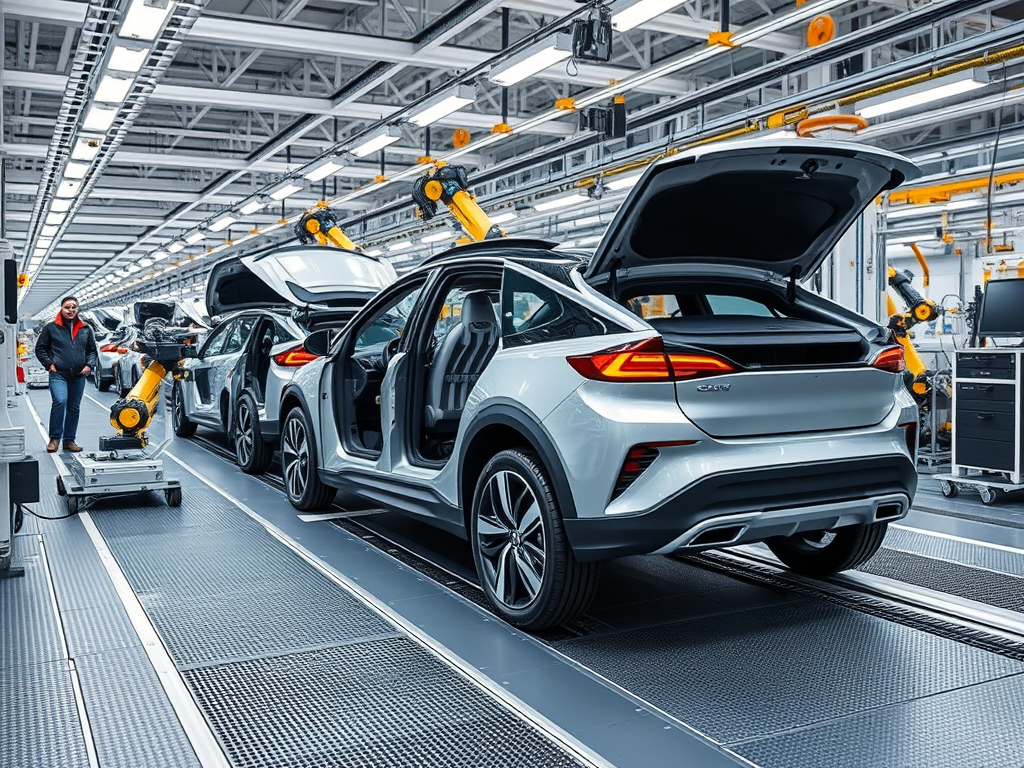
    illustrative image of an automotive assembly line. China controls over 90 percent of the processing capacity of rare earth minerals needed in magnets that go into EVs. Its tightening restrictions are impacting global supply chains.

    China tightens rare earth export controls

    China has expanded its restrictions on rare earth exports to safeguard national security and interests, a move seen as Beijing strengthening its leverage in trade talks with the US. The new rules add five more rare-earth elements to the existing control list, bringing the total to 12, Reuters reports. Export licenses will now be required for the production technologies of these minerals and for their overseas use, including for military and semiconductor applications.

    China is seeking assurances from India that rare earth magnets supplied by it will only be used locally for civilian purposes, and also that they will not be exported to the US, Economic Times reports.

    Listen to the episode

    India targets 5MMT annual hydrogen output by 2030

    India’s Petroleum and Natural Gas Minister, Hardeep Singh Puri, said that the country’s “Hydrogen Age has begun,” with a target to produce 5 million metric tonnes of green hydrogen annually by 2030, ET Energyworld reports. This would account for 10% of the global market. A key project is the NTPC Green Hydrogen Hub near Visakhapatnam, which will be one of the country’s largest integrated green hydrogen facilities. The government’s National Green Hydrogen Mission has an outlay of Rs. 19,744 crore to help achieve these goals.

    Andhra Pradesh forms hydrogen advisory panel

    The Andhra Pradesh government has formed a high-level advisory committee to promote the green hydrogen initiative ‘Green Hydrogen Valley – Amaravati,’ The Hindu reports. The panel, co-chaired by Dr. V.K. Saraswat and Chief Secretary K. Vijayanand, will guide the state’s efforts in technology adoption, research, and infrastructure development. The goal is to make Andhra Pradesh India’s largest green hydrogen hub by 2030, contributing to the country’s sustainable hydrogen economy.

    Tokamak Energy and Gauss Fusion partner to advance fusion

    Tokamak Energy and Gauss Fusion have announced a strategic collaboration to accelerate the commercialization of fusion technology. The partnership will focus on advancing high temperature superconducting (HTS) magnets. This alliance brings together Tokamak Energy’s expertise in HTS technology with Gauss Fusion’s leadership in industrializing fusion energy. The companies aim to pool their industrial know-how to accelerate the path to the first generation of European fusion power plants.

    Aavishkaar Group launches defence and deep-tech fund

    Aavishkaar Group has partnered with Jamwant Ventures to launch the ‘Jamwant Ventures Fund 2’, India’s first veteran-led defence and deep-tech fund. The new fund, targeting a corpus of INR 500 crore, is the first initiative under Aavishkaar’s new ‘OneAavishkaar’ platform. The partnership aims to provide catalytic capital and strategic mentorship to indigenous startups, empowering them to drive innovation for national security.

    Newtral raises funds for global expansion

    Newtral Technologies, a climate-tech startup in Bengaluru, has raised $600,000 in funding from NOW Accelerate, Indian Startup Times reports. The capital will help Newtral expand its sustainability platform and prepare for a Series A funding round. As part of the partnership, NOW will provide venture-building resources and expertise to help Newtral scale its platform, which helps businesses measure, report, and reduce their emissions.

  • Rare-Earth free electric motors: Six takeaways from a conversation with Bhaktha Keshavachar at Chara

    Rare-Earth free electric motors: Six takeaways from a conversation with Bhaktha Keshavachar at Chara

    Bhaktha Ram Keshavachar, founder and CEO of Chara Technologies in Bengaluru, is leading an effort to develop motors that don’t need the conventional permanent magnets, whose make up includes rare-Earth metals, the processing of which is almost entirely controlled by China. The mining and processing of these minerals also has an environmental impact.

    Bhaktha and his fellow founders Ravi Prasad and Mahalingam Koushik, bring decades of industry expertise to their venture. Founded in 2019, Chara has engineered what are called reluctance motors. Unlike the traditional motors, reluctance motors don’t have permanent the magnets that need rare Earth minerals such as neodymium or samarium. Magnetic fields are instead created by the electric current in the windings around the stationary part (stator) of these motors.

    In my recent conversation with him, Bhaktha discusses Chara’s technical pivots, manufacturing milestones, industry partnerships, and the challenges of deep tech entrepreneurship in India. He also shares insights on talent development, the evolving ecosystem, and Chara’s plans for global expansion. Here are my top six takeaways.

    1. Rare earth-free motor technology addresses a critical global supply chain risk

    Most high-efficiency electric motors today rely on rare earth magnets, which are expensive, environmentally damaging to extract, and subject to geopolitical risk — especially as China controls over 90 percent of the global supply chain. Chara’s technology, based on reluctance motors, eliminates the need for rare earths, offering a strategic solution to this problem.

    1. Product-market fit is emerging fastest in off-highway and industrial applications

    While Chara initially targeted India’s large two-wheeler and three-wheeler market, Bhaktha notes that the most immediate traction has come from off-highway uses such as agricultural equipment, golf carts, turf care machines, and compressors. These sectors value Chara’s high-efficiency, rare earth-free motors and have helped the company build early credibility.

    1. Strategic partnerships and manufacturing scale are key to customer confidence

    A major milestone for Chara is its partnership with Greaves Cotton, which will manufacture and distribute Chara’s motors under license. Bhaktha explains that large customers are wary of “startup risk” and prefer established suppliers; this partnership provides the scale and distribution needed to win bigger deals and accelerate adoption.

    1. Chara’s deep R&D helped the startup develop a market-ready product

    The company’s early years involved a challenging pivot from switched reluctance motors, which proved too noisy, to synchronous reluctance motors. Chara invested heavily in core R&D, especially in software algorithms to control non-linear motor behavior, resulting in a certified, field-deployed product that matches the performance of traditional motors.

    1. Building a deep tech team in India requires nurturing core engineering talent

    Bhaktha notes a shortage of experienced engineers in electromagnetics and mechanical domains, as most graduates prefer software careers. Chara addresses this by hiring young engineers with some experience and training them further in the requisite foundational physics and engineering, which is essential for their multidisciplinary innovation.

    1. Chara’s next phase is focused on scaling sales and global expansion

    With technical challenges largely solved and products certified, Bhaktha says Chara’s top priority is now sales and deployment — both in India and internationally. The company is targeting new product development for larger vehicles and is actively pursuing business in Europe and the US, tapping global interest in rare earth alternatives and recent geopolitical shifts.