Tag: climate-tech

  • EyeROV, Indian marine robotics startup, raises funding for autonomous ocean surveillance

    EyeROV, Indian marine robotics startup, raises funding for autonomous ocean surveillance

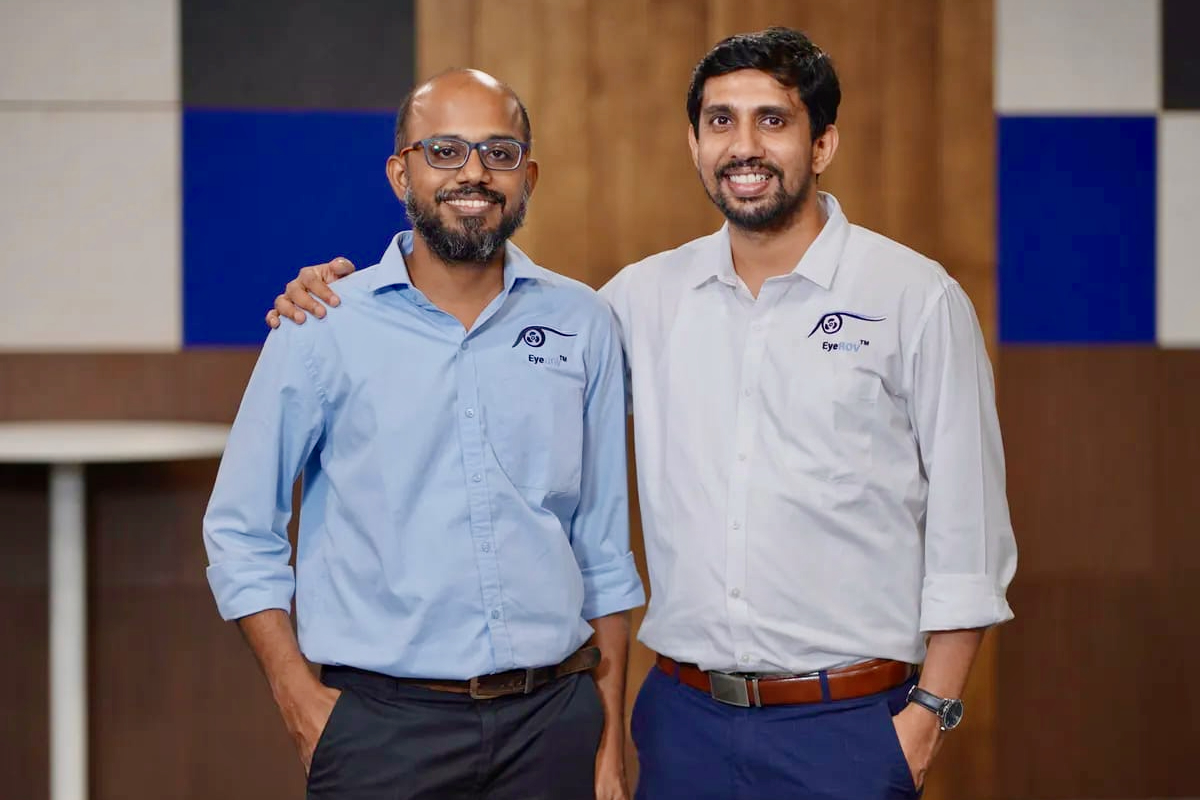
    EyeROV Founders (L-R) Kannappa Palaniappan P (CTO) and Johns T. Mathai (CEO).
    EyeROV Founders (L-R) Kannappa Palaniappan P (CTO) and Johns T. Mathai (CEO). Image source: Company. Editing by Hari Arakali.

    For a start-up navigating the murky depths of the Indian Ocean, IROV Technologies (EyeROV) is beginning to see quite clearly. The Kochi-based marine robotics startup has raised Rs. 13 crore in pre-Series-A funding, co-led by AWE Funds and Unicorn India Ventures, according to a press release.

    The money is intended to bolster research and development as EyeROV seeks to expand beyond its domestic shores into global markets.

    Since its founding in 2017 by IIT alumni Johns T. Mathai (CEO) and Kannappa Palaniappan P (CTO), EyeROV has carved out a niche in the high-stakes world of underwater inspection. With a portfolio that includes a proprietary 10km long-tunnel inspection capability, the company has already completed over 150 projects for industrial heavyweights such as Maersk, ONGC, and Adani.

    Its Robotics-as-a-Service model aims to replace high-risk manual diving with autonomous, sustainable electric systems, a shift underscored by a recent Rs. 47 crore order from the Indian Navy.

    Indian startups such as EyeROV are developing products to win a share of the global market for maintenance of offshore assets which is seeing a shift from manual, hazardous operations to automated surveillance.

    EyeROV estimates a $13 billion global addressable market for underwater infrastructure inspection. Deep-tech companies are increasingly viewed as essential for the long-term viability of the aging energy pipelines, subsea cables, and ports that underpin international trade.

    “Some of the world’s most critical infrastructure such as energy pipelines, subsea cables, ports are offshore assets. They are all beneath the ocean’s surface and historically maintained through high-risk, manual, and expensive operations. We believe this is precisely where deep technology creates both outsized returns and meaningful impact,” Seema Chaturvedi, Founder and Managing Partner of AWE Funds, said in the press release.

    The broader environment for Indian deep tech is warming, spurred by government grants and a burgeoning innovation ecosystem. For EyeROV, this round is a strategic precursor to a planned $10 million Series A, as it seeks to capture a larger share of the $800 million Indian market.

    “With our recent Rs. 47 crore Indian Navy order and the surging demand for specialized inspections in the energy and infrastructure sectors, EyeROV has reached a clear inflection point,” CEO Mathai said in the press release. “This funding will accelerate our trajectory as we scale our technology and expand our footprint internationally.”

  • Manish Singhal: ‘India will be seen as a global deep tech nation in less than five years’

    Manish Singhal: ‘India will be seen as a global deep tech nation in less than five years’

    In this episode, I’m joined by Manish Singhal, founding partner of pi Ventures, a Bengaluru-based early-stage venture capital firm backing some of India’s most ambitious deep tech startups.

    India’s start-up story is often told through software and services. Yet a quieter transformation is under way in laboratories, machine shops and clean rooms. And Manish has been one of the earliest investors consistently supporting this gradual change, first as an angel investor and then through pi Ventures.

    Over the past decade, pi Ventures has gone from backing AI-led software plays to financing startups in sectors such as space, semiconductors, robotics, clean energy and electric mobility. From its first fund, pi Ventures backed companies such as Zenatix, Niramai, Sigtuple, Locus, and Wysa, but also Agnikul Cosmos.

    The firm is currently investing from its second fund, which, at $85 million, is almost three times the first fund. Its portfolio now includes startups building 3D-printed rocket engines, optical interconnects for data centres, electric tractors designed from first principles and in-orbit satellite “jetpacks” that extend the life of multi-million-dollar assets.

    Prior to pi Ventures, which turns 10 in March, Manish started out as an electrical engineer from IIT Kanpur, and accumulated two decades of operating experience – building products and teams at companies including Motorola, Ittiam Systems, and Sling Media, where he helped scale the company’s India R&D centre.

    His firm’s recent investments such as Moonrider (electric tractors), LightSpeed Photonics (optical interconnects for AI data centers), and Aule Space (in-orbit satellite servicing) reflect Manish’s conviction that Indian startups can build globally relevant deep tech products.

    He is not unaware of the still entrenched and considerable challenges in the way those dreaming of deep tech success from India. And he’s also clear-eyed about the limits of industrial policy, and wary of fads in “indigenous” technology.

    But Manish is optimistic, when he talks about how deep tech founders in India are becoming more audacious in their aspirations and how India is on the cusp of being seen as a genuine deep-tech nation.

  • IFC backs GFCL EV with $50 mln, Hyundai launches MobED autonomous mobile robot, Viavi, QNu team up

    IFC backs GFCL EV with $50 mln, Hyundai launches MobED autonomous mobile robot, Viavi, QNu team up

    Hyundai Motor Group’s MobED AMR on display at an exhibition. Image source: Hyundai.
    Listen to the episode

    (00:20) Mobile robots market to nearly double by 2030

    Global demand for mobile robots is set to surge, with the market projected to grow from $27.39 billion in 2025 to $52.11 billion by 2030, driven by AI, 5G, e-commerce, and labour shortages, while Asia-Pacific leads adoption and high costs, regulatory hurdles, and integration challenges remain important constraints.

    (00:50) Hyundai debuts MobED autonomous robot platform at iREX 2025

    Hyundai Motor Group has unveiled MobED, a production-ready autonomous mobility robot platform, at the iREX 2025 robotics show in Tokyo, positioning it as the company’s first mass-produced mobility robot for industrial and everyday applications, with Pro and Basic variants set for market launch in the first half of 2026.

    (01:17) IFC backs Gujarat Fluorochemicals’ EV unit with $50 million

    IFC will invest about $50 million in Gujarat Fluorochemicals’ EV venture GFCL EV Products to build India’s first fully integrated battery-materials plant, supporting local production of key inputs for electric vehicle and energy storage batteries and reducing import dependence while strengthening the country’s position in global clean-energy supply chains.

    (01:46) Viavi, QNu Labs team up on quantum-safe network security

    Viavi Solutions and QNu Labs, a quantum cybersecurity startup in India, have formed a strategic R&D partnership to develop test frameworks, standards, and reference architectures for quantum-safe network security, spanning post-quantum cryptography, quantum key distribution, quantum random number generator, and hybrid systems, with plans for a broader industry consortium to help operators and enterprises transition from classical to quantum-resilient infrastructures.

    (02:20) Skylark Drones, WELL Labs ink MoU on data-led water intelligence

    Skylark Drones has signed an MoU with Bengaluru-based WELL Labs to build data-driven water-resource intelligence platforms, according to a press release. The platforms will fuse large-scale drone-based mapping with hydrological science, supporting watershed management, flood resilience, and climate-linked water planning for governments and communities across India.

    (02:46) Shastra VC launches SDEX deep-tech fellowship with $100,000 grants

    Shastra VC has launched SDEX, Shastra Deep-Tech Excellence Fellowship, a 16–24-week programme to help researchers at IITs, IISc, NITs and other labs turn frontier technologies into venture-ready startups, with the first cohort set to pick up to 15 teams and provide each with equity-free funding and resources of up to $100,000 dollars.

    (03:20) Chiratae launches Sonic DeepTech with cheques up to $2 million

    Chiratae, a VC firm in Bengaluru, has launched the Sonic DeepTech programme to back early-stage Indian deep-tech startups with seed cheques of up to $2 million, promising 48-hour investment decisions, and access to domain experts, corporate partners, and portfolio founders to help teams move quickly from lab prototypes to market-ready products.

    (03:45) ChemLex raises $45m for AI-driven autonomous drug discovery lab in Singapore

    ChemLex, an AI-for-science startup, has raised 45 million dollars led by Granite Asia and is establishing its global headquarters and a 24/7 self-driving chemistry lab in Singapore to accelerate small-molecule drug discovery, supported by new technical hires and an MoU with Singapore’s Experimental Drug Development Centre.

  • Biomoneta wins FDA approval, Moonrider raises $6 million from pi Ventures, other VCs

    Biomoneta wins FDA approval, Moonrider raises $6 million from pi Ventures, other VCs

    Janaki Venkatraman, Santanu Datta and Arindam Ghatak, co-founders of Biomoneta. Image source: company.

    (00:20) IVCA forum urges more domestic capital for deep tech

    The Indian Venture and Alternate Capital Association hosted its Domestic Institutional Investors & Exits Forum 2025 in New Delhi, spotlighting the role of local capital in deep tech and biotech. An MoU between IVCA and BIRAC aims to boost capacity building and investment awareness, as BIRAC’s Managing Director Dr. Jitendra Kumar urged institutional investors to back research-led startups moving from incubation to commercial scale.

    Listen to the episode


    (00:53) Rama Devi Lanka joins NITI Aayog frontier tech hub

    Rama Devi Lanka has joined NITI Aayog’s Frontier Tech Hub to drive state-level engagement on AI, blockchain, drones and other emerging technologies. The former Telangana state emerging tech director will work with state governments to scale pilots, shape policy frameworks and strengthen innovation ecosystems, aiming to align frontier tech deployments with inclusive governance and public-impact use cases nationwide.

    (01:22) Biomoneta wins US FDA nod for Avata Rx

    Biomoneta, a Bengaluru startup, has secured US FDA approval for Avata Rx, its ZeBox-powered air-decontamination device, becoming the first Indian company cleared in this category. The system targets airborne pathogens in high-risk clinical and biotech environments, backed by independent validations including an IISc study on SARS-CoV-2. The milestone strengthens its global market entry and validates investor Beyond Next Ventures’ deep-science thesis.

    (02:00) Moonrider raises $6m for EV tractor rollout

    Moonrider, an electric tractor startup in Bengaluru, has raised $6 million in a Series A round led by deep-tech fund pi Ventures, with Singularity AMC, Advantedge Founders and Micelio Fund participating. The capital will fund commercial rollout of its fully homologated, road-ready electric tractors, which the company says match diesel tractors on upfront price while sharply lowering operating costs to improve farm economics.

    (02:32) SynaXG raises over $20m for AI-RAN platform

    Singapore deep-tech startup SynaXG has raised over $20 million in its first funding round, led by January Capital, Vertex Ventures and Qualgro. The company builds AI-powered radio access network (AI-RAN) technology for wireless infrastructure. The capital will be used to scale product development and engineering, and deepen partnerships with telecom operators and enterprise customers deploying next-generation network solutions.

    Niobium raises $23m to advance FHE silicon

    (03:03) US-based Niobium has raised more than $23 million in an oversubscribed follow-on round to accelerate its second-generation fully homomorphic encryption (FHE) hardware platform. The funding will support the shift from prototype to production-ready ASICs, hardware–software co-design and customer pilots. Existing backers Fusion Fund and Morgan Creek joined new investors including Blockchange Ventures, ADVentures, Korea Development Bank and JobsOhio Ventures.

    (03:37) Korean team links desalination with hydrogen production

    Researchers at Seoul National University have built a modular water-purification system that simultaneously produces clean water and hydrogen using ion concentration polarization across a single cation-exchange membrane. The finger-sized device removes salts and contaminants while generating hydrogen, recovering about 8–10 percent of input energy. Its compact, scalable design targets use in disaster zones, remote sites, military deployments and even space missions.

  • Google, Accel team up to back Indian AI startups, SBI Ventures’ next climate tech fund

    Google, Accel team up to back Indian AI startups, SBI Ventures’ next climate tech fund

    An AI generated image for illustrating an Indian startups co-working space.

    (00:20) Google, Accel to co-invest in Indian AI startups

    Google and Accel will co-invest in at least 10 early-stage Indian AI startups through a new partnership between Google’s AI Futures Fund and Accel’s Atoms programme, with up to 2 million dollars available per company.

    The tie-up, based in Bengaluru, is Google’s first such funding collaboration and follows its $15 billion India data-centre commitment and broader push to tap the country’s nearly one billion internet users.

    Listen to the episode


    (00:54) India’s largest bank to launch next climate startup fund

    SBI Ventures, promoted by State Bank of India and headquartered in Mumbai, intends to raise Rs. 2,000 crore for its third climate-focused investment fund launching in January-March 2026. The fund will invest in early and growth-stage climate startups, particularly frontier climate technologies and AI-enabled innovations.

    SBI Ventures identified critical funding deficits in water security, climate-smart agriculture, and disaster-proof infrastructure, targeting an estimated $170 billion annual requirement.

    (01:34) Bio-based coastal concrete material nurtures marine life

    Researchers at the Royal Netherlands Institute for Sea Research in Yerseke tested Xiriton, a bio-based concrete alternative made from grass, shells, sand, lime, pozzolan, and seawater, for tidal restoration.

    After a year, blocks deployed on mudflats were densely colonised by oysters, mussels, and algae while withstanding strong currents, suggesting a durable, degradable, low-alkaline material for greener coastal protection.

    (02:10) German defence drone startup nears €200m raise 

    Munich-based Quantum Systems is close to securing about €200 million in new funding at a roughly $3 billion valuation, just months after becoming a unicorn. 

    The dual-use surveillance drone maker, founded in 2015, is riding Europe’s defence spending boom as governments seek homegrown aerial intelligence, with annual revenue reportedly growing triple digits on the back of contracts in Ukraine and other NATO markets.

    (02:42) Europe backs optical vortex photonics network

    Tampere University in Finland will lead HiPOVor, a €4.4 million EU-funded doctoral network to advance high‑power optical vortex beams and train 15 researchers in photonics.

    The Europe‑wide consortium of eight universities, the ELI‑NP laser facility in Romania, and nine industry partners aims to turn twisting light beams into core tools for precision manufacturing, particle acceleration, and high‑capacity communications from 2026.

  • India backs JCM, seeks global action on energy for small islands at COP30, and more

    India backs JCM, seeks global action on energy for small islands at COP30, and more

    AI generated image for illustration. India is backing the international solar alliance with a call for global action on energy for small island developing nations, at the COP30 meet.


    (00:20) India calls joint crediting mechanism a model for equitable climate action

    At UNFCCC COP30 in Brazil, India’s Environment Minister Bhupender Yadav said the Joint Crediting Mechanism (JCM) is crucial for scalable, technology-driven climate solutions. India-Japan cooperation under JCM will mobilise investments, deploy low-carbon technologies, and build capacity, supporting national climate goals and Article 6 implementation. India’s Carbon Market portal will aid JCM transparency and impact.

    Listen to the episode


    (00:50) India urges global solar push for energy security in small island states

    Separately, Minister Yadav highlighted support for Small Island Developing States through the International Solar Alliance. India showcased rooftop solar, solar pumps, and battery projects, calling for global action to boost clean energy, cut diesel imports, and build climate resilience. Over 124 nations now participate in ISA’s initiatives.

    (01:18) Mehta Family Foundation announces two conferences with IITs 

    The Mehta Family Foundation will host two conferences under its collaboration for academic and research excellence or CARE initiative in partnership with IIT Madras and IIT Guwahati. The events focus on bioengineering and AI, convening global and Indian researchers to advance interdisciplinary collaboration and showcase innovations, marking the Foundation’s growing role in India’s academic ecosystem.


    (01:48) Glow-in-the-gut pill offers non-invasive colonoscopy alternative 

    Researchers in China have developed a pill embedded with heme-sensing bacteria that glow in response to gastrointestinal bleeding, enabling early colitis detection without invasive colonoscopies. Tested safely in mice, the pill’s magnetic microspheres are retrieved from feces and produce light proportional to disease severity, potentially revolutionizing gut health diagnostics.


    (02:17) JuliaHub and Synopsys partner to power AI-driven digital twins 

    JuliaHub will integrate its Dyad simulation platform with Synopsys’ Ansys TwinAI™, blending physics-based modelling and adaptive AI for more accurate, cloud-based digital twins. The collaboration aims to accelerate innovation in hardware design and system optimization, merging JuliaHub’s SciML tech with Synopsys’ robust simulation ecosystem.

    (02:45) Rift raises €4.6M to launch Europe’s first on-demand aerial network 

    French startup Rift has raised €4.6 million to deploy autonomous drone stations across Europe, creating a real-time aerial intelligence network for public safety and critical infrastructure monitoring. The “Surveillance-as-a-Service” platform aims to mitigate wildfires, border breaches, and infrastructure threats with plans to deploy 20 stations by 2027.


    (03:14) Teradar exits stealth with $150M series B for terahertz vision sensors 

    Teradar, a Boston startup, has unveiled its terahertz vision sensor technology for automotive safety after raising $150 million in Series B funding. The modular terahertz sensor offers all-weather perception to enhance autonomous driving and commercial vehicle safety, with production targeted by 2028. Investors include Lockheed Martin Ventures and VXI Capital.