In today’s episode, Ramamurthy Sivakumar, co-founder and CEO at HrdWyr, a semiconductor design startup in Bengaluru, talks about the company’s plans after recently raising $13 million in Series A funding, in an investment led by Ideaspring Capital.
The company was co-founded in 2023 by Siva and Ganesh Guruswamy, both industry veterans spanning companies including Intel, AMD, Sandisk and Motorola.
In this conversation, Siva talks about how the era of custom silicon is upon us and what the AI-led opportunity represents. The company specialises in System-on-Chip (AISoC) designs tailored for edge computing and applications like electric vehicles and industrial equipment.
HrdWyr’s first product, named Indus 1011, is expected to hit the market by the end of this year, Siva says. In August last year, the company had announced it had picked Tata Electronics as the packaging partner and also that Indian consumer electronics company boAt would be an anchor customer for the chip — a small, but historic milestone for India’s semiconductor aspirations. boAt is to use this chip, which offers power management as a core feature, in its truly wireless earbuds charging case.
As many of you know, startups such as HrdWyr are getting funded in the time of a broader national push in India for semiconductor self-reliance, supported by significant government investment. Siva notes, however, that significant challenges remain, such as the lack of timely and adequate funding at critical stages.
Still, he thinks that the only way forward is to look at the aggregate of all the ongoing efforts — from startups such as HrdWyr to conglomerates like Tata setting up foundries and OSATs — as an opportunity to tap a trillion-dollar sector, and, as a nation building mission.
In today’s episode, I bring you Part 2 of an interview with Naganand Doraswamy, managing partner, and Suryaprakash Konanuru, CTO, at Ideaspring Capital in Bengaluru.
In this episode, we pick up the conversation with a brief discussion on what the two VC investors are seeing when it comes to the growth of translational research in India — and I want to add that this was in the broader sense of any movement from scientific lab to commercial product, and not just in the medical field, where the term originated.
And if you stick around you’ll hear Naganand and Suri discuss their views on how early-stage investing in deep tech is changing, can such investors make meaningful investments in highly capital intensive sectors such as robotics, nuclear fusion and quantum computing hardware, in India, getting something not quite right but moving on, and whether AI is changing their work as well, and in what ways.
And as promised in Part 1, we take a quick look at what might represent a ‘Flipkart moment’ in India’s deep tech sector, and the evolution of Ideaspring itself from Fund 1 to Fund 4.
Rice is one of our biggest staples, here in India, but the way our farmers grow it is becoming increasingly unsustainable, as it contributes to depleting our water tables to dangerous levels.
Rice cultivation is also responsible for 10-12 percent of all methane released into the atmosphere from human activity — a gas that is 80-86 more potent than CO2 in warming the planet over a 20-year period.
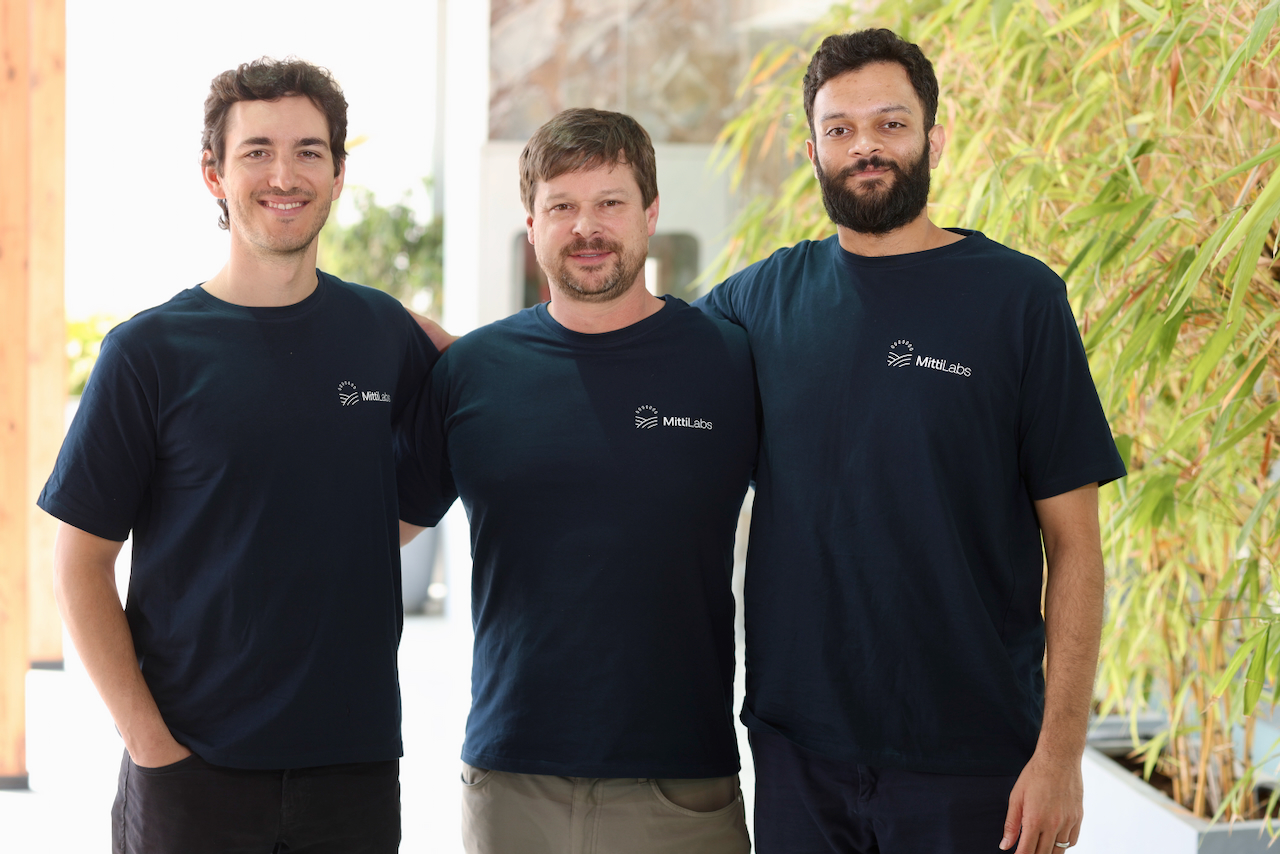
Devdut Dalal, Xavier Laguarta Soler and Nathan Torbick, founders of Mitti Labs, have a plan to change this, at scale. And they’re already persuading some 70,000 rice farmers in India to try out their science-backed methods.
In the process, they also want to translate the reduced methane emissions to equivalent carbon credits, so that the farmers benefit from a share of the money from the sale of those credits.
Catch the full conversation on Friday, June 5, World Environment Day, right here or wherever you get your podcasts. Here’s a quick preview, with Nate giving us a sense of the potential for methane reduction and the water savings.
In any field, and especially in deep tech, India’s startups don’t get the type of funding that Silicon Valley ventures command. In fact even a modest Series A fund raise takes a long time and represents a solid achievement for Indian startups.
Therefore how can they make a dent, globally, in a field like robotics that is extremely hardware intensive and integrating the physical robot and its “intelligence” is a daunting task. Especially for any entrepreneurs looking to build humanoids.
In a recent conversation with me, Arjun Dutt, a partner at Bain & Company, and a former tech entrepreneur himself, offered his views on what and how Indian robotics startups can do to strategically position themselves.
You can find the full conversation via the related post link below. Here’s two minutes on the four priorities that Arjun suggests: “going narrow,” taking hybrid approaches to the form factor, building partnerships, and offering the best technical solutions to specific layers of the tech stack that currently are universal pain points that everyone in the field is dealing with.
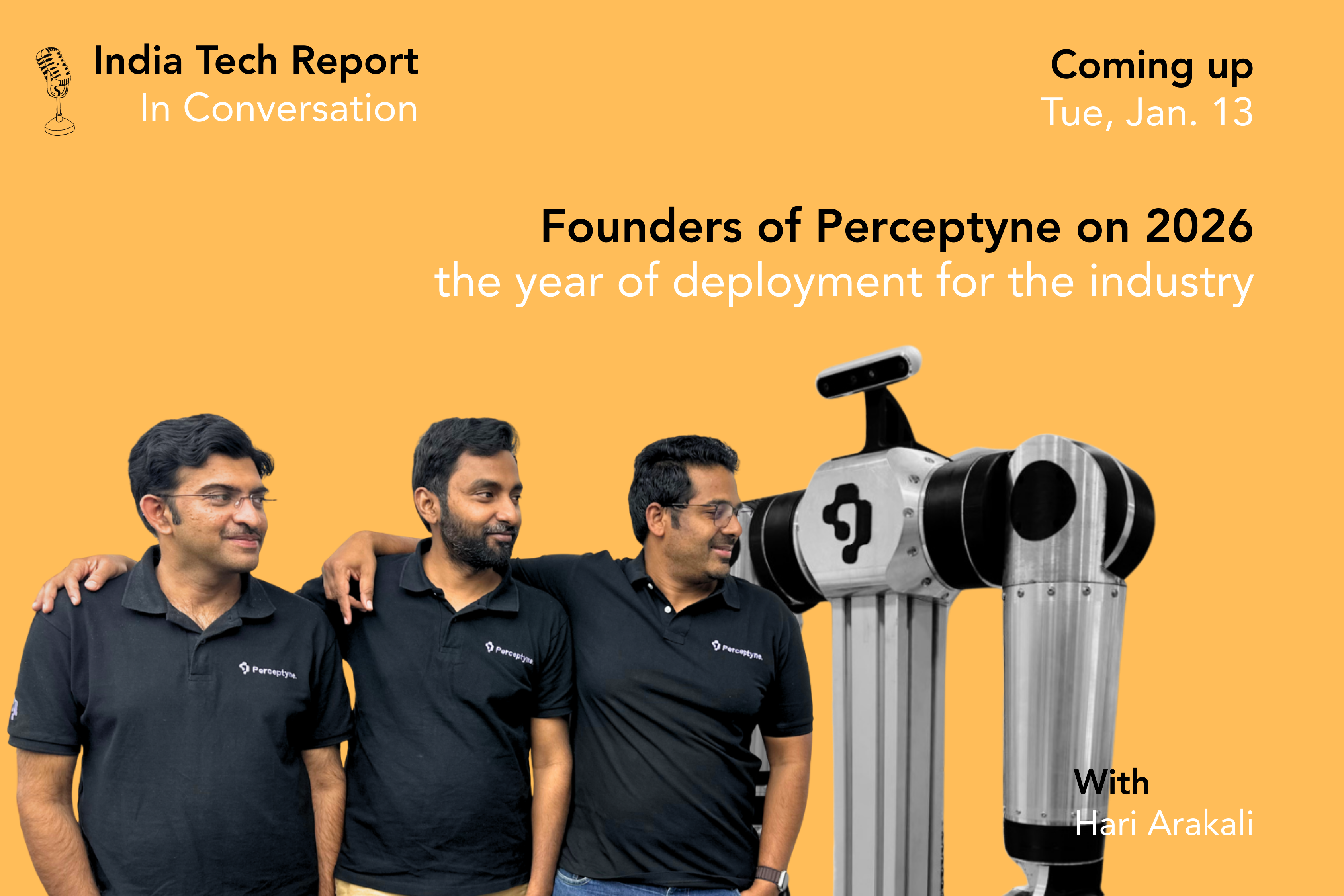
Founders of Perceptyne Robots, Mrutyunjaya N, Raviteja Chivukala and Jagga Raju N are building autonomous, dexterous robots and the physical AI stack needed.
Happy new year to all of you deep tech enthusiasts in India. An area in which 2026 is already shaping up to be one that will likely see advances, is robotics and automation and the AI needed for this, being called physical AI or even ’embodied AI’.
If you caught Boston Dynamics CSO Marc Theermann recently saying the company’s Atlas humanoid is “not designed for YouTube” but for the real world, what’s your view on that — premature or prophetic? Will 2026 show us?
Listen to the preview
To kick off my reports this year, I got a chance to chat with a dynamic entrepreneur trio building what they say will be autonomous and dexterous robots for the real world — at Perceptyne Robots.
So, coming up on Tuesday, Jan. 13, this year’s first episode of India Tech Report: In Conversation, will feature Mrutyunjaya N, Raviteja Chivukala and Jagga Raju N, co-founders of this Hyderabad-based robotics and physical AI startup.
Their venture, which turns four this year, is backed a couple of well-known deep-tech VC firms, Yali Capital and Endiya Partners. Catch the full conversation right here, or wherever you get your podcasts. Here’s a less-than-a-minute preview.
An ISRO SSLV with an Earth Obervation Satellite. Govt backing for space tech startups is soaring. Image source ISRO website.
(00:21) SIDBI hits first close of Antariksh, India’s largest space fund
SIDBI Venture Capital announced the first close of its Antariksh fund at Rs 1,005 crore, anchored by a Rs 1,000 crore commitment from IN-SPACe, Times of India reports. Registered as a Category II alternative investment fund with a decade-long tenure, it represents India’s largest dedicated space-tech vehicle and among the biggest globally.
The Rs. 1,600 crore fund will back early and growth-stage companies across launch systems, satellites, ground infrastructure, earth observation and downstream applications. The initiative advances India’s ambition to build a $44 billion space economy by 2033.
Prenishq unveiled India’s first indigenous high-precision compact diode laser, marking a significant step forward in the nation’s quantum technology efforts. Supported by the National Quantum Mission, Prenishq’s laser delivers high beam quality, superior stability and long-term reliability across wavelengths from ultraviolet to near infrared, according to a statement from the ministry of science and technology.
The plug-and-play system will enable quantum-safe transactions for financial institutions, protecting sensitive data against future quantum computing threats. It also supports photonic quantum computers tackling drug discovery and chemical process analysis.
(01:49) Government backs Rs 7,172 crore electronics manufacturing push
The Ministry of Electronics and IT has approved seventeen proposals under the Electronics Components Manufacturing Scheme, spanning nine states with cumulative investment of Rs 7,172 crore. The projects will generate Rs 65,111 crore in production and create 11,808 direct jobs.
Key approvals include India’s first optical transceiver manufacturing facilities by Jabil Circuit India and Zetchem Supply Chain Services, alongside oscillators for communication devices and industrial electronics. The scheme targets components for smartphones, IT hardware, electric vehicles, defence and renewable energy sectors.
(02:40) Hyderabad biotech startup forges Japan regenerative med tie-up
BioVaram, incubated at the University of Hyderabad’s ASPIRE-BioNEST, entered a strategic partnership with Japan’s Teijin Limited to expand regenerative medicine between the two nations, UNI reports. The collaboration will bring Teijin’s cardiovascular repair patch SYNFOLIUM and Japan Tissue Engineering’s regenerative products to India, whilst Teijin supports commercialisation of BioVaram’s exosome-based diagnostics, therapeutics and bio-derived materials in Japan.
Founded in 2020 and recognised among the top five startups at BioAsia 2024, BioVaram develops artificial intelligence-driven peptides, exosomes and biomaterials for regenerative medicine. The alliance strengthens India’s capabilities in advanced tissue engineering and scalable manufacturing.
(03:36) Varaha raises $30M for India’s regenerative agriculture programme
Climate tech startup Varaha has raised $30 million from French sustainable investor Mirova to expand its Kheti soil-carbon project across Haryana and Punjab, TechCrunch reports. The transaction, structured as project-level investment against future carbon credits, represents Mirova’s largest single carbon deal and its first in India.
The funds will support over 337,000 smallholder farmers implementing regenerative practices across 675,000 hectares. Varaha operates four removal pathways: regenerative agriculture, biochar, agroforestry on degraded lands and enhanced rock weathering. The company runs experiments with institutions including IARI Pusa and IIT Kharagpur to quantify net carbon change. Earlier this year, Varaha signed a multi-year biochar offtake agreement with Google.