
The ultimate aim for robot makers is to build a fully general-purpose machine that can pretty much perform any task that we can do. At that point we’ll have robots that can finally relieve us of the daily drudgery of doing the laundry, washing the dishes and putting out the trash.
In the mean time, there are two distinct approaches being followed by robotics companies, says Arjun Dutt, a partner at Bain & Company, who recently discussed the global consultancy’s views on how these technologies are evolving and what’s influencing their deployment.
The first is to look at specific tasks, like those repeatedly needed in factories and warehouses, for example, and build robots that can takeover — part of the attraction here is the labour shortage in the advanced economies. This isn’t generally an issue in the global south, where labour is available but skilled labour requires training at scale.
The second approach is far more ambitious, because it’s about solving general robotic intelligence and capabilities in unconstrained settings, Arjun points out. Arjun is a former tech entrepreneur himself. He is an electrical and computer engineer by training and a specialist in commercial applications of AI technologies.
Catch the full conversation via the related video link. Here’s two minutes on Arjun’s viewpoint, explaining the two divergent approaches briefly.
Tag: deep-tech
-

Humanoid robots: which approach will win the race?
-
What’s holding humanoids back? This expert’s answer might surprise you
Arjun Dutt, a partner at Bain & Company, spoke with me a couple of weeks ago on the global consultancy’s views on how robotics technologies are evolving.
Arjun recently co-authored a note on the impact of early commercialisation of humanoid robots — how that will likely play out in three waves, from ‘brownfield’ plants to eventually, our homes.
You can catch the full conversation via the related post below. Here’s a short chapter with Arjun briefly explaining the four critical areas in which advancements are needed before humanoids can be more human-like.And one technology might be holding back even faster adoption of these robots. It might surprise you to know that it’s not intelligence.
Related post
-
Humanoid future: Arjun Dutt at Bain on the coming waves of robots
In this episode, we explore the rapidly evolving world of physical intelligence with Arjun Dutt, a Partner at Bain & Company and former entrepreneur. As generative AI transitions from digital interfaces into the physical world, Arjun explains why humanoid robots are emerging as a solution to the worsening labour shortages, especially in the so-called ‘brownfield’ plants in many advanced economies.
We dive into Bain’s four-point definition of humanoids — adaptive intelligence, spatial perception, bipedal dexterity, and sustained power — and talk about how the current battery technologies remain the “long pole in the tent” for true autonomy.
Arjun outlines the three waves of adoption that are discussed in a recent note that he co-authored, predicting that while industrial brownfield settings will see scale within three to five years, consumer-centric home robots are at least a decade away.
You will also find interesting insights on the following topics: The role of generative AI as a “foundational capability,” allowing robots to learn via observation and training data rather than rigid, scenario-based programming; the evolution of specific task-oriented robots versus truly general-purpose humanoids; and where might the eventual “control points” lie, as Arjun put it, of humanoid robots – meaning, who’ll control the most critical technologies in these robots?
Lastly, we touched upon his advice for India’s deep tech entrepreneurs, discussing the merits of “going narrow” and how to navigate the reliability and regulatory hurdles of the US market.
-

Coming up: Arjun Dutt at Bain on the three waves of adoption of humanoid robots — from factories to homes
Coming up on India Tech Report, we dive into the future of physical intelligence with Arjun Dutt, Partner at Bain & Company. Arjun explains how, aided by both physical tech breakthroughs and generative AI moving beyond the screen and into the physical world, humanoid robots are on the cusp of becoming a likely solution to global labor shortages – one of the big applications driving the multi-billion-dollar investments into this form factor.
We explore Bain’s four-pillar definition of a humanoid — intelligence, perception, dexterity, and sustained power — and why current battery technology remains the “long pole in the tent” for true autonomy.
Arjun breaks down the “three waves of adoption” of humanoids that he and his colleagues Xin Cheng, Anne Hoecker and Peter Hanbury outlined in a recent note: starting with industrial brownfield settings – massive sunk investments with infrastructure built around how humans work – in the next three to five years, moving to mining and construction by 2030, and finally reaching consumers’ homes as early as within a decade.
For the builders out there, Arjun draws on his own entrepreneurial roots to offer his insights for Indian robotics startups navigating the global stage. Should you build the full stack or “go narrow”? How do you scale manufacturing and reliability for the US market? From the state of the art in robot training to the regulatory hurdles ahead, this is a quick look at the race to build a general-purpose worker.
Catch the full conversation on Tuesday, March 17th right here, or wherever you get your podcasts. Here’s a 90-second preview with Arjun explaining the connection between generative AI and robotics.
-
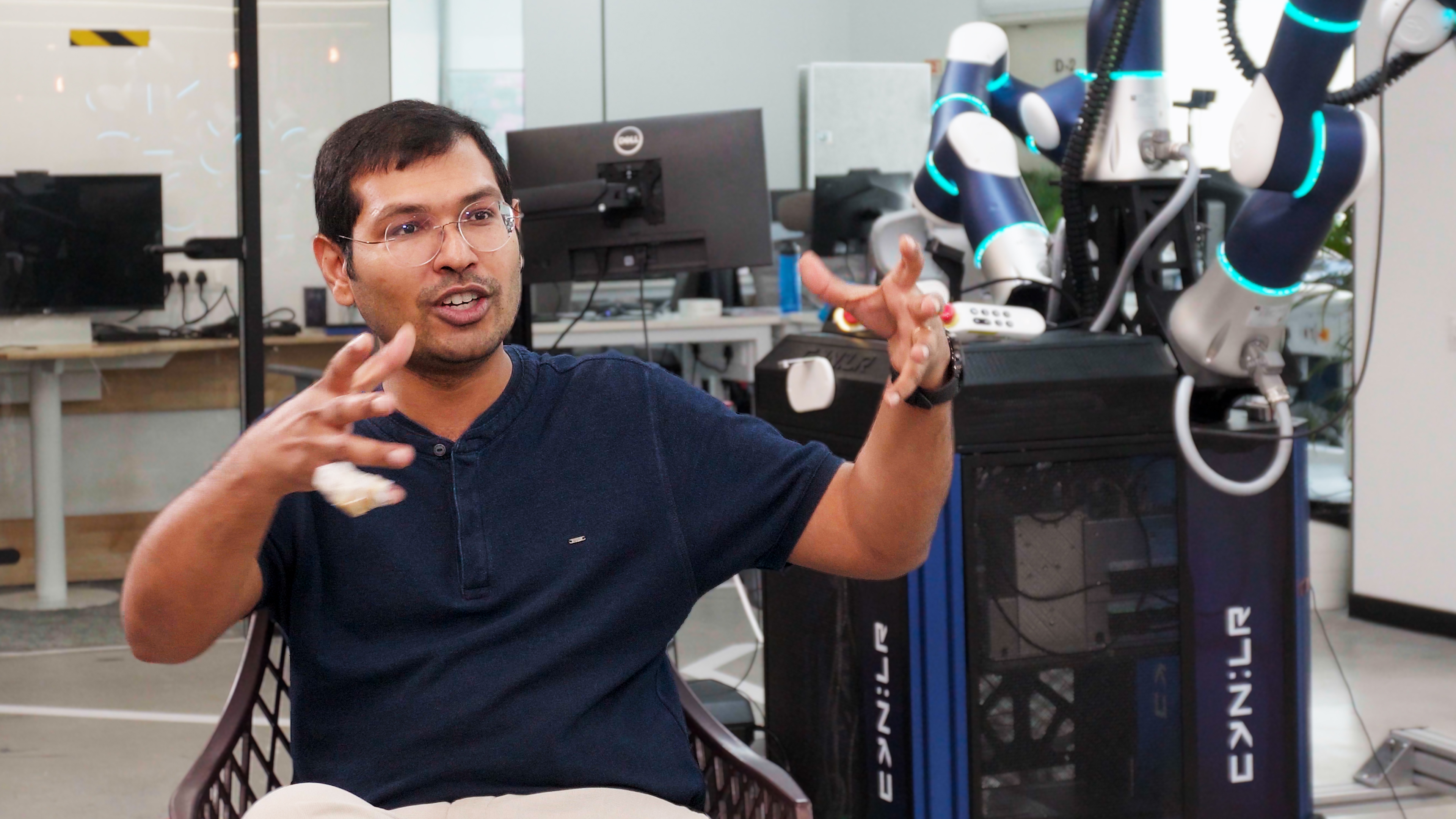
Beyond Government: Gokul NA’s hard truths for industry in deep tech
Once upon a time, it used to be a popular joke in many industry speeches in India — one that government leaders used to sportively join in — that the IT services industry grew “despite the government.” Of course, it was untrue. Several forward-thinking officials and technocrats in governments both at the central and state levels played a strong role in helping that industry grow. As did many top political leaders.
Today, with deep tech, while micro-procedural frustrations still very much remain, no one needs to say they need to grow despite the government. Public support is visible and hundreds of thousands of crores of rupees are being committed in mission mode to R&D and Innovation.
In a recent conversation with India Tech Report, Gokul NA, founder of CynLr, a robotics venture based in Bengaluru, spoke about the other side of the table — those representing private industry, and what they need to do if India’s deep tech ventures are to have a serious chance in the long term.
Catch the full conversation by clicking on the the related post link below. Here’s two minutes on the need for exporting “homegrown IP,” building world-class research clusters and more.
-
Why ‘Factories will be the new products’: Gokul NA on the bigger picture behind CynLr’s Object Intelligence Stack
In this excerpt from a recent conversation with India Tech Report, Gokul NA, founder of CynLr, explains his view of the bigger picture in developing the company’s “Object Intelligence Stack” for robots.
Gokul, his fellow-founder Nikhil Ramaswamy and their 85-member team have put in some five years of R&D into this stack, which they see as a precursor to a general purpose “manipulation OS” for robots.
In this view point, Gokul talks about today’s challenges that large manufacturers face, with the example of the auto sector, in an age of rapidly shifting consumer tastes. Robots that could quickly switch from one type of task to another could hold the key to genuine personalised product customisation in cars and the gadgets that go into them and therefore serve as a source of market expansion for the OEMs Gokul argues.
Such robots could also help make factories and manufacturing significantly more sustainable by advancing material recycling —what if your new car could come from your old car or your new phone from your old phone, he asks.
Today that recycling is very costly and therefore not attractive, but a robot that automates the effort could change the landscape, he says. In this scenario, it would also be possible to go from centralised, gargantuan Giga-factories to hyper-local “micro-factories” that offer personalisation plus sustainability.

