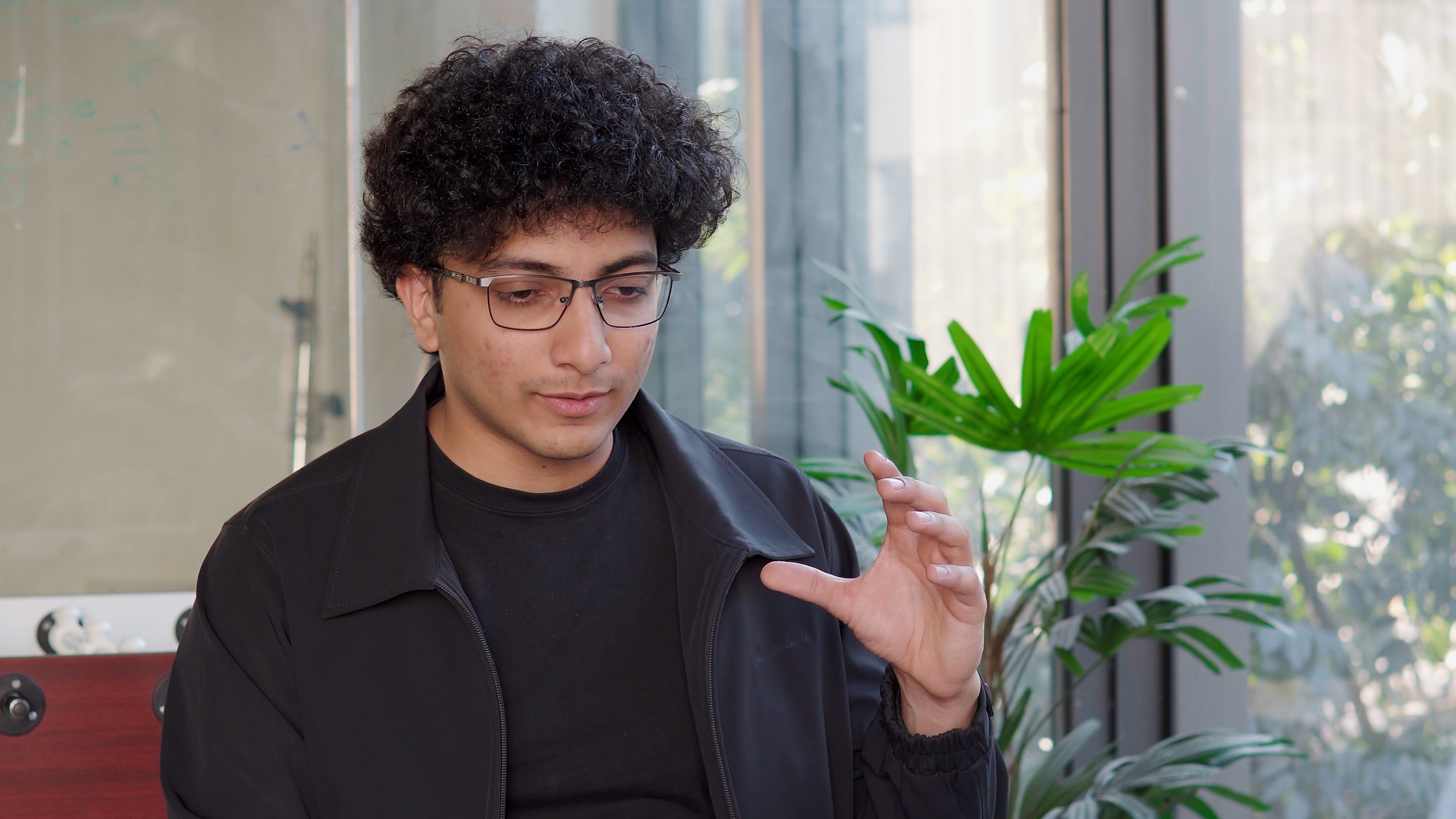
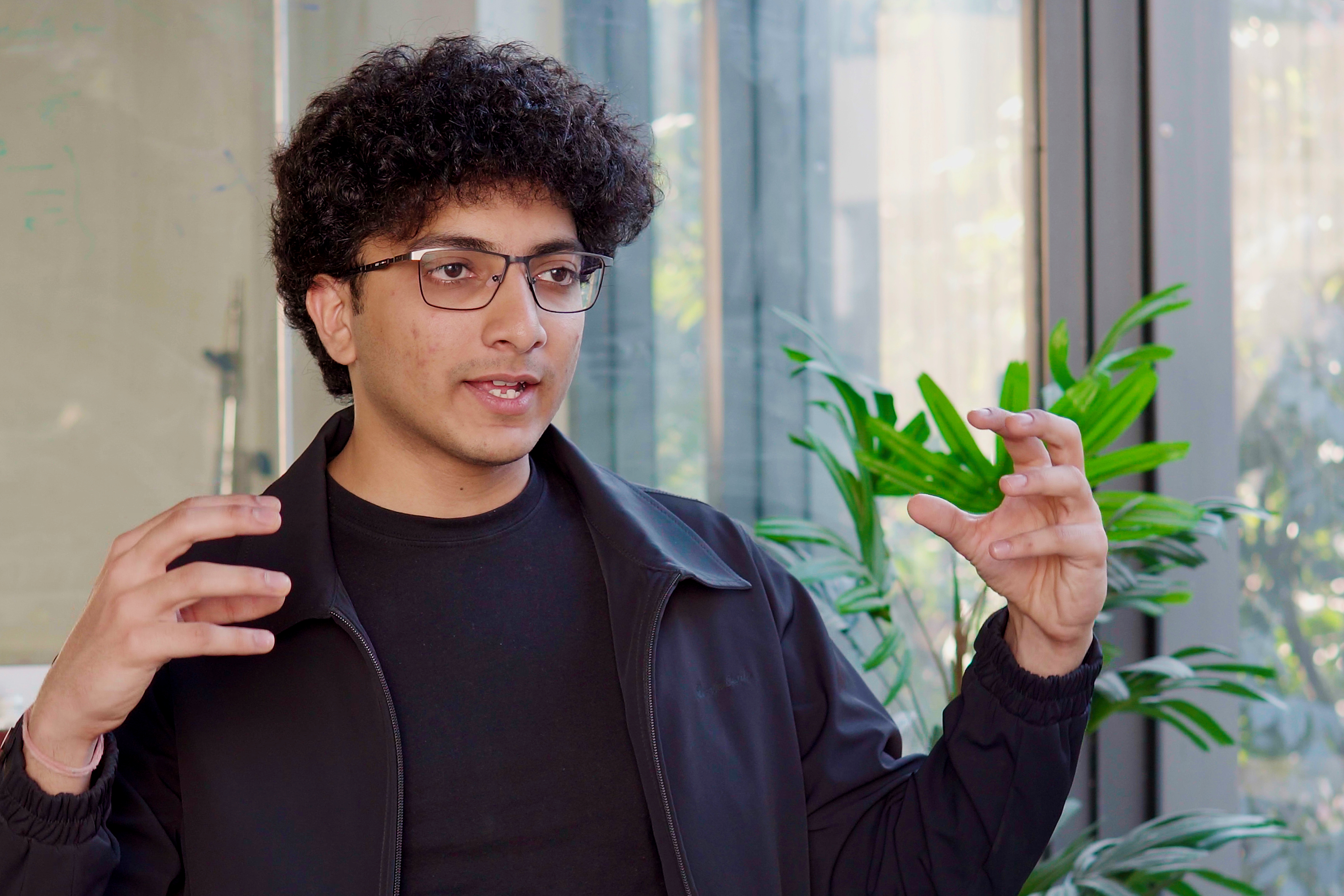
In a recent episode of Conversations at India Tech Report, Jay Panchal, founder and CEO at Aule Space spoke about his young space-tech startup’s vision to help build India’s robot workforce in space.
Aule is starting on that journey with the aim of launching a fleet of “jetpacks” that will work as mission extension vehicles for geostationary satellites and offer other applications in the defense sector as well. You can find the full conversation at indiatechreport.in or wherever you get your podcasts.
Here’s a quick point, with Jay talking about how he and his co-founders bring complementary skills to the table, their current team and immediate hiring needs – focused on core engineering.
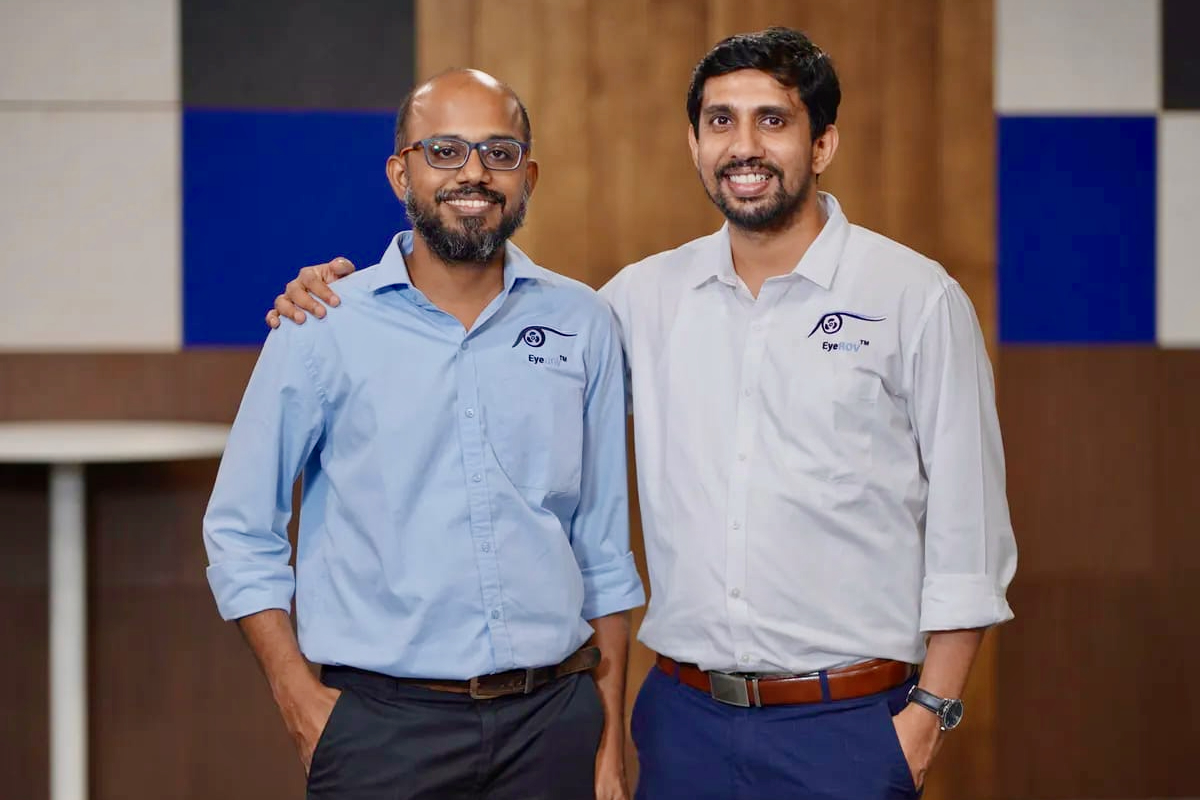
EyeROV Founders (L-R) Kannappa Palaniappan P (CTO) and Johns T. Mathai (CEO). Image source: Company. Editing by Hari Arakali.
For a start-up navigating the murky depths of the Indian Ocean, IROV Technologies (EyeROV) is beginning to see quite clearly. The Kochi-based marine robotics startup has raised Rs. 13 crore in pre-Series-A funding, co-led by AWE Funds and Unicorn India Ventures, according to a press release.
The money is intended to bolster research and development as EyeROV seeks to expand beyond its domestic shores into global markets.
Since its founding in 2017 by IIT alumni Johns T. Mathai (CEO) and Kannappa Palaniappan P (CTO), EyeROV has carved out a niche in the high-stakes world of underwater inspection. With a portfolio that includes a proprietary 10km long-tunnel inspection capability, the company has already completed over 150 projects for industrial heavyweights such as Maersk, ONGC, and Adani.
Its Robotics-as-a-Service model aims to replace high-risk manual diving with autonomous, sustainable electric systems, a shift underscored by a recent Rs. 47 crore order from the Indian Navy.
Indian startups such as EyeROV are developing products to win a share of the global market for maintenance of offshore assets which is seeing a shift from manual, hazardous operations to automated surveillance.
EyeROV estimates a $13 billion global addressable market for underwater infrastructure inspection. Deep-tech companies are increasingly viewed as essential for the long-term viability of the aging energy pipelines, subsea cables, and ports that underpin international trade.
“Some of the world’s most critical infrastructure such as energy pipelines, subsea cables, ports are offshore assets. They are all beneath the ocean’s surface and historically maintained through high-risk, manual, and expensive operations. We believe this is precisely where deep technology creates both outsized returns and meaningful impact,” Seema Chaturvedi, Founder and Managing Partner of AWE Funds, said in the press release.
The broader environment for Indian deep tech is warming, spurred by government grants and a burgeoning innovation ecosystem. For EyeROV, this round is a strategic precursor to a planned $10 million Series A, as it seeks to capture a larger share of the $800 million Indian market.
“With our recent Rs. 47 crore Indian Navy order and the surging demand for specialized inspections in the energy and infrastructure sectors, EyeROV has reached a clear inflection point,” CEO Mathai said in the press release. “This funding will accelerate our trajectory as we scale our technology and expand our footprint internationally.”
In a recent episode of Conversations at India Tech Report, Jay Panchal, founder and CEO at Aule Space spoke about his young space-tech startup’s vision to help build India’s robot workforce in space.
Aule is starting on that journey with the aim of launching a fleet of “jetpacks” that will work as mission extension vehicles for geostationary satellites and offer other applications in the defense sector as well.
You can find the full conversation at indiatechreport.in or wherever you get your podcasts.
Here’s a quick chapter on some of Jay’s important formative experiences that set him on the path to entrepreneurship in the space economy.
Today I’m joined by Jay Panchal, founder and CEO of Aule Space, in Bengaluru. Jay started the company in 2024 with his fellow founders Nithyaa Giri, who’s Aule’s CTO, and Hrishit Tambi, its COO.
He talks about their efforts so far to develop “jetpacks” – sophisticated Mission Extension Vehicles (MEVs) designed for the task of rendezvous, proximity operations, and docking (RPOD).
The trio of entrepreneurs has just raised $2 million in pre-seed funding led by pi Ventures, a well-known deep tech VC firm in Bengaluru.
Aule Space founders (L-R) Hrishit Tambi, Jay Panchal and Nithyaa Giri. Image source: Aule Space. Edited by Hari Arakali.
Aule is developing an innovative non-cooperative docking mechanism, giving its jetpacks the ability to latch onto satellites and debris not originally designed for docking. Its design combines a satellite-agnostic docking mechanism with AI-driven guidance, navigation and control algorithms, aiming to field one of the world’s lightest and most cost-efficient RPOD satellite fleets.
The company is targeting use-cases from life extension of high-value geostationary communications satellites and debris removal to defence applications such as close-in inspection for space-domain awareness. With the long-term vision of establishing a robotic workforce in space, Jay hopes that over the next five years, Aule will operate a fleet of jetpacks. Their technology demonstrator could be ready as early as next year.
Jay Panchal, founder and CEO at Aule Space, along with his fellow founders Nithyaa Giri and Hrishit Tambi, has raised $2 million led by pi Ventures, to build ‘jetpacks’ that can keep satellites going.Listen to the preview
Coming up on Tuesday, Feb. 3 For my next episode of Conversations at India Tech Report, I sat down with Jay Panchal, the young Founder and CEO at Aule Space.
Jay and his fellow founders Nithyaa Giri and Hrishit Tambi have raised pre-seed funding for Aule to build autonomous “jetpack” satellites that can dock with spacecraft that are running out of fuel and keep them going in orbit.
The round totals $2 million, led by pi Ventures with participation from several angel investors, including former Intelsat board member Eash Sundaram and Tonbo Imaging chief executive Arvind Lakshmikumar.
Founded in 2024 by Jay, Nithyaa and Hrishit, Aule Space is developing satellites that can safely approach, latch on to and manoeuvre other spacecraft, a class of capability known in the trade as Rendezvous, Proximity Operations and Docking (RPOD).
The company will use the new capital to expand its engineering team, build ground infrastructure for docking tests and ready its first demonstration satellites, slated to launch next year.
Aule’s design combines a satellite-agnostic docking mechanism with AI-driven guidance, navigation and control algorithms, aiming to field one of the world’s lightest and most cost-efficient RPOD satellite fleets. The company is targeting use-cases from life extension of high-value geostationary communications satellites and debris removal to defence applications such as close-in inspection for space-domain awareness.
Catch the full conversation right here, or wherever you get your podcasts. Here’s a quick preview.
In this episode, I’m joined by Manish Singhal, founding partner of pi Ventures, a Bengaluru-based early-stage venture capital firm backing some of India’s most ambitious deep tech startups.
India’s start-up story is often told through software and services. Yet a quieter transformation is under way in laboratories, machine shops and clean rooms. And Manish has been one of the earliest investors consistently supporting this gradual change, first as an angel investor and then through pi Ventures.
Over the past decade, pi Ventures has gone from backing AI-led software plays to financing startups in sectors such as space, semiconductors, robotics, clean energy and electric mobility. From its first fund, pi Ventures backed companies such as Zenatix, Niramai, Sigtuple, Locus, and Wysa, but also Agnikul Cosmos.
The firm is currently investing from its second fund, which, at $85 million, is almost three times the first fund. Its portfolio now includes startups building 3D-printed rocket engines, optical interconnects for data centres, electric tractors designed from first principles and in-orbit satellite “jetpacks” that extend the life of multi-million-dollar assets.
“Founders in India are dreaming big. Founders in India are not thinking India. Founders in India are thinking global from day one.”
Manish Singhal
Prior to pi Ventures, which turns 10 in March, Manish started out as an electrical engineer from IIT Kanpur, and accumulated two decades of operating experience – building products and teams at companies including Motorola, Ittiam Systems, and Sling Media, where he helped scale the company’s India R&D centre.
His firm’s recent investments such as Moonrider (electric tractors), LightSpeed Photonics (optical interconnects for AI data centers), and Aule Space (in-orbit satellite servicing) reflect Manish’s conviction that Indian startups can build globally relevant deep tech products.
He is not unaware of the still entrenched and considerable challenges in the way those dreaming of deep tech success from India. And he’s also clear-eyed about the limits of industrial policy, and wary of fads in “indigenous” technology.
But Manish is optimistic, when he talks about how deep tech founders in India are becoming more audacious in their aspirations and how India is on the cusp of being seen as a genuine deep-tech nation.