In this episode, I’m joined by Manish Singhal, founding partner of pi Ventures, a Bengaluru-based early-stage venture capital firm backing some of India’s most ambitious deep tech startups.
India’s start-up story is often told through software and services. Yet a quieter transformation is under way in laboratories, machine shops and clean rooms. And Manish has been one of the earliest investors consistently supporting this gradual change, first as an angel investor and then through pi Ventures.
Over the past decade, pi Ventures has gone from backing AI-led software plays to financing startups in sectors such as space, semiconductors, robotics, clean energy and electric mobility. From its first fund, pi Ventures backed companies such as Zenatix, Niramai, Sigtuple, Locus, and Wysa, but also Agnikul Cosmos.
The firm is currently investing from its second fund, which, at $85 million, is almost three times the first fund. Its portfolio now includes startups building 3D-printed rocket engines, optical interconnects for data centres, electric tractors designed from first principles and in-orbit satellite “jetpacks” that extend the life of multi-million-dollar assets.
“Founders in India are dreaming big. Founders in India are not thinking India. Founders in India are thinking global from day one.”
Manish Singhal
Prior to pi Ventures, which turns 10 in March, Manish started out as an electrical engineer from IIT Kanpur, and accumulated two decades of operating experience – building products and teams at companies including Motorola, Ittiam Systems, and Sling Media, where he helped scale the company’s India R&D centre.
His firm’s recent investments such as Moonrider (electric tractors), LightSpeed Photonics (optical interconnects for AI data centers), and Aule Space (in-orbit satellite servicing) reflect Manish’s conviction that Indian startups can build globally relevant deep tech products.
He is not unaware of the still entrenched and considerable challenges in the way those dreaming of deep tech success from India. And he’s also clear-eyed about the limits of industrial policy, and wary of fads in “indigenous” technology.
But Manish is optimistic, when he talks about how deep tech founders in India are becoming more audacious in their aspirations and how India is on the cusp of being seen as a genuine deep-tech nation.
For my next conversation, I sat down with Manish Singhal, founding partner at pi Ventures, one of the earliest bona fide deep tech investors in India. pi Ventures turns 10 is a couple of months. Before pi, Manish, an IIT Kanpur alumnus with over two decades of operating experience, built products and teams at Motorola, Ittiam Systems, and Sling Media, where he helped scale the India R&D centre during the company’s journey to a $380 million acquisition by EchoStar.
In 2016, he launched pi Ventures with a sharp focus on AI-led deep tech, backing companies like Niramai, Locus, Wysa, but also ventures like Agnikul Cosmos. With its second fund – at $85 million, almost 3X the first fund – pi Ventures has expanded its thesis to frontier sectors including spacetech, semiconductors, quantum technologies, advanced robotics, and climate-tech hardware.
Recent investments such as Moonrider (electric tractors), LightSpeed Photonics (optical interconnects for AI data centers), and Aule Space (in-orbit satellite servicing) reflect his conviction that India can build globally relevant deep tech product startups.
In this episode, Manish talks about how founders are becoming more ambitious in India and how, if we do it right, we can be counted among the world’s top deep tech nations in less than five years.
Catch the conversation right here, or wherever you get your podcasts.
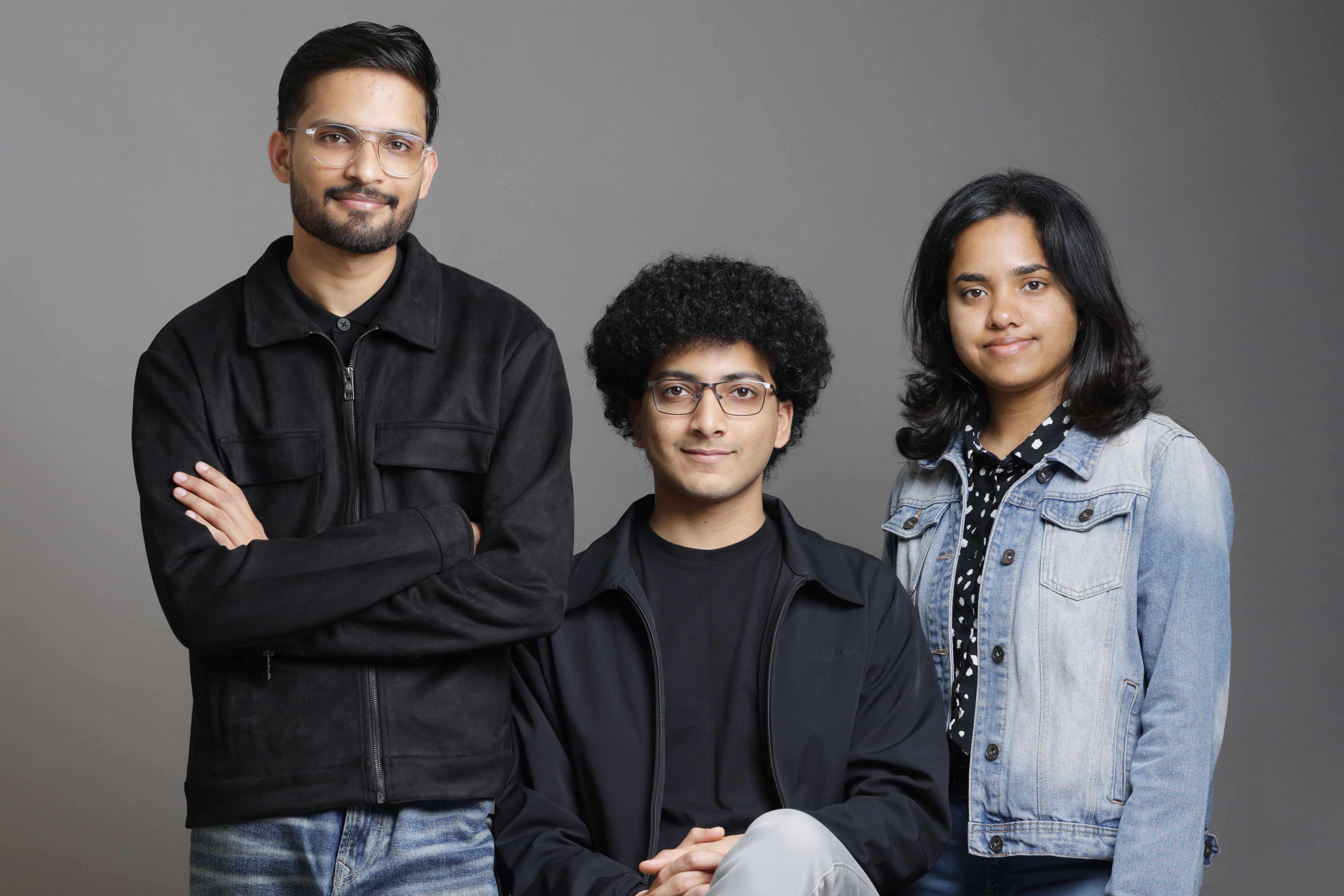
Hrishit Tambi, Jay Panchal and Nithyaa Giri, founders of Aule Space Technologies, aim to put India in the club of nations offering ISAM technologies. Image source: Aule. Edited by Hari Arakali.Listen to the episode
Two space-tech startups kicked off 2026’s funding news for the sector in India, aiming to expand India’s presence in the global space economy in two challenging areas. And they’ve both found backing from top-notch investors.
Ethereal Exploration Guild (EtherealX) and Aule Space Technologies revealed a Series A and a pre-seed-stage investment respectively, in separate announcements, last week.
EtherealX was founded by Manu J. Nair, Shubhayu Sardar, and Prashanth Sharma, who bring experience from ISRO and the International Institute for Astronautical Sciences to their endeavour.
They have found backing from Japan’s TDK Ventures. The venture arm of TDK Corporation will invest up to $5 million in Bengaluru-based Ethereal Exploration’s series A round.
The partnership aims to accelerate development of Razor Crest Mk-1 — the world’s first medium-lift rocket designed for full reusability, according to a press release.
EtherealX’s vehicle, still under development, targets launch costs as low as $500 per kilogram, roughly 10X lower than current rates, although the rates vary based on the type of rocket and other factors such as whether the mission is a small dedicated one or something part of large payload and so on.
At its targeted $500-$1000 range, EtherealX hopes to unlock a wide range of commercial missions, including rocket cargo as a service. Its distinguishing feature is a reusable upper stage powered by a proprietary Full Flow Segregated Cooling Cycle engine, coupled with in-house simulation and test infrastructure to shorten development cycles and improve reusability.
The global space economy is entering a phase of billion-dollar bets and trillion-dollar visions. Valued at about $630 billion in 2023, it is expected to nearly triple to $1.8 trillion by 2035, according to a McKinsey estimate, fuelled by the proliferation of satellite constellations and expanding national space ambitions.
Demand for medium-lift systems — rockets capable of carrying 2 ,000 kg to 20,000 kg of payload (to low-Earth orbits)* — is projected to grow strongly, with one forecast, by Research and Markets, estimating it grow from more than $10 billion in 2025 to nearly $16 billion by 2030, at a CAGR of about 8.5 percent. Startups from Austin to Bengaluru are racing to supply governments and private operators squeezed by bottlenecked launch capacity.
Shubhayu Sardar, Prashanth Sharma and Manu J. Nair, founders of EtherealX, are developing a reusable medium-lift launch system. Image source: EtherealX. Edited by Hari Arakali.
“TDK Ventures is thrilled to back the Guild in its goal to reshape the medium-lift space-launch industry,” Nicolas Sauvage, President of TDK Ventures, said in the press release. “The company aligns seamlessly with our vision for transformative innovation, excelling in slashing launch costs, pioneering novel technologies, and harnessing India’s ISRO expertise and cost-efficient supply chain.”
EtherealX’s existing investors include YourNest VC, Bluehill Capital, BIG Capital, Campus Fund, and Golden Sparrow VC. The company has already manufactured its 80kN upper-stage reusable engine (Pegasus) and has signed collaboration agreements with the Indian National Space Promotion and Authorization Centre (IN-SPACe), ISRO, and other national space agencies, as well as commercial satellite operators, launch aggregators, and launch ports globally.
Aule’s orbital jetpacks
Separately, Aule Space, also in Bengaluru, has raised pre-seed funding to build autonomous “jetpack” satellites that can dock with spacecraft that are running out of fuel and keep them going in orbit. The round totals $2 million, led by pi Ventures with participation from several angel investors, including former Intelsat board member Eash Sundaram and Tonbo Imaging chief executive Arvind Lakshmikumar.
Founded in 2024 by Jay Panchal, Nithyaa Giri and Hrishit Tambi, Aule Space is developing satellites that can safely approach, latch on to and manoeuvre other spacecraft, a class of capability known in the trade as Rendezvous, Proximity Operations and Docking (RPOD). The company will use the new capital to expand its engineering team, build ground infrastructure for docking tests and ready its first demonstration satellites, slated to launch next year.
Aule’s design combines a satellite-agnostic docking mechanism with AI-driven guidance, navigation and control algorithms, aiming to field one of the world’s lightest and most cost-efficient RPOD satellite fleets. The company is targeting use-cases from life extension of high-value geostationary communications satellites and debris removal to defence applications such as close-in inspection for space-domain awareness.
Today most satellites are abandoned once their fuel runs out, even if their payloads remain largely functional, because there is no routine in-orbit servicing infrastructure. More than 95 percent of the $100 billion generated each year in commercial satellite revenues comes from satellites in geostationary orbit (GEO) and a single satellite can generate tens to hundreds of millions of dollars in annual revenue, according to Joseph Anderson, a vice president at Space Logistics, a Northrup Grumman company.
“However, every year, between 10 and 20 satellites in good operating condition, and with paying customers, are shut down by their operators and replaced with expensive new satellites. This is not by choice, but by necessity: these satellites have run out of fuel,” Anderson wrote in Room, a space economy journal, in 2019.
The following year, Northop Grumman became the first company to successfully demonstrate what they called mission extension, with its MEV-1 and MEV-2 mission extension vehicles. Since then, the field has advanced and technologies that are being developed include robotic arms for in-orbit repairs, AI-based autonomous navigation, and standardized docking interfaces.
“At Aule, we are building the foundational blocks to make autonomous servicing routine,” the Bengaluru startup’s founders say on their website. “We’re kickstarting the in-space economy, supporting ISAM (in-space servicing, assembly, and manufacturing), space superiority, and orbital sustainability,” they say.
Backed by the Entrepreneurs First accelerator and the Transpose Platform, they say their’s is the first company in India building a life-extension solution for existing GEO satellites using “non-cooperative docking” with legacy spacecraft. (Meaning docking with spacecraft, and even debris that have no specific docking mechanisms built in, and therefore requiring autonomous navigation, advanced sensors, grappling equipment and so on.)
Only a handful of private companies globally have demonstrated such capabilities, a rarity that helped convince pi Ventures of the startup’s mix of technical depth and commercial clarity. Founding partner Manish Singhal said Aule is building “critical infrastructure” for satellite servicing, orbital sustainability and space security as it works towards operating a robotic workforce for the in-space economy.
*Note: This episode, and the corresponding show notes here, were corrected to reflect that medium-lift rockets are widely considered to be those that can carry payloads in the range of 2,000 kg to 20,000 kg to low-Earth orbits, as per NASA’s definition. Not 2-50 tonnes, as previously mentioned.
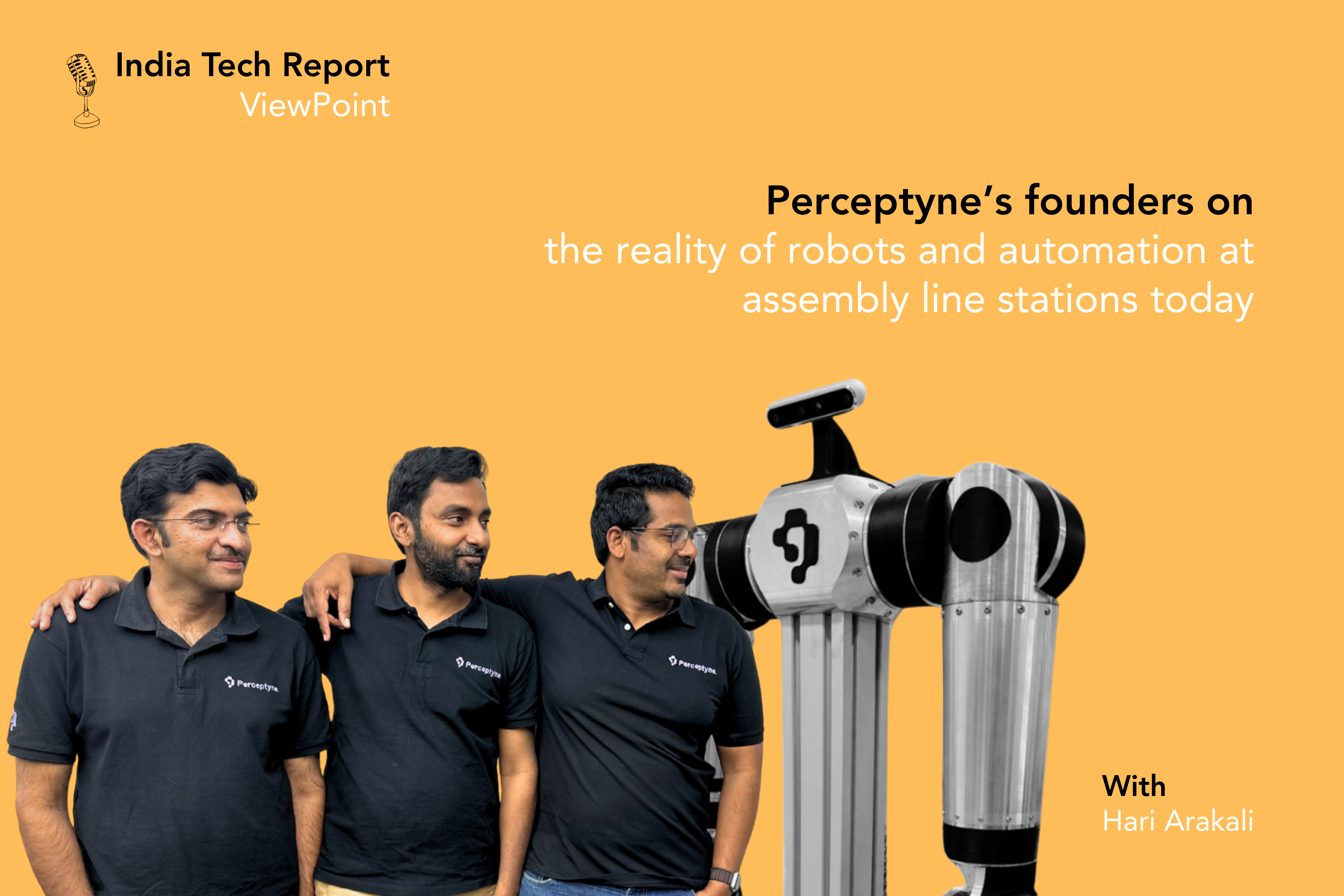
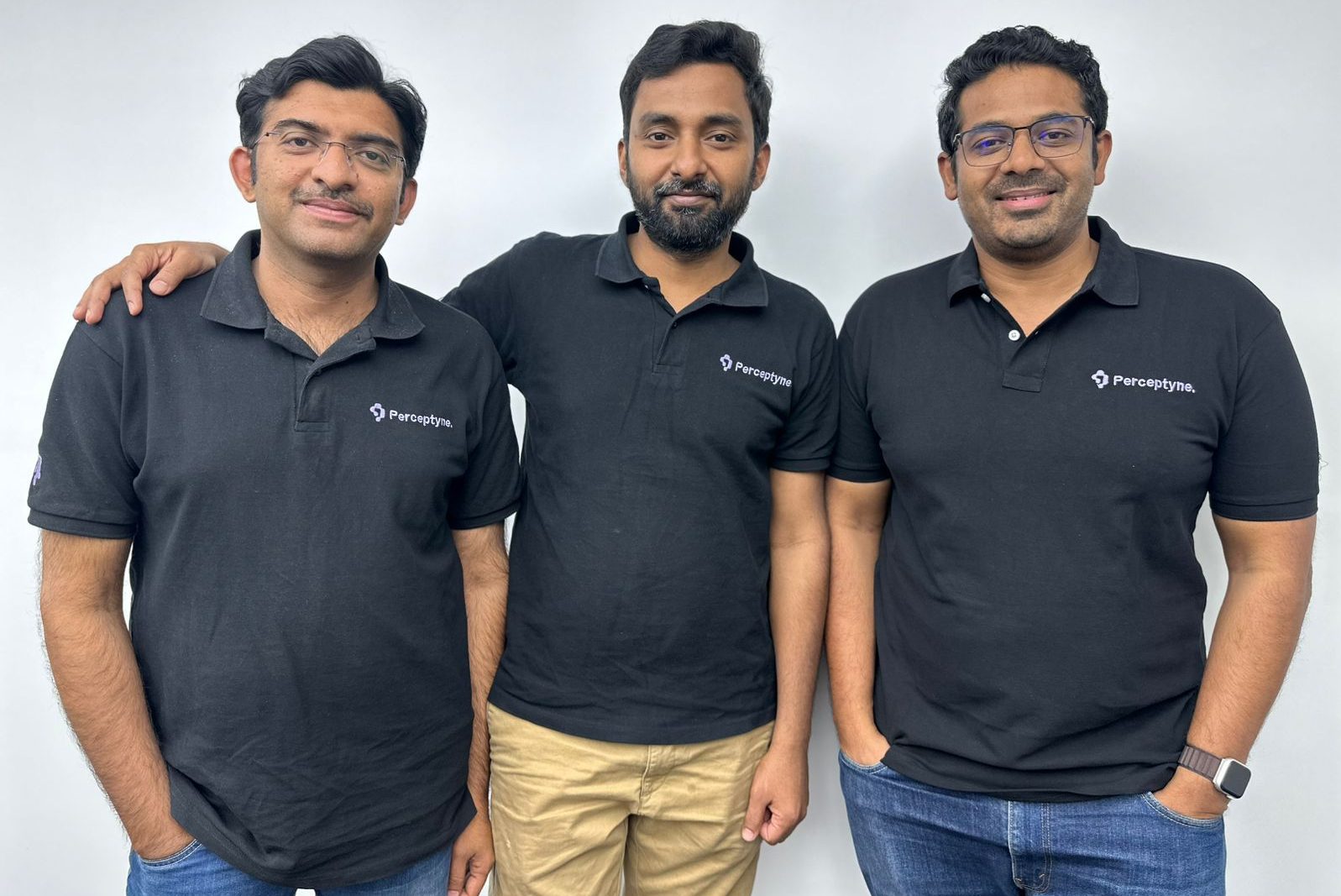
Founders of Perceptyne Robots, Mrutyunjaya N, Raviteja Chivukala and Jagga Raju N are building autonomous, dexterous robots and the physical AI stack needed.Listen to the audio
What are some of the practical, seemingly small but truly challenging engineering problems in translating what seems intuitive to humans to robotics automation, today?
Mrutyunjaya N, Raviteja Chivukala and Jagga Raju N, founders of Perceptyne Robots, explain here in simple terms in just a few minutes.
Perceptyne is a Hyderabad-based company building dexterous, dual-arm, intelligent robots for industrial automation, currently focused on automotive and electronics manufacturing lines.
The founders explain the gap they saw on real shop floors, where many assembly stations still rely on manual work because traditional approaches cannot handle unstructured inputs, fine force control, or frequent product changes.
The conversation goes into their vertically integrated hardware, including mobile configurations, and their PR-PhI “physical intelligence” software layer that orchestrates perception, control, and imitation-learning–based skills like visual servo, slip-free grasping, and force-based assembly.
You will also hear their take on the state of India’s robotics ecosystem, the evolution of robots as a combined hardware-and-software challenge, and how they are moving from pilots with global automotive and electronics manufacturers toward larger deployments. Perceptyne, which turns four this year, is backed by two well-known deep-tech VC firms, Yali Capital and Endiya Partners.
Founders of Perceptyne Robots, Mrutyunjaya N, Raviteja Chivukala and Jagga Raju N are building autonomous, dexterous robots and the physical AI stack needed.
Happy new year to all of you deep tech enthusiasts in India. An area in which 2026 is already shaping up to be one that will likely see advances, is robotics and automation and the AI needed for this, being called physical AI or even ’embodied AI’.
If you caught Boston Dynamics CSO Marc Theermann recently saying the company’s Atlas humanoid is “not designed for YouTube” but for the real world, what’s your view on that — premature or prophetic? Will 2026 show us?
Listen to the preview
To kick off my reports this year, I got a chance to chat with a dynamic entrepreneur trio building what they say will be autonomous and dexterous robots for the real world — at Perceptyne Robots.
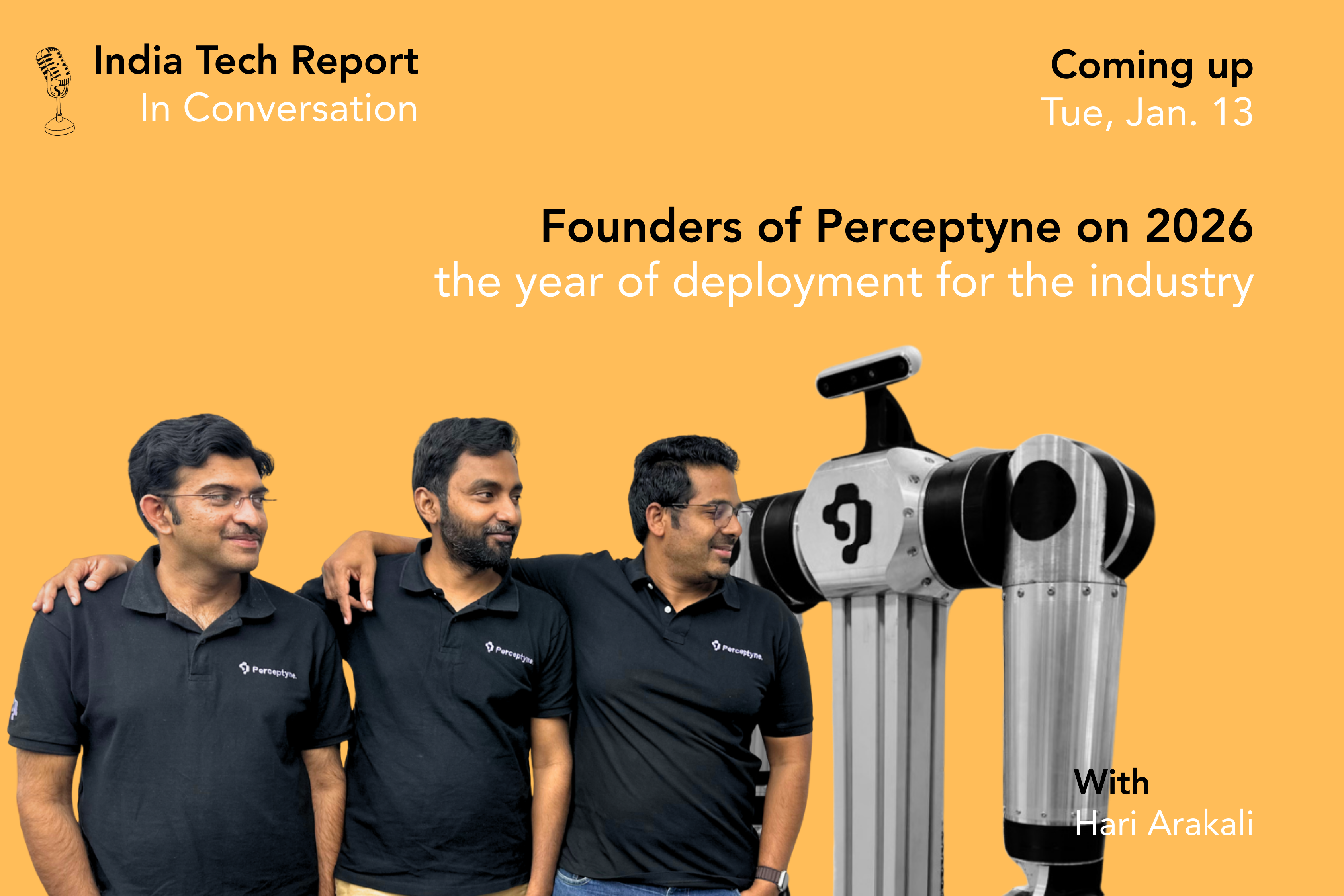
So, coming up on Tuesday, Jan. 13, this year’s first episode of India Tech Report: In Conversation, will feature Mrutyunjaya N, Raviteja Chivukala and Jagga Raju N, co-founders of this Hyderabad-based robotics and physical AI startup.
Their venture, which turns four this year, is backed a couple of well-known deep-tech VC firms, Yali Capital and Endiya Partners. Catch the full conversation right here, or wherever you get your podcasts. Here’s a less-than-a-minute preview.