Tag: india

  • Coming up: Arjun Dutt at Bain on the three waves of adoption of humanoid robots — from factories to homes

    Coming up: Arjun Dutt at Bain on the three waves of adoption of humanoid robots — from factories to homes

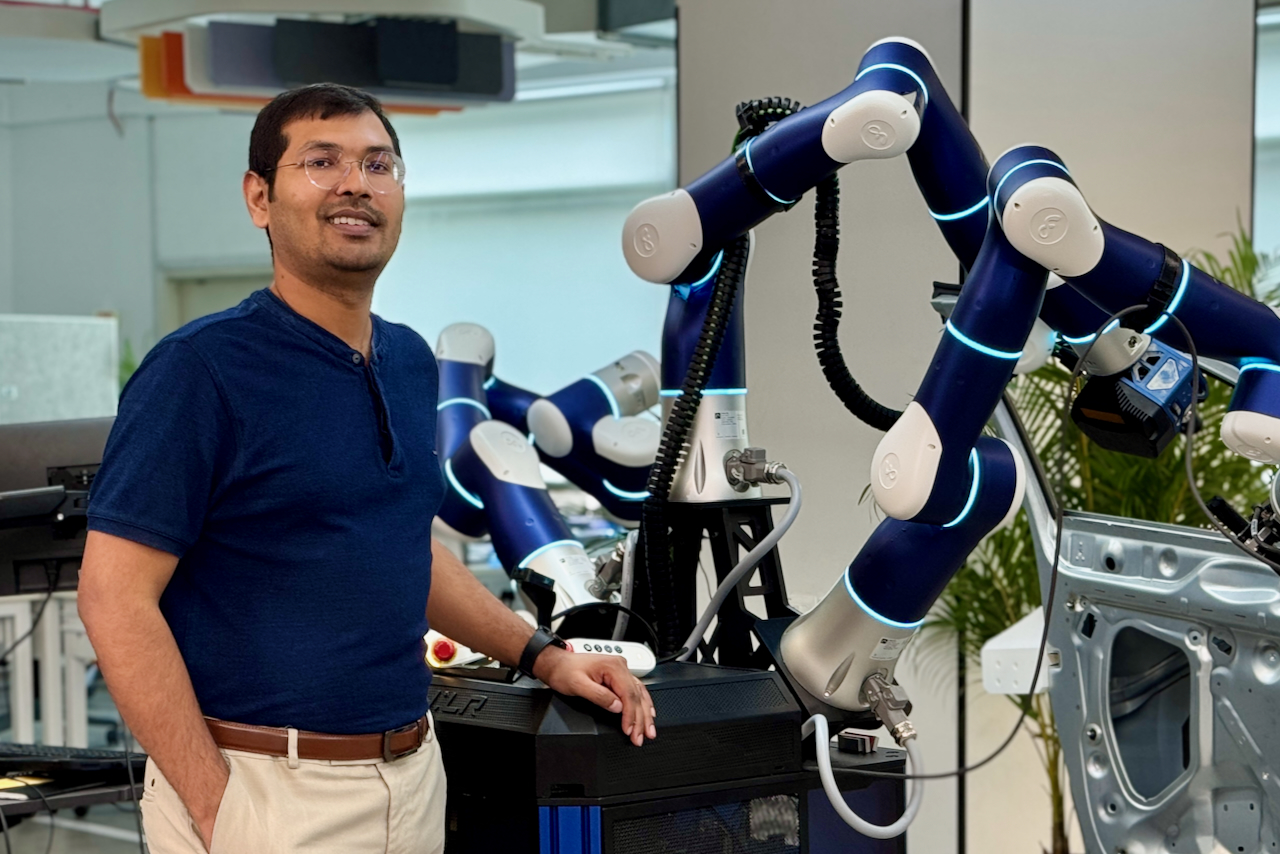
    Coming up on India Tech Report, we dive into the future of physical intelligence with Arjun Dutt, Partner at Bain & Company. Arjun explains how, aided by both physical tech breakthroughs and generative AI moving beyond the screen and into the physical world, humanoid robots are on the cusp of becoming a likely solution to global labor shortages – one of the big applications driving the multi-billion-dollar investments into this form factor.

    We explore Bain’s four-pillar definition of a humanoid — intelligence, perception, dexterity, and sustained power — and why current battery technology remains the “long pole in the tent” for true autonomy.

    Arjun breaks down the “three waves of adoption” of humanoids that he and his colleagues Xin Cheng, Anne Hoecker and Peter Hanbury outlined in a recent note: starting with industrial brownfield settings – massive sunk investments with infrastructure built around how humans work – in the next three to five years, moving to mining and construction by 2030, and finally reaching consumers’ homes as early as within a decade.

    For the builders out there, Arjun draws on his own entrepreneurial roots to offer his insights for Indian robotics startups navigating the global stage. Should you build the full stack or “go narrow”? How do you scale manufacturing and reliability for the US market? From the state of the art in robot training to the regulatory hurdles ahead, this is a quick look at the race to build a general-purpose worker.

    Catch the full conversation on Tuesday, March 17th right here, or wherever you get your podcasts. Here’s a 90-second preview with Arjun explaining the connection between generative AI and robotics.

  • Beyond Government: Gokul NA’s hard truths for industry in deep tech

    Beyond Government: Gokul NA’s hard truths for industry in deep tech

    Once upon a time, it used to be a popular joke in many industry speeches in India — one that government leaders used to sportively join in — that the IT services industry grew “despite the government.” Of course, it was untrue. Several forward-thinking officials and technocrats in governments both at the central and state levels played a strong role in helping that industry grow. As did many top political leaders.

    Today, with deep tech, while micro-procedural frustrations still very much remain, no one needs to say they need to grow despite the government. Public support is visible and hundreds of thousands of crores of rupees are being committed in mission mode to R&D and Innovation.

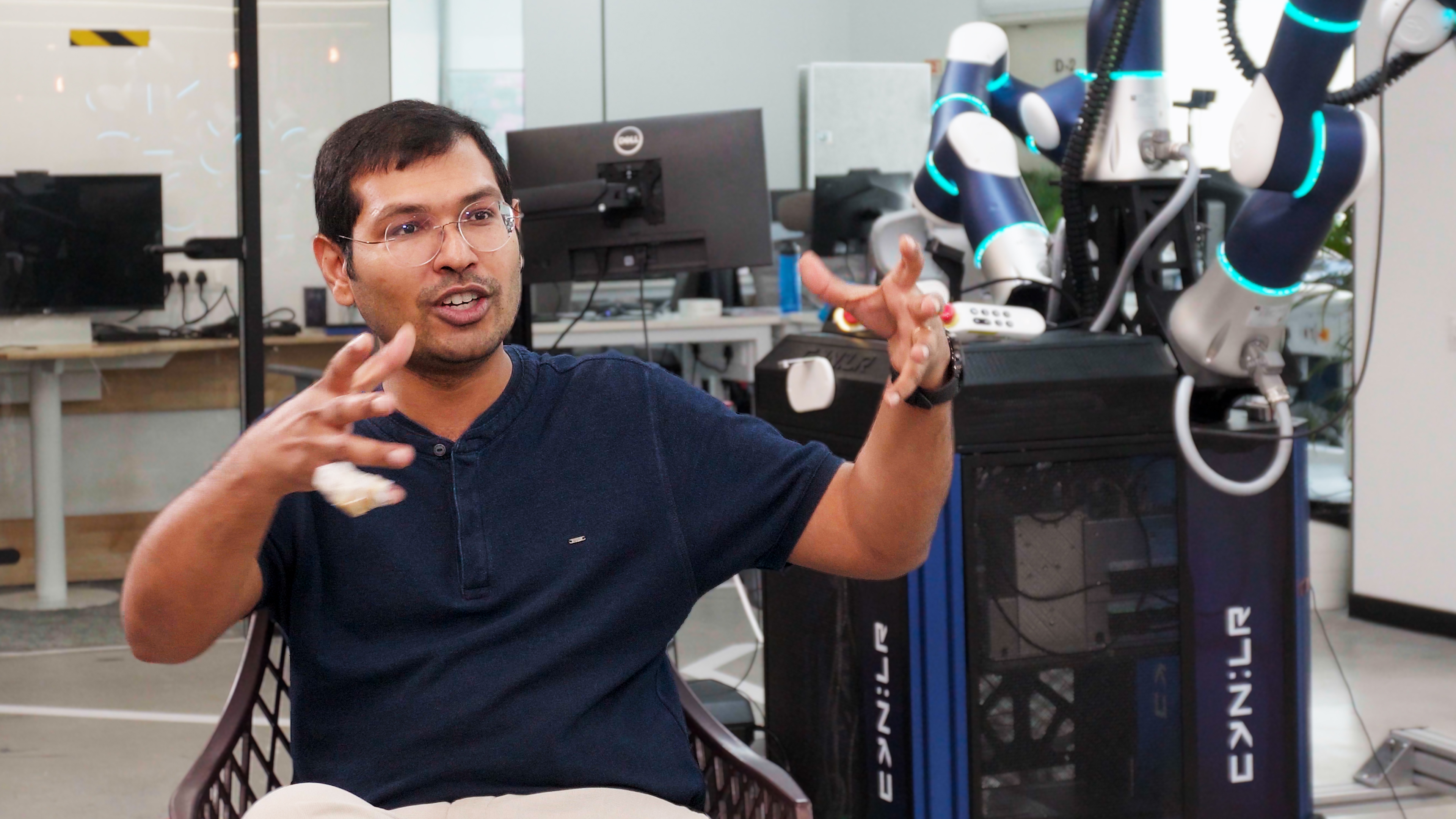
    In a recent conversation with India Tech Report, Gokul NA, founder of CynLr, a robotics venture based in Bengaluru, spoke about the other side of the table — those representing private industry, and what they need to do if India’s deep tech ventures are to have a serious chance in the long term.

    Catch the full conversation by clicking on the the related post link below. Here’s two minutes on the need for exporting “homegrown IP,” building world-class research clusters and more.

  • Why ‘Factories will be the new products’: Gokul NA on the bigger picture behind CynLr’s Object Intelligence Stack

    Why ‘Factories will be the new products’: Gokul NA on the bigger picture behind CynLr’s Object Intelligence Stack

    In this excerpt from a recent conversation with India Tech Report, Gokul NA, founder of CynLr, explains his view of the bigger picture in developing the company’s “Object Intelligence Stack” for robots.

    Gokul, his fellow-founder Nikhil Ramaswamy and their 85-member team have put in some five years of R&D into this stack, which they see as a precursor to a general purpose “manipulation OS” for robots.

    In this view point, Gokul talks about today’s challenges that large manufacturers face, with the example of the auto sector, in an age of rapidly shifting consumer tastes. Robots that could quickly switch from one type of task to another could hold the key to genuine personalised product customisation in cars and the gadgets that go into them and therefore serve as a source of market expansion for the OEMs Gokul argues.

    Such robots could also help make factories and manufacturing significantly more sustainable by advancing material recycling —what if your new car could come from your old car or your new phone from your old phone, he asks.

    Today that recycling is very costly and therefore not attractive, but a robot that automates the effort could change the landscape, he says. In this scenario, it would also be possible to go from centralised, gargantuan Giga-factories to hyper-local “micro-factories” that offer personalisation plus sustainability.

  • Gokul NA on training robots to learn like infants: CynLr’s Object Intelligence Stack

    Gokul NA on training robots to learn like infants: CynLr’s Object Intelligence Stack

    In today’s episode, we dive into the future of robotics with Gokul NA, founder of CynLr, or Cybernetics Laboratory, perhaps one of India’s most advanced companies in this field.

    CynLr is headquartered in Bengaluru, with an advanced R&D Lab in Switzerland and a growing customer-facing operation in the US, where Gokul’s fellow founder Nikhil Ramaswamy is based.

    The entrepreneur duo and its 85-member team are tackling a challenge that scientists and engineers have been working on for several decades: the ability for robots to intuitively handle unfamiliar objects without custom programming or prior training.

    In this conversation, Gokul explains their new “Object Intelligence Stack,” a system designed to imitate some of the functions related how a human brain might learn — much like a baby impulsively grasping a new toy without knowing its name or purpose.

    By collaborating with the Centre for Neuroscience at the Indian Institute of Science, CynLr is translating brain-function research into a sophisticated software and sensor framework. Shifting the focus from algorithms that work on data to the “physics of objects,” CynLr’s intelligence stack is what Gokul describes as the precursor to a “manipulation OS.”

    Drawing parallels to Apple in the 1980s, Gokul shares his vision for a future of “object computers” and micro-factories – important components of CynLr’s vision for global manufacturing, where instead of Giga-factories, we might have fabrication facilities as small as a car dealership or even a garage.


    Chapters

    (00:00) Challenges of building a deep tech organization in an absent industry

    (05:58) Imitating the human brain’s ability to handle unfamiliar objects

    (09:18) Partnering with neuroscience researchers to replicate human intuition

    (11:32) Developing a manipulation operating system and the future object store

    (19:47) Automating assembly for automotive and semiconductor manufacturing

    (25:17) Transitioning from rigid gigafactories to software-defined micro-factories

    (35:49) Fostering a deep tech ecosystem to address the brain drain

    (40:18) Strategic funding goals and the technical roadmap for scaling


    Gokul and Nikhil are backed by investors including Speciale Invest, growX ventures, Pavestone VC, Athera Venture Partners (formerly Inventus India), Anicut Capital, Arali Ventures, Redstart Labs, and several other institutional and angel investors.

    CynLr’s long-term vision also involves creating a manipulation operating system and an “object store” and a “task store” to transform flexible manufacturing, just as the App Store transformed the smartphone.

    Currently, they are deploying these solutions in the automotive and semiconductor industries to automate some complex manual assembly processes.

    In this conversation, Gokul also talks about some of the challenges of building a company like CynLr in India, where many important ingredients are missing, and what he thinks the industry can do to change that.

  • Gokul NA at CynLr on a ‘manipulation OS’ for robots

    Gokul NA at CynLr on a ‘manipulation OS’ for robots

    Coming up, a conversation with Gokul NA, founder and head of product, design & brand at CynLr (Cybernetics Laboratories), a robotics startup in Bengaluru.

    Gokul, his fellow founder Nikhil Ramaswamy, and their team at CynLr, have recently released what he described as an Object Intelligence Stack. The technology aims to mimic the curiosity and adaptability of a human infant, allowing robots to manipulate unfamiliar items without specific prior training.

    By collaborating with the Centre for Neuroscience at the Indian Institute of Science, CynLr is translating brain-function research into a sophisticated software and sensor framework. Their long-term vision involves creating a manipulation operating system and an “object store” and a “task store” to transform flexible manufacturing, just as the App Store transformed the smartphone.

    Currently, they are deploying these solutions in the automotive and semiconductor industries to automate some complex manual assembly processes. You can catch the full conversation on Friday, March 6 right here or wherever you get your podcasts.

    Here’s a one-minute preview with Gokul envisioning a future “manipulation OS” for robots of which the object intelligence stack is the precursor.

  • Gokul NA at CynLr on bringing ‘object intelligence’ to robots

    Gokul NA at CynLr on bringing ‘object intelligence’ to robots

    Coming up, a conversation with Gokul NA, founder and head of product, design & brand at CynLr (Cybernetics Laboratory), a robotics startup in Bengaluru.

    Gokul, his fellow founder Nikhil Ramaswamy, and their team at CynLr, have recently released what he described as an Object Intelligence Stack. The technology aims to mimic the curiosity and adaptability of a human infant, allowing robots to manipulate unfamiliar items without specific prior training.

    By collaborating with the Centre for Neuroscience at the Indian Institute of Science, CynLr is translating brain-function research into a sophisticated software and sensor framework. Their long-term vision involves creating a manipulation operating system and an “object store” and a “task store” to transform flexible manufacturing, just as the App Store transformed the smartphone.

    Currently, they are deploying these solutions in the automotive and semiconductor industries to automate some complex manual assembly processes. You can catch the full conversation on Friday, March 6 right here or wherever you get your podcasts.

    Here’s a 90-second preview with Gokul giving a brief description of the object intelligence stack.