Tag: india

  • Gokul NA on training robots to learn like infants: CynLr’s Object Intelligence Stack

    Gokul NA on training robots to learn like infants: CynLr’s Object Intelligence Stack

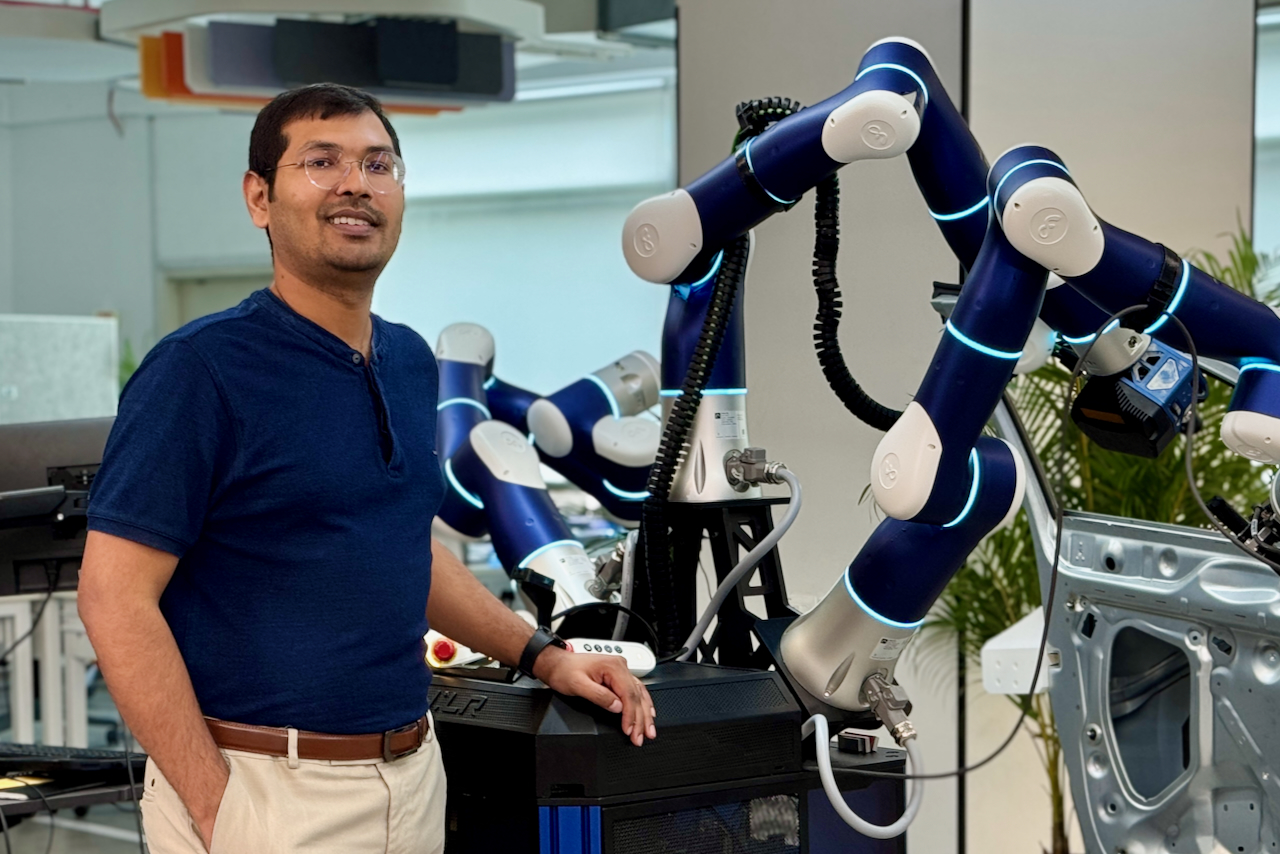
    In today’s episode, we dive into the future of robotics with Gokul NA, founder of CynLr, or Cybernetics Laboratory, perhaps one of India’s most advanced companies in this field.

    CynLr is headquartered in Bengaluru, with an advanced R&D Lab in Switzerland and a growing customer-facing operation in the US, where Gokul’s fellow founder Nikhil Ramaswamy is based.

    The entrepreneur duo and its 85-member team are tackling a challenge that scientists and engineers have been working on for several decades: the ability for robots to intuitively handle unfamiliar objects without custom programming or prior training.

    In this conversation, Gokul explains their new “Object Intelligence Stack,” a system designed to imitate some of the functions related how a human brain might learn — much like a baby impulsively grasping a new toy without knowing its name or purpose.

    By collaborating with the Centre for Neuroscience at the Indian Institute of Science, CynLr is translating brain-function research into a sophisticated software and sensor framework. Shifting the focus from algorithms that work on data to the “physics of objects,” CynLr’s intelligence stack is what Gokul describes as the precursor to a “manipulation OS.”

    Drawing parallels to Apple in the 1980s, Gokul shares his vision for a future of “object computers” and micro-factories – important components of CynLr’s vision for global manufacturing, where instead of Giga-factories, we might have fabrication facilities as small as a car dealership or even a garage.


    Chapters

    (00:00) Challenges of building a deep tech organization in an absent industry

    (05:58) Imitating the human brain’s ability to handle unfamiliar objects

    (09:18) Partnering with neuroscience researchers to replicate human intuition

    (11:32) Developing a manipulation operating system and the future object store

    (19:47) Automating assembly for automotive and semiconductor manufacturing

    (25:17) Transitioning from rigid gigafactories to software-defined micro-factories

    (35:49) Fostering a deep tech ecosystem to address the brain drain

    (40:18) Strategic funding goals and the technical roadmap for scaling


    Gokul and Nikhil are backed by investors including Speciale Invest, growX ventures, Pavestone VC, Athera Venture Partners (formerly Inventus India), Anicut Capital, Arali Ventures, Redstart Labs, and several other institutional and angel investors.

    CynLr’s long-term vision also involves creating a manipulation operating system and an “object store” and a “task store” to transform flexible manufacturing, just as the App Store transformed the smartphone.

    Currently, they are deploying these solutions in the automotive and semiconductor industries to automate some complex manual assembly processes.

    In this conversation, Gokul also talks about some of the challenges of building a company like CynLr in India, where many important ingredients are missing, and what he thinks the industry can do to change that.

  • Gokul NA at CynLr on a ‘manipulation OS’ for robots

    Gokul NA at CynLr on a ‘manipulation OS’ for robots

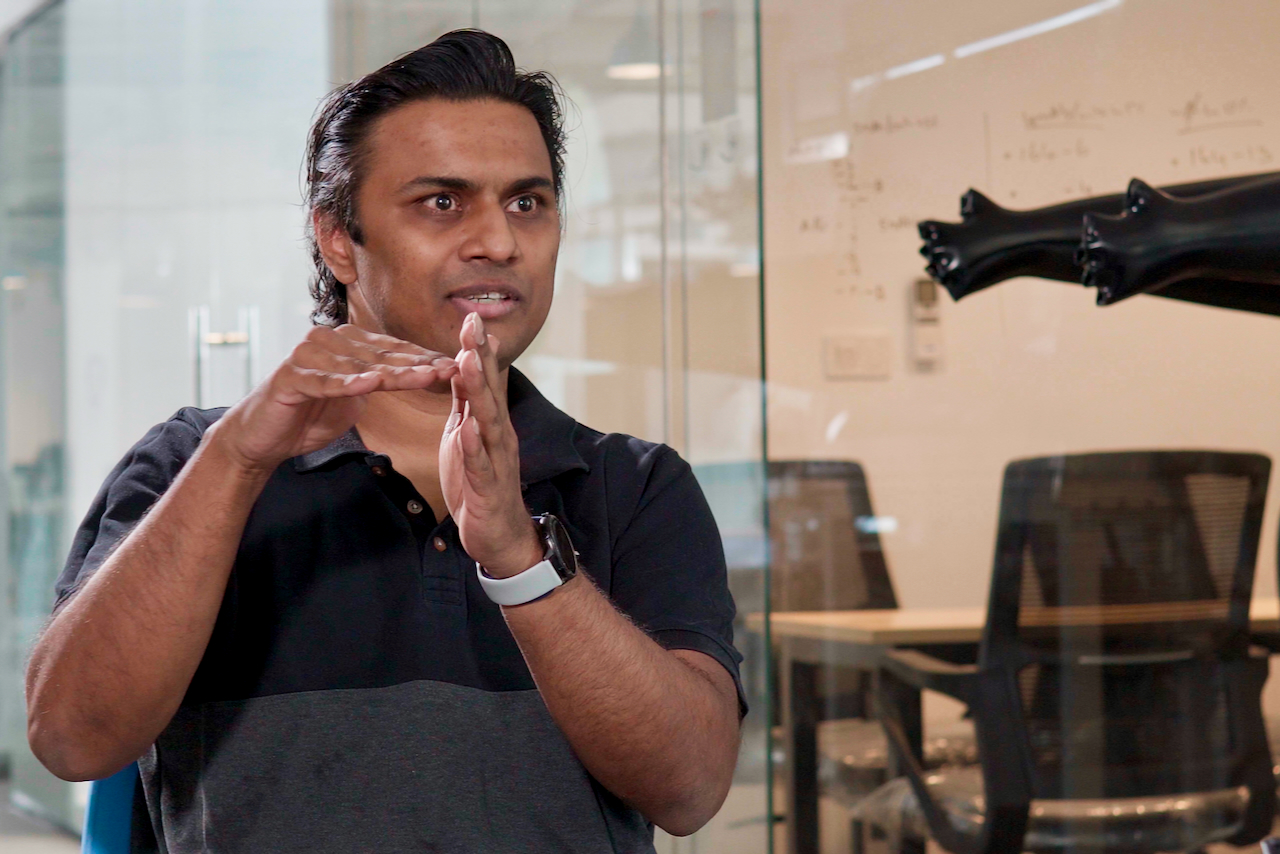
    Coming up, a conversation with Gokul NA, founder and head of product, design & brand at CynLr (Cybernetics Laboratories), a robotics startup in Bengaluru.

    Gokul, his fellow founder Nikhil Ramaswamy, and their team at CynLr, have recently released what he described as an Object Intelligence Stack. The technology aims to mimic the curiosity and adaptability of a human infant, allowing robots to manipulate unfamiliar items without specific prior training.

    By collaborating with the Centre for Neuroscience at the Indian Institute of Science, CynLr is translating brain-function research into a sophisticated software and sensor framework. Their long-term vision involves creating a manipulation operating system and an “object store” and a “task store” to transform flexible manufacturing, just as the App Store transformed the smartphone.

    Currently, they are deploying these solutions in the automotive and semiconductor industries to automate some complex manual assembly processes. You can catch the full conversation on Friday, March 6 right here or wherever you get your podcasts.

    Here’s a one-minute preview with Gokul envisioning a future “manipulation OS” for robots of which the object intelligence stack is the precursor.

  • Gokul NA at CynLr on bringing ‘object intelligence’ to robots

    Gokul NA at CynLr on bringing ‘object intelligence’ to robots

    Coming up, a conversation with Gokul NA, founder and head of product, design & brand at CynLr (Cybernetics Laboratory), a robotics startup in Bengaluru.

    Gokul, his fellow founder Nikhil Ramaswamy, and their team at CynLr, have recently released what he described as an Object Intelligence Stack. The technology aims to mimic the curiosity and adaptability of a human infant, allowing robots to manipulate unfamiliar items without specific prior training.

    By collaborating with the Centre for Neuroscience at the Indian Institute of Science, CynLr is translating brain-function research into a sophisticated software and sensor framework. Their long-term vision involves creating a manipulation operating system and an “object store” and a “task store” to transform flexible manufacturing, just as the App Store transformed the smartphone.

    Currently, they are deploying these solutions in the automotive and semiconductor industries to automate some complex manual assembly processes. You can catch the full conversation on Friday, March 6 right here or wherever you get your podcasts.

    Here’s a 90-second preview with Gokul giving a brief description of the object intelligence stack.

  • The ‘knowhow challenge’ — Apoorv Shaligram, founder of e-TRNL

    The ‘knowhow challenge’ — Apoorv Shaligram, founder of e-TRNL

    There are challenges beyond importing sophisticated components that India’s deep tech startups can’t yet source locally. Some of these challenges are equally or more fundamental.

    I had a chance to get some insights on this from Apoorv Shaligram, founder and CEO at e-TRNL Energy, recently.
    Apoorv, his fellow founder Uttam Sen, and their team are innovating new cell architectures to make cells, batteries and their applications safer, more reliable and better alternatives to fossil fuel.

    They are backed by well-known investors including Speciale Invest, Micelio, Navam Capital, Indian Angel Network, and Anicut.
    Check out the related video for the full conversation with Apoorv. Here’s a one-minute view on how the real science and engineering knowhow underlying the products that many Indian deep tech startups are developing has to be acquired ground up.

  • EVs and beyond: Apoorv Shaligram on barriers to adoption

    EVs and beyond: Apoorv Shaligram on barriers to adoption

    Barriers to not just EV adoption, but beyond, in terms of widespread use of larger electric batteries the same way we’ve adopted smartphones, for example. What factors are holding adoption back?
    Apoorv Shaligram, founder and CEO at e-TRNL Energy in Bengaluru, offers a quick point here. He identifies convenience and safety as the primary limiters for electric battery tech adoption in India.
    Check out the related post for the full conversation with Apoorv, who with his fellow founder Uttam Sen and their team, is innovating new cell architectures to make cells, batteries and their applications safer, more reliable and better alternatives to fossil fuel.

  • Apoorv Shaligram on e-TRNL Energy’s efforts to innovate better cell architectures

    Apoorv Shaligram on e-TRNL Energy’s efforts to innovate better cell architectures

    In this episode I’m joined by Apoorv Shaligram, founder and CEO of e-TRNL Energy. Apoorv, and his fellow founder Uttam Sen, IIT Bombay alumni both, and their team are tackling the electric vehicle industry’s most critical “wants”: high levels of safety and fast charging.

    While battery chemistry has attracted a lot of innovation effort, e-TRNL is focusing on the cell architecture instead. Their core innovation, 3D Electrode Architecture (3DEA), moves away from the traditional 2D thin-layered designs found in everything from smartphones to current EVs.

    By fundamentally changing how current flows inside the cell, 3DEA reduces resistance and heat at the source, Apoorv explains. This makes batteries “super resilient” to thermal waste – the excess heat generated within a battery cell during its operation, primarily caused by internal resistance – preventing the catastrophic “cascading” fires in some EV batteries.

    Beyond safety, this architecture unlocks the capability for 15-minute fast charging and longer-lasting, lighter battery packs, he says.

    Apoorv also explains how they have verticalized their technology stack, putting together manufacturing processes from the ground up: They have also condensed the conventional 24-step manufacturing process into a precise 8-step operation. And the entrepreneurs envision modular, container-sized factories that reduce energy consumption and that are better suited to markets that lack large-scale adoption.

    In this episode, Apoorv also talks about how India’s deep tech landscape is changing, with the government catalysing the discourse in the country. And we takeaway some lessons from e-TRNL’s recent Rs. 27.4 crore seed round, and the roadmap to hit full-scale manufacturing.