
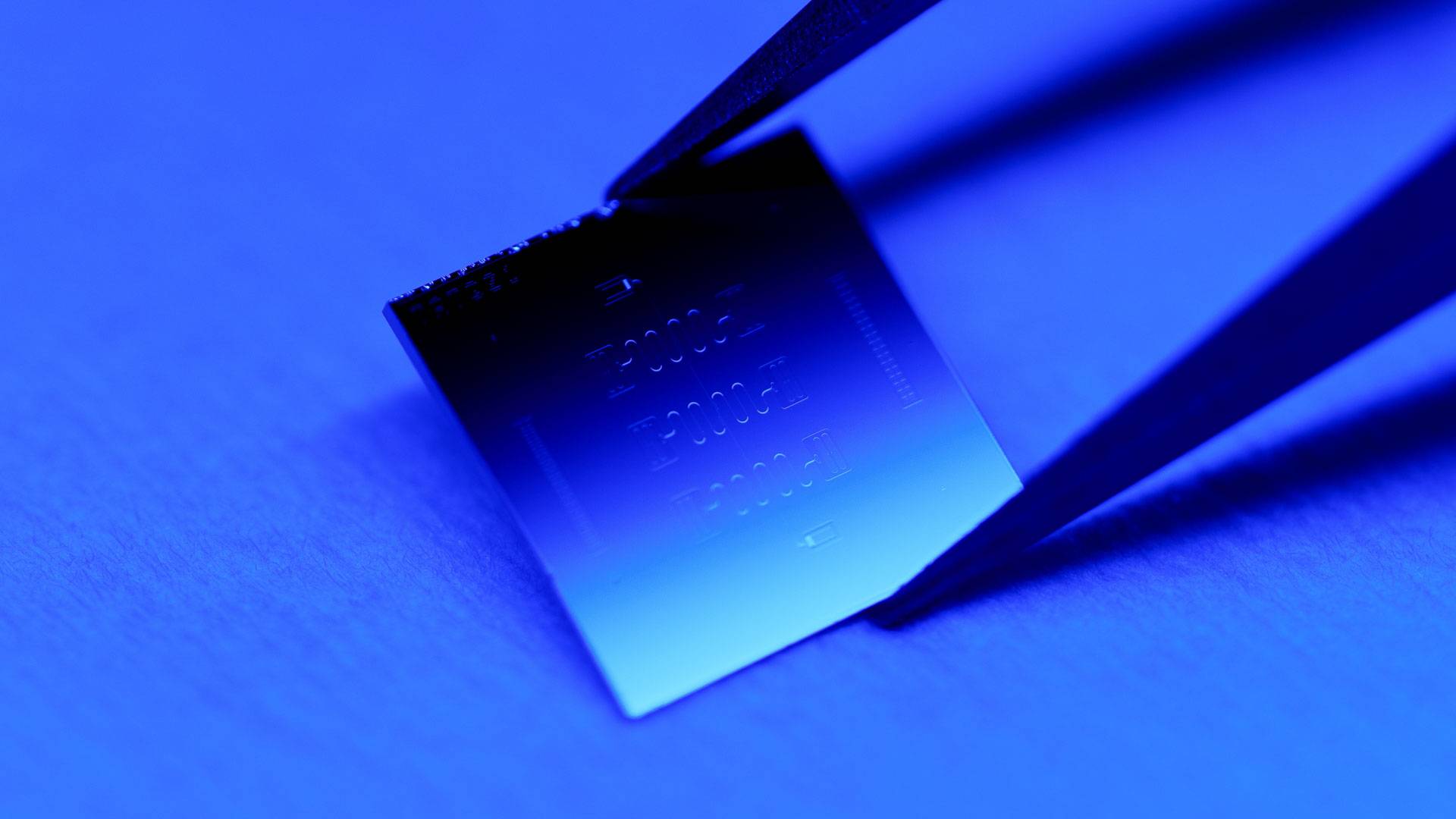

Image by Matthew Raspanti, Office of Communications, Princeton University.
(00:21) Princeton’s qubit breakthrough extends coherence threefold
Princeton University researchers have demonstrated a quantum qubit with coherence times exceeding one millisecond — triple the laboratory record and fifteen times the industry standard, Science Daily reports. The team built a functioning quantum chip proving the design supports error correction at scale, addressing the fundamental challenge limiting quantum processors.
Their architecture is compatible with systems used by Google and IBM. According to analysis, replacing key components in Google’s Willow processor with Princeton’s approach could yield a thousandfold performance increase, signalling meaningful progress toward fault-tolerant quantum systems essential for practical applications.
(01:10) Google quantum AI achieves 13,000× speedup on physics
Separately, some of you may recall that last month Google announced that its Willow quantum processor executed a physics simulation 13,000 times faster than classical supercomputers using a novel “Quantum Echoes” algorithm published in Nature. The breakthrough demonstrates the first verifiable quantum advantage running a physically meaningful algorithm — measuring quantum interference effects called out-of-time-order correlators.
Beyond raw speed, the work establishes quantum computing’s practical relevance to experimental science, particularly nuclear magnetic resonance spectroscopy, validating a path toward real-world quantum applications within five years.
(01:54) Sentinel-6B launches to continue climate monitoring mission
The European Space Agency and NASA successfully launched Copernicus Sentinel-6B aboard a SpaceX Falcon 9 rocket on Nov. 17, continuing a decades-long mission tracking sea-level rise — a critical indicator of climate change, Spaceflight Now reports.
The satellite carries advanced altimetry instruments measuring ocean surface heights with centimetre precision, directly supporting climate science and international efforts to understand planetary warming. This mission exemplifies the growing convergence of space infrastructure and environmental monitoring, with satellite data becoming indispensable for climate policy and adaptation planning worldwide.
(02:43) Emulate launches organ-on-chip platform for drug development
Emulate, a leader in organ-on-chip technology, unveiled its Brain-Chip R1 in partnership with FUJIFILM Cellular Dynamics to accelerate neurological drug discovery, the company said in a press release. The platform uses living human brain cells to model central nervous system responses, addressing a critical gap in preclinical testing where traditional methods fail to predict clinical outcomes.
This technology promises faster, more reliable validation of neurological therapeutics while reducing dependence on animal testing—positioning Emulate at the intersection of biotechnology and advanced manufacturing innovation.
(03:27) Cornerstone Robotics raises $200 million for surgical robot platform
Hong Kong’s Cornerstone Robotics secured $200 million in fresh funding to accelerate global commercialization of its multi arm Sentire Endoscopic Surgical System, Fierce Biotech reports.
Recently approved in China and now in UK clinical trials, the platform targets colorectal and urologic surgeries. The round, backed by major global funds, affirms demand for accessible next-gen surgical robotics as the company deepens its global footprint.
Leave a Reply