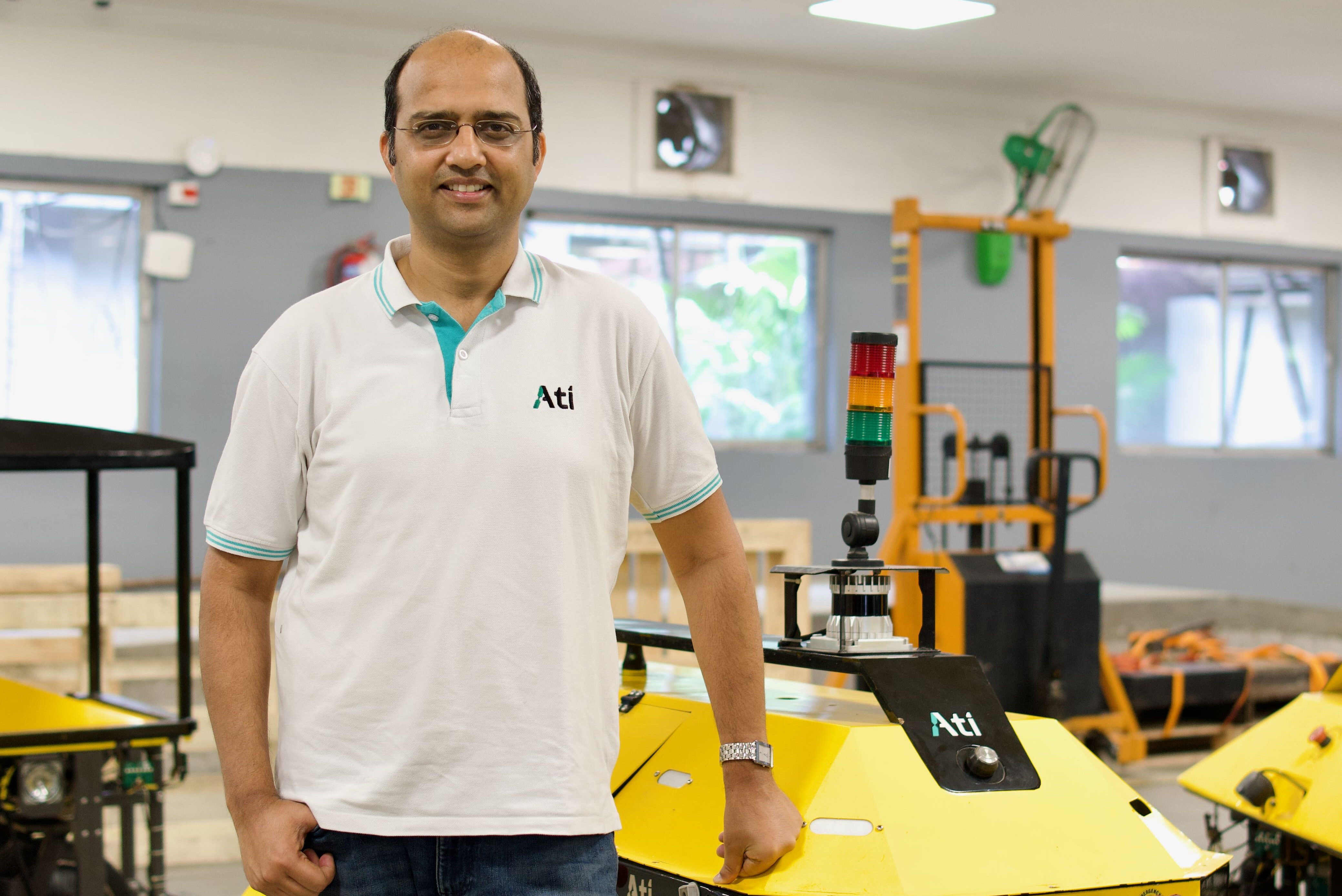
My guest today is Saurabh Chandra, co-founder and CEO of Ati Motors, an autonomous mobile robots (AMRs) venture in Bengaluru. In this conversation, Saurabh talks about how the robots are coming – changing the industrial manufacturing landscape forever.
He talks about Ati’s own family of robots, named Sherpa, some early engineering decisions that have stood the company in good stead, and how Ati can go from shipping hundreds of robots to thousands, and more. We also briefly touched upon lessons from building a deep tech robotics company out of India.
Under Chandra’s leadership, Ati Motors has become a pioneer in developing AMRs for material movement in factories and warehouses. Unlike traditional automated guided vehicles (AGVs), Ati’s Sherpa robots are engineered to perform in the most challenging industrial environments — handling gradients, potholes, clutter, and even outdoor conditions.
This is made possible by a full-stack, first-principles approach and the use of advanced 3D LiDAR-based navigation, which allows Sherpa robots, today best known for their tugging capabilities, to operate without any external markers, reflectors, or teleoperation. All autonomy is processed onboard, ensuring robust performance even in environments with unreliable connectivity.
Ati’s current portfolio of AMRs include the Sherpa Tug, Sherpa Lifter, Sherpa Pallet Mover, and Sherpa Pivot. The company has some 50 customers in India, Southeast Asia and North America, Chandra says, including names such as Forvia and Hyundai.
On building AMRs out of India, Chandra credits Bengaluru’s multidisciplinary talent pool and thriving manufacturing ecosystem as important advantages that support innovation. The day isn’t that far away when, in factories and warehouses and other such complexes, “whatever moves is going to be autonomous,” he says.
Bhaktha Ram Keshavachar, founder and CEO of Chara Technologies in Bengaluru, is leading an effort to develop motors that don’t need the conventional permanent magnets, whose make up includes rare-Earth metals, the processing of which is almost entirely controlled by China. The mining and processing of these minerals also has an environmental impact.
Bhaktha and his fellow founders Ravi Prasad and Mahalingam Koushik, bring decades of industry expertise to their venture. Founded in 2019, Chara has engineered what are called reluctance motors. Unlike the traditional motors, reluctance motors don’t have permanent the magnets that need rare Earth minerals such as neodymium or samarium. Magnetic fields are instead created by the electric current in the windings around the stationary part (stator) of these motors.
In my recent conversation with him, Bhaktha discusses Chara’s technical pivots, manufacturing milestones, industry partnerships, and the challenges of deep tech entrepreneurship in India. He also shares insights on talent development, the evolving ecosystem, and Chara’s plans for global expansion. Here are my top six takeaways.
Rare earth-free motor technology addresses a critical global supply chain risk
Most high-efficiency electric motors today rely on rare earth magnets, which are expensive, environmentally damaging to extract, and subject to geopolitical risk — especially as China controls over 90 percent of the global supply chain. Chara’s technology, based on reluctance motors, eliminates the need for rare earths, offering a strategic solution to this problem.
Product-market fit is emerging fastest in off-highway and industrial applications
While Chara initially targeted India’s large two-wheeler and three-wheeler market, Bhaktha notes that the most immediate traction has come from off-highway uses such as agricultural equipment, golf carts, turf care machines, and compressors. These sectors value Chara’s high-efficiency, rare earth-free motors and have helped the company build early credibility.
Strategic partnerships and manufacturing scale are key to customer confidence
A major milestone for Chara is its partnership with Greaves Cotton, which will manufacture and distribute Chara’s motors under license. Bhaktha explains that large customers are wary of “startup risk” and prefer established suppliers; this partnership provides the scale and distribution needed to win bigger deals and accelerate adoption.
Chara’s deep R&D helped the startup develop a market-ready product
The company’s early years involved a challenging pivot from switched reluctance motors, which proved too noisy, to synchronous reluctance motors. Chara invested heavily in core R&D, especially in software algorithms to control non-linear motor behavior, resulting in a certified, field-deployed product that matches the performance of traditional motors.
Building a deep tech team in India requires nurturing core engineering talent
Bhaktha notes a shortage of experienced engineers in electromagnetics and mechanical domains, as most graduates prefer software careers. Chara addresses this by hiring young engineers with some experience and training them further in the requisite foundational physics and engineering, which is essential for their multidisciplinary innovation.
Chara’s next phase is focused on scaling sales and global expansion
With technical challenges largely solved and products certified, Bhaktha says Chara’s top priority is now sales and deployment — both in India and internationally. The company is targeting new product development for larger vehicles and is actively pursuing business in Europe and the US, tapping global interest in rare earth alternatives and recent geopolitical shifts.
My guest today is Bhaktha Ram Keshavachar, founder and CEO of Chara Technologies, in Bengaluru. Chara is at the forefront of a technological shift that could reshape for the better India’s electric mobility landscape, and potentially make an impact overseas as well.
The mission is both urgent and ambitious: to build high-performance electric motors that are free of rare earth magnets — a critical component in most electric vehicles and industrial machines today.
Bhaktha and his fellow founders Ravi Prasad, the chief motor designer, and Mahalingam Koushik, the CTO at Chara, are engineering veterans from industry, each one bringing decades of experience to their entrepreneurial journey.
It started in late 2019, just as the world was heading into the uncertainty of the Covid pandemic. Recognizing the strategic risks posed by global dependence on rare earth minerals — with China controlling about 90 percent of the global refining and processing — and also the environmental impact, he and his team set out to engineer an alternative.
The result is a new generation of reluctance motors, designed and manufactured in India, that match or surpass the efficiency of traditional permanent-magnet motors, while sidestepping the environmental and geopolitical pitfalls of rare earth mining.
L-R: Ravi Prasad, chief motor designer, Mahalingam Koushik, CTO, and Bhaktha Keshavachar, CEO at Chara Technologies are building a new generation of made-in-India reluctance motors
In this conversation, Bhaktha shares the technical and business challenges Chara has overcome — from early R&D pivots and tackling the challenge of torque ripple in reluctance motors, to building a pilot production facility and securing industry partnerships, including a manufacturing and distribution alliance with Greaves Cotton.
He discusses the hurdles of deep tech entrepreneurship in India, the evolving talent landscape, and Chara’s plan to take its products global.
Whether you’re a founder, investor, engineer, or simply curious about the future of cleaner technology, this episode offers an example of how Indian deep tech innovation is rising to meet one of the challenges of our era: building a sustainable, secure, and scalable electric future — one motor at a time.
Early-stage VC firms partnering universities to identify and back promising deep-tech startups is a well-established practice in the US. What lessons does that hold for India’s nascent deep tech sector? Recently, I spoke about this with Karthee Madasamy, founding managing partner at MFV Partners in the US. MFV has just established a new fund – Harper Court Ventures Fund I – dedicated to supporting pre-seed deep science startups coming out of University of Chicago.
Here are five important takeaways from our conversation.
Smart funding is crucial for early-stage deep tech startups
Harper Court Ventures was created to fill a critical gap in the University of Chicago’s ecosystem: the need for “smart funding” at the pre-seed stage. This means providing not just capital, but also hands-on support—helping founders build teams, set milestones, and connect with syndicate partners. Such proactive involvement is especially vital for deep tech startups, where technical risk and commercialisation challenges are high.
2. University research is a powerful driver of tech ecosystems
The fund’s model is inspired by the historic role of US universities in powering innovation hubs like Silicon Valley. By translating academic research into startups, universities can become engines of economic growth. Harper Court Ventures aims to unlock this potential within the Chicago ecosystem, focusing on areas where the university has world-leading expertise, such as quantum engineering and health sciences.
3. Sector focus leverages university strengths and national assets
The fund targets four strategic sectors — quantum engineering, energy, life sciences, and data science — where the University of Chicago and its partnerships with famous labs such as Argonne National Laboratory and Fermilab (Fermi National Accelerator Laboratory) have unique capabilities. This focused approach enables deeper support and de-risks investments, a lesson for India to align deep tech funding with institutional and national strengths.
4. A locally relevant partnership holds the key to success
Harper Court Ventures is an independent fund with a formal cooperation agreement to invest exclusively in University of Chicago deep tech startups. This structure ensures a strong pipeline of investable companies and aligns the incentives of the university, the fund, and the founders. In India, Karthee sees promise in a different model. A fund that can be drawn upon by multiple top universities such as the IITs and BITS might be a better model for India, he says.
5. India’s deep tech ecosystem is growing, but structural gaps remain
While India is seeing more deep tech activity, including government focus and new funds, the pipeline of university spinouts and formal VC-university partnerships is still limited. Karthee notes that incentives, infrastructure, and mindset in Indian academia are improving, but a dedicated, large-scale approach — possibly spanning multiple top institutes — is needed for this sector to really flourish in India.
My guest today is Karthee Madasamy, founding managing partner at MFV Partners, a US-based early-stage deep-tech focused VC firm.
In this episode, Karthee gives us a quick overview of MFV’s $25 million Harper Court Ventures Fund 1 – a specialized vehicle bridging academic research and commercial viability for the deep tech startups coming out of University of Chicago.
He talks about how the fund addresses critical gaps in early-stage ecosystems through “smart funding,” meaning combining capital with hands-on operational support, to translate lab breakthroughs into viable companies.
The model focuses on high-impact sectors where UChicago holds world-class capabilities, including quantum computing, life sciences, energy, and artificial intelligence. Unlike traditional VC, the fund embeds itself in the university’s innovation pipeline – collaborating with accelerators, tapping extensive alumni networks, and guiding startups from IP validation to Series A readiness.
Early bets include Flow Medical, which is developing a next-generation catheter-based therapy to treat acute pulmonary embolism,
SimCare AI, which is developing a platform for clinical skills training and evaluation, and Beacon, which is developing technology that eliminates viruses, bacteria, and molds from air and surfaces.
Karthee also briefly discusses potential takeaways and best practices from partnerships such as the Harper Court fund, which are not new in the US, for India’s emerging deep tech ecosystem. MFV’s investments in India include Ati Motors, an autonomous mobile robots company in Bengaluru, and EV energy infrastructure company Sun Mobility.
On World Environment Day, my guest on India Tech Report: In Conversation was Vishal Kataria, a member of the investment team at Ankur Capital, and co-author of the Mumbai-based early-stage VC firm’s recent climate tech report titled Transforming India’s Core Sectors.
Here are my top 10 takeaways from that conversation.
1. Climate tech investment remains robust in India
Despite a broader slowdown in venture capital, climate tech investments in India have consistently exceeded $1 billion annually over the past three or four years. This resilience highlights the sector’s growing maturity and the increasing recognition that climate solutions are not just about emissions reduction but also about long-term economic competitiveness.
2. Disproportionate investment across sectors
There is a notable mismatch between sectors’ emissions contributions and the investments they attract. For instance, transportation receives nearly half of all climate tech venture funding, despite contributing only 10–15 percent of emissions. This is largely because electric mobility offers immediate economic benefits, such as lower total cost of ownership, making it attractive for investors.
Only about 4 percent of climate investments in India have gone into industrial decarbonization, even though industry accounts for roughly a quarter of emissions. High abatement costs (typically, $ cost per metric tonne of CO2 equivalent reduced or eliminated) and the need for deep technological innovation — especially in sectors like cement and steel — have limited investor interest. Significant R&D breakthroughs are required to make these solutions cost-effective and scalable.
4. Deep tech and climate tech are intertwined
Many impactful climate interventions require deep science and hardware innovation, not just software. However, scaling such solutions is capital-intensive, and India’s funding ecosystem is still developing the depth needed to support late-stage growth for these ventures. The landscape is changing, with more researchers focusing on commercialization and entrepreneurship.
5. India’s unique strength in carbon removal
India is emerging as a global leader in natural carbon removal technologies such as enhanced rock weathering and biochar. These solutions leverage India’s abundant volcanic rock and agricultural waste, offering scalable, scientifically validated methods for permanent carbon sequestration. Startups in this space are gaining international recognition and funding.
6. Renewable energy deployment is accelerating
India’s rapid adoption of solar and wind energy has been a standout success, with ambitious targets set for 2030. However, as renewables become a larger share of the grid, challenges around storage and grid management will require next-generation technologies, such as long-duration batteries and decentralized energy resources.
7. Platform technologies drive energy transition
Startups such as Vimano, an Ankur portfolio venture, are developing core technology platforms — such as advanced ion-conductive membranes — that can serve multiple applications across energy storage, hydrogen production, and industrial processes. These platforms are critical for enabling the next wave of energy transition solutions and are attractive for their scalability and versatility.
8. Diversity and maturity in climate tech investments
Investment is becoming less concentrated, with significant funding now flowing into a range of sectors, including food and agriculture, energy, and carbon management. This diversification signals a maturing ecosystem where both early-stage and growth-stage companies are scaling up across various climate verticals.
9. Context-specific solutions for food and agriculture
India’s climate tech innovation in food and agriculture must be tailored to local conditions, such as smallholder farms and unique supply chain challenges. While global trends like autonomous farming are promising, Indian solutions will likely differ in approach, focusing on cost-effectiveness and adaptability to fragmented landholdings.
10. Future priorities: advanced materials and earth intelligence
Looking ahead, areas that Ankur Capital sees as promising include advanced materials (e.g., graphene, ceramics, new construction materials) and Earth and climate intelligence (including satellite-based data and AI-driven analytics). These areas are expected to underpin breakthroughs in energy, industry, and sustainable agriculture over the next few years.