Tag: artificial-intelligence

  • India’s AI data centre landscape expands: OpenAI’s giga plant, RIL’s deep tech unit

    India’s AI data centre landscape expands: OpenAI’s giga plant, RIL’s deep tech unit

    Daily brief on deep tech and climate tech news from Indian and around the world.

    Illustrative image. OpenAI and Indian conglomerate Reliance are planning large AI data centres in the country – investments that could boost AI compute availability for many.

    OpenAI to build multi-gigawatt AI data center in India, expanding local footprint

    OpenAI is planning to set up a major data center in India with at least 1 gigawatt capacity, supported by local partnerships and backed by Microsoft, Reuters reports. The company has registered as a legal entity in India, established a local team, and will open its first office in New Delhi this year to strengthen its presence in its second-largest market. The project marks a significant move for OpenAI’s Stargate-branded AI infrastructure expansion in Asia, with further details likely during CEO Sam Altman’s September visit.

    Listen to the podcast

    Reliance launches AI subsidiary to power India’s deep tech future

    Reliance Industries has launched a wholly owned subsidiary, Reliance Intelligence, to advance India’s AI capabilities and make the country a global hub for deep tech, The Hindu reports. The new company will focus on gigawatt-scale, green energy-powered AI data centers, forge global tech partnerships, build wide-reaching AI services for major sectors, and nurture talent. Strategic alliances with Google and Meta will enable scalable, affordable AI solutions for Indian consumers and businesses.

    Lizy raises €75m to scale circular EV leasing for European firms

    Lizy, a Brussels-based car leasing company, raised €75 million to expand its circular electric vehicle leasing model across Europe, Tech Funding News reports. By championing used EV leasing, Lizy offers small businesses affordable, sustainable mobility solutions, unlike the traditional “one and done” car contracts. The investment, combining capital and debt, will allow Lizy to scale up and accelerate the transition to electric fleets for companies, enhancing both environmental impact and growth.

    Runway targets robotics sector with AI-powered training simulations

    Runway, known for its video-generating AI, is expanding into robotics by leveraging its world models for training simulations, making robot and self-driving car development faster and more cost-effective, TechCrunch reports. Companies can use its models to test specific scenarios and actions in a virtual environment, improving scalability and precision over real-world tests. Runway will fine-tune its existing models for industry needs, backed by over $500 million in funding.

    Gene variant pairs act as switches to unlock hidden disease pathways

    Researchers at IIT Madras and Denmark found that interactions between specific genetic variants can act as “switches” to unlock hidden metabolic pathways, increasing understanding of complex diseases, according to a post on the institute’s website. Their yeast study, using multi-omics and time-based analysis, showed certain variant pairs rewire cellular networks and activate previously silent functions. This approach could guide new personalized therapies, biomarkers, and drug targets for conditions such as cancer, diabetes, and neurodegeneration.

    Styrofoam upcycling enables safe, efficient hydrogen storage solution

    UNIST-led researchers developed a process to convert waste Styrofoam into a safe, reusable hydrogen storage medium using liquid organic hydrogen carriers (LOHCs), Tech Xplore reports. The method utilizes polystyrene’s aromatic structure for hydrogen storage and retrieval, with ruthenium and platinum catalysts enabling efficient absorption and release. Innovations include improved catalyst durability and the use of waste heat, solving both hydrogen storage and plastic recycling challenges for future industrial adoption.

    Norma validates quantum AI algorithms on NVIDIA GPUs for scalable use

    Norma has completed validation of its quantum AI algorithms on NVIDIA hardware, demonstrating robust performance and compatibility for high-impact applications, Quantum Insider reports. This achievement marks a significant milestone in bridging quantum computing with advanced AI, enabling scalable solutions in areas like optimization and materials science. The testing confirms that Norma’s quantum AI stack integrates smoothly with industry-standard GPUs, paving the way for commercial deployments and future research.

    6G wireless promises ultra-fast, AI-powered connectivity for advanced applications

    6G wireless technology will offer ultra-high data rates, near-zero latency, and large-scale connectivity, integrating sensing and AI-driven operations for advanced applications beyond traditional communication, IEEE Spectrum reports. It will support scenarios requiring precise positioning, critical low-latency vehicular communications, and highly adaptive resource management in dense, heterogeneous environments. Innovations like terahertz spectrum, smart antennas, full duplex, and meta-surfaces are key features, making 6G transformative for industries and society.


    In Conversation

    Insight

    Spotlight

  • Autonomous mobile robots: Saurabh Chandra at Ati Motors on the future of manufacturing

    Autonomous mobile robots: Saurabh Chandra at Ati Motors on the future of manufacturing

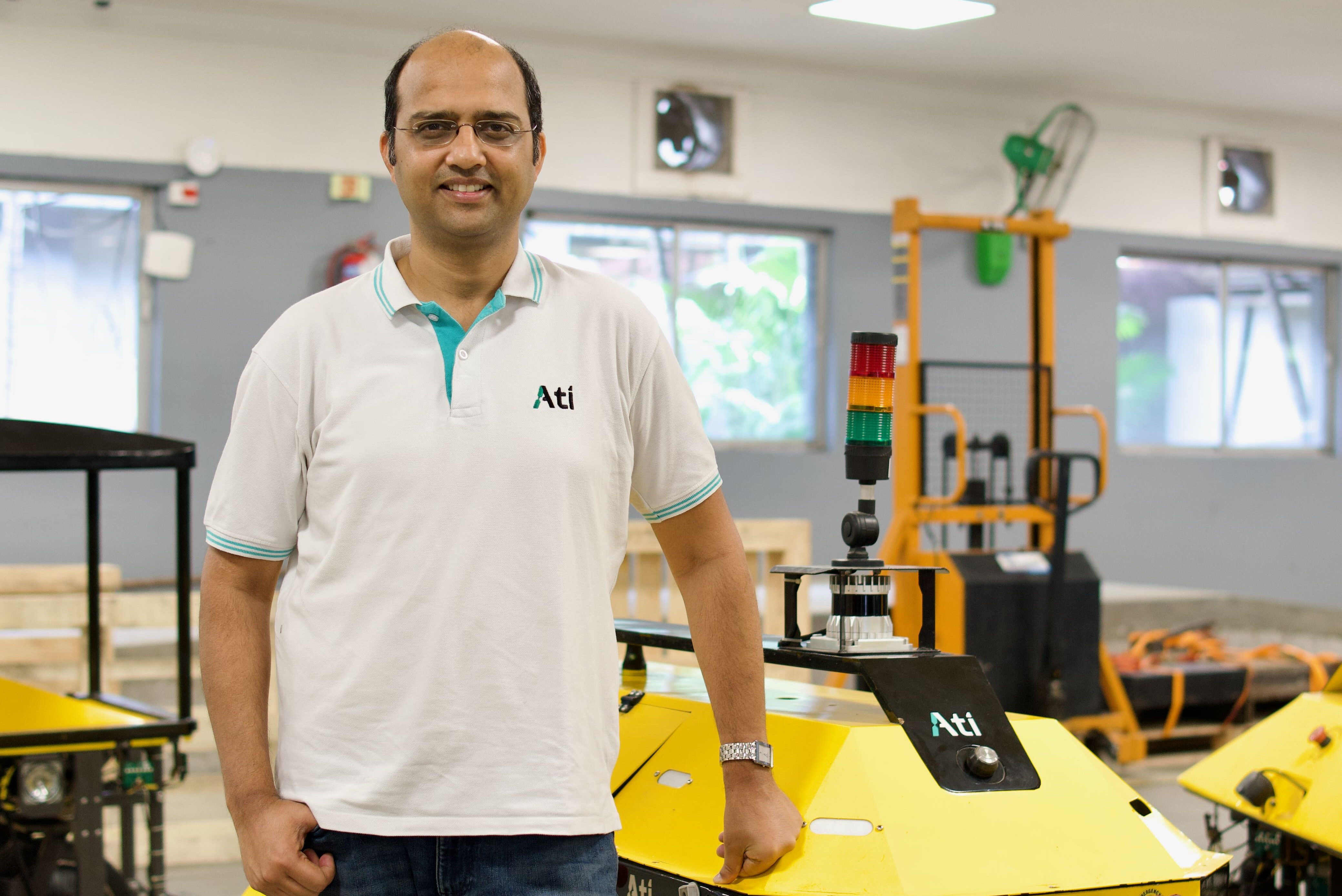
    My guest today is Saurabh Chandra, co-founder and CEO of Ati Motors, an autonomous mobile robots (AMRs) venture in Bengaluru. In this conversation, Saurabh talks about how the robots are coming – changing the industrial manufacturing landscape forever.

    He talks about Ati’s own family of robots, named Sherpa, some early engineering decisions that have stood the company in good stead, and how Ati can go from shipping hundreds of robots to thousands, and more. We also briefly touched upon lessons from building a deep tech robotics company out of India.

    Under Chandra’s leadership, Ati Motors has become a pioneer in developing AMRs for material movement in factories and warehouses. Unlike traditional automated guided vehicles (AGVs), Ati’s Sherpa robots are engineered to perform in the most challenging industrial environments — handling gradients, potholes, clutter, and even outdoor conditions.

    This is made possible by a full-stack, first-principles approach and the use of advanced 3D LiDAR-based navigation, which allows Sherpa robots, today best known for their tugging capabilities, to operate without any external markers, reflectors, or teleoperation. All autonomy is processed onboard, ensuring robust performance even in environments with unreliable connectivity.

    Ati’s current portfolio of AMRs include the Sherpa Tug, Sherpa Lifter, Sherpa Pallet Mover, and Sherpa Pivot. The company has some 50 customers in India, Southeast Asia and North America, Chandra says, including names such as Forvia and Hyundai.

    On building AMRs out of India, Chandra credits Bengaluru’s multidisciplinary talent pool and thriving manufacturing ecosystem as important advantages that support innovation. The day isn’t that far away when, in factories and warehouses and other such complexes, “whatever moves is going to be autonomous,” he says.

  • TI’s $60 billion US plan, L&T’s second ESG bond, Embedl’s edge-AI tech, Neoclease’s gene-editing platform, and more

    TI’s $60 billion US plan, L&T’s second ESG bond, Embedl’s edge-AI tech, Neoclease’s gene-editing platform, and more

    Daily brief on deep tech and climate tech from India and around the world.

    Texas Instruments commits $60 billion to semiconductor expansion

    The investment will build seven fabs across Texas and Utah, boosting U.S. production of 300mm chips for companies like Apple and Nvidia. Supported by $1.6B in CHIPS Act funding, the project will create 60,000 jobs and manufacture hundreds of millions of chips daily. 

    Embedl secures €5.5 million to scale its edge AI platform

    The Swedish deep tech startup, spun out from Chalmers University, raised pre-Series A funding to make edge-AI deployment accessible for developers in robotics, defense, and automotive. Their platform optimizes AI inference for local hardware, reducing cloud dependency and energy use. Chalmers Ventures led the round, bringing total funding to €12 million.

    Listen to the podcast

    OrangeQS sets Dutch record with €12 million seed round

    The Delft-based quantum startup raised the largest seed investment in the Netherlands’ quantum sector to scale automated testing systems for quantum chips. Funding will accelerate the transition from lab prototypes to industrial quantum computers, leveraging deep academic expertise.

    Neoclease wins Merck’s biotech grant for its AI gene-editing tech

    The Boston startup won Merck’s 2025 North American Advance Biotech Grant for its AI-designed platform targeting Parkinson’s disease. The grant provides access to Merck’s manufacturing tech and regulatory support to scale therapies for 6,000+ genetic disorders.

    Fervo and Form Energy advance energy projects for AI

    Fervo is building the world’s largest geothermal plant in Utah to power data centers, while Form Energy raised $400 million to scale iron-air batteries. Both startups are fast-tracking deployments amid surging AI-driven energy demand, with Constellation Energy restarting nuclear plants for Microsoft.

    Typedef raises $5.5 million for AI data infrastructure

    The startup’s platform automates data pipeline management for LLM workloads, enabling faster AI deployment. Pear VC led the seed round to target the $200B AI infrastructure market, simplifying prompt experimentation and pipeline optimization for enterprises.

    L&T considers second ESG bond after strong demand for debut issue

    Indian infrastructure giant Larsen & Toubro is exploring a second round of ESG (environmental, social, and governance) bonds after its inaugural ₹500 crore ($58 million) issue sold at a premium under India’s new ESG debt framework. The three-year notes, rated AAA by Crisil, were priced at a 6.35 percent coupon—lower than comparable bonds—reflecting high demand from banks and mutual funds. SBI Mutual Fund was a key investor in the debut.


    In Conversation

    In-depth conversations with entrepreneurs, investors, industry leaders and other stakeholders building India’s deep tech and climate tech ecosystems.


  • India’s AI GPU capacity, Tata’s strategic investments, Wipro’s CTO on quantum technologies

    India’s AI GPU capacity, Tata’s strategic investments, Wipro’s CTO on quantum technologies

    India’s AI GPU capacity hits 34,000 units

    India’s national compute capacity has surpassed 34,000 GPUs, significantly boosting the IndiaAI Mission’s efforts to strengthen indigenous AI capabilities, the union government’s ministry of electronics IT said in a statement on Friday last.

    At the ‘IndiaAI – Make AI in India, Make AI work for India’ event, Union Minister Ashwini Vaishnaw announced the selection of three new startups to build India-specific Foundation Models, aiming for global leadership. The mission is also expanding AI datasets. Additionally, winners of the IndiaAI I4C CyberGuard AI Hackathon were recognized for developing AI solutions to enhance cybercrime complaint classification.

    Tata Sons $3.5 billion plan for strategic emerging businesses

    Tata Sons will inject Rs. 30,000 crore, or about $3.5 billion, into its emerging ventures—including Tata Digital, Tata Electronics, Air India, and its defence and battery units, to step up their next growth phase, Economic Times reports. This is on top of a $120 billion commitment in recent years, aims to help these businesses prioritize execution and achieve profitability by FY27. Tata Digital is soon expected to get a new CEO, according to ET.

    TCS, Google Cloud see opportunity in India’s sovereign cloud

    India’s drive for digital sovereignty is fueling rapid growth in sovereign cloud services, creating a multi-billion-dollar opportunity for both local and foreign tech giants. Tata Consultancy Services and Google Cloud are among those seeking an early lead in tapping this demand, with government agencies increasingly seeking to store sensitive data on domestic platforms, Mint reports.

    Wipro CTO: expect significant advances in quantum computing soon

    Quantum computing technologies will see significant advances in under a year, Sadhya Arun, chief technology officer at Wipro, told Economic Times in a recent interview. At Wipro, the Indian IT services company is advancing quantum computing through its Quantum Leap program, working with clients in sectors such as life sciences and supply chain to develop proof-of-concepts, according to ET.

    Worldwide, quantum computing commercialization is accelerating, with 2025 marking a pivotal year as industries begin adopting early-stage quantum solutions. The global quantum technology market is projected to reach $4.89 billion in 2029 from $1.88 billion in 2025, driven by advances in hardware, software, and cloud-based services, according to the State of the Global Quantum Industry Report, published by the Quantum Consortium.