Tag: deep-tech

  • EtherealX, Aule kick off 2026 space tech funding in India with ambitious targets

    EtherealX, Aule kick off 2026 space tech funding in India with ambitious targets

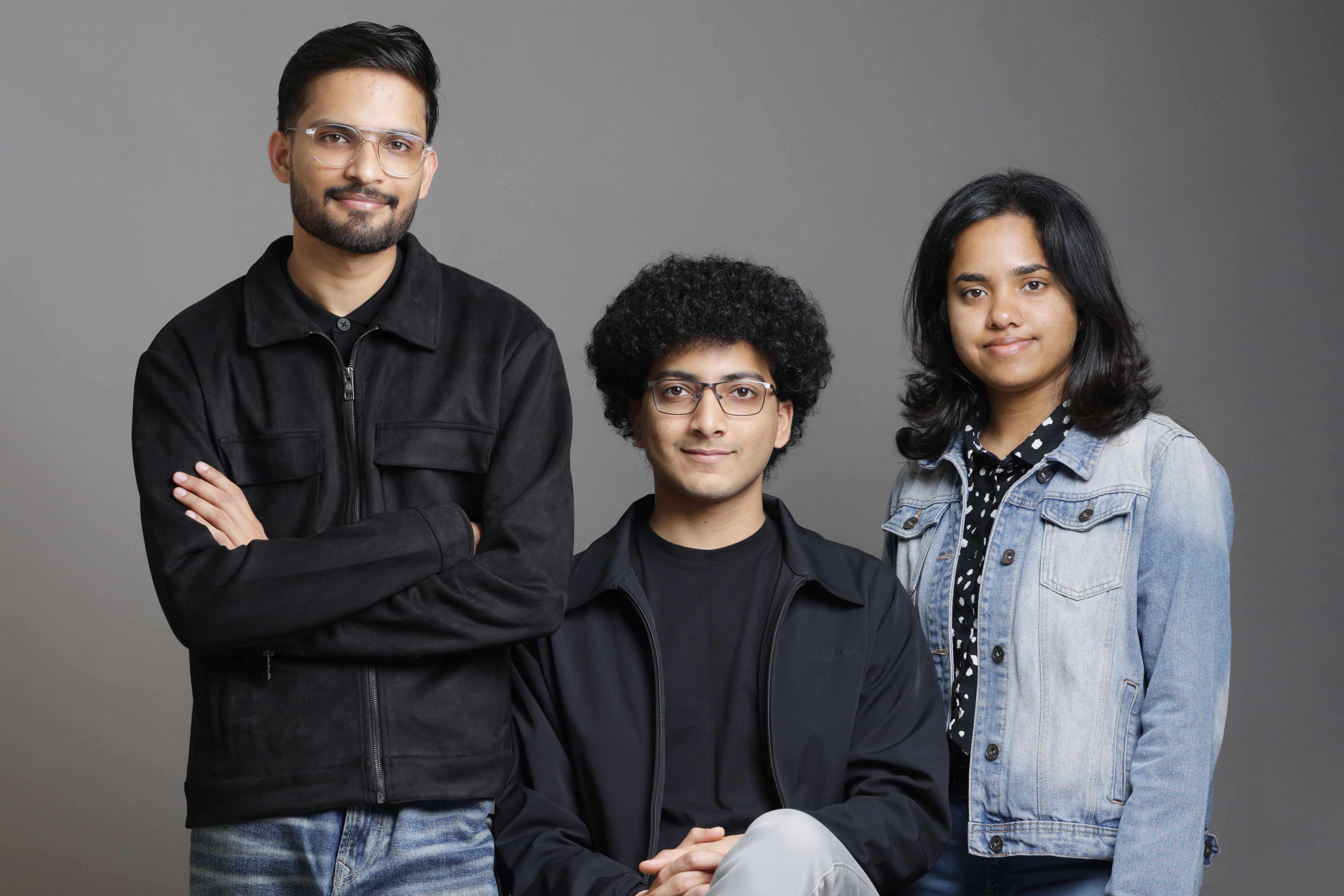
    Hrishit Tambi, Jay Panchal and Nithyaa Giri, founders of Aule Space Technologies, aim to put India in the club of nations offering ISAM technologies. Image source: Aule. Edited by Hari Arakali.
    Listen to the episode

    Two space-tech startups kicked off 2026’s funding news for the sector in India, aiming to expand India’s presence in the global space economy in two challenging areas. And they’ve both found backing from top-notch investors.

    Ethereal Exploration Guild (EtherealX) and Aule Space Technologies revealed a Series A and a pre-seed-stage investment respectively, in separate announcements, last week.

    EtherealX was founded by Manu J. Nair, Shubhayu Sardar, and Prashanth Sharma, who bring experience from ISRO and the International Institute for Astronautical Sciences to their endeavour.

    They have found backing from Japan’s TDK Ventures. The venture arm of TDK Corporation will invest up to $5 million in Bengaluru-based Ethereal Exploration’s series A round.

    The partnership aims to accelerate development of Razor Crest Mk-1 — the world’s first medium-lift rocket designed for full reusability, according to a press release. 

    EtherealX’s vehicle, still under development, targets launch costs as low as $500 per kilogram, roughly 10X lower than current rates, although the rates vary based on the type of rocket and other factors such as whether the mission is a small dedicated one or something part of large payload and so on.

    At its targeted $500-$1000 range, EtherealX hopes to unlock a wide range of commercial missions, including rocket cargo as a service. Its distinguishing feature is a reusable upper stage powered by a proprietary Full Flow Segregated Cooling Cycle engine, coupled with in-house simulation and test infrastructure to shorten development cycles and improve reusability. 

    The global space economy is entering a phase of billion-dollar bets and trillion-dollar visions. Valued at about $630 billion in 2023, it is expected to nearly triple to $1.8 trillion by 2035, according to a McKinsey estimate, fuelled by the proliferation of satellite constellations and expanding national space ambitions.

    Demand for medium-lift systems — rockets capable of carrying 2 ,000 kg to 20,000 kg of payload (to low-Earth orbits)* — is projected to grow strongly, with one forecast, by Research and Markets, estimating it grow from more than $10 billion in 2025 to nearly $16 billion by 2030, at a CAGR of about 8.5 percent. Startups from Austin to Bengaluru are racing to supply governments and private operators squeezed by bottlenecked launch capacity.

    Shubhayu Sardar, Prashanth Sharma and Manu J. Nair, founders of EtherealX, are developing a reusable medium-lift launch system. Image source: EtherealX. Edited by Hari Arakali.

    “TDK Ventures is thrilled to back the Guild in its goal to reshape the medium-lift space-launch industry,” Nicolas Sauvage, President of TDK Ventures, said in the press release. “The company aligns seamlessly with our vision for transformative innovation, excelling in slashing launch costs, pioneering novel technologies, and harnessing India’s ISRO expertise and cost-efficient supply chain.” 

    EtherealX’s existing investors include YourNest VC, Bluehill Capital, BIG Capital, Campus Fund, and Golden Sparrow VC. The company has already manufactured its 80kN upper-stage reusable engine (Pegasus) and has signed collaboration agreements with the Indian National Space Promotion and Authorization Centre (IN-SPACe), ISRO, and other national space agencies, as well as commercial satellite operators, launch aggregators, and launch ports globally.

    Aule’s orbital jetpacks

    Separately, Aule Space, also in Bengaluru, has raised pre-seed funding to build autonomous “jetpack” satellites that can dock with spacecraft that are running out of fuel and keep them going in orbit. The round totals $2 million, led by pi Ventures with participation from several angel investors, including former Intelsat board member Eash Sundaram and Tonbo Imaging chief executive Arvind Lakshmikumar. 

    Founded in 2024 by Jay Panchal, Nithyaa Giri and Hrishit Tambi, Aule Space is developing satellites that can safely approach, latch on to and manoeuvre other spacecraft, a class of capability known in the trade as Rendezvous, Proximity Operations and Docking (RPOD). The company will use the new capital to expand its engineering team, build ground infrastructure for docking tests and ready its first demonstration satellites, slated to launch next year.

    Aule’s design combines a satellite-agnostic docking mechanism with AI-driven guidance, navigation and control algorithms, aiming to field one of the world’s lightest and most cost-efficient RPOD satellite fleets. The company is targeting use-cases from life extension of high-value geostationary communications satellites and debris removal to defence applications such as close-in inspection for space-domain awareness. 

    Today most satellites are abandoned once their fuel runs out, even if their payloads remain largely functional, because there is no routine in-orbit servicing infrastructure. More than 95 percent of the $100 billion generated each year in commercial satellite revenues comes from satellites in geostationary orbit (GEO) and a single satellite can generate tens to hundreds of millions of dollars in annual revenue, according to Joseph Anderson, a vice president at Space Logistics, a Northrup Grumman company.

    “However, every year, between 10 and 20 satellites in good operating condition, and with paying customers, are shut down by their operators and replaced with expensive new satellites. This is not by choice, but by necessity: these satellites have run out of fuel,” Anderson wrote in Room, a space economy journal, in 2019.

    The following year, Northop Grumman became the first company to successfully demonstrate what they called mission extension, with its MEV-1 and MEV-2 mission extension vehicles. Since then, the field has advanced and technologies that are being developed include robotic arms for in-orbit repairs, AI-based autonomous navigation, and standardized docking interfaces.

    “At Aule, we are building the foundational blocks to make autonomous servicing routine,” the Bengaluru startup’s founders say on their website. “We’re kickstarting the in-space economy, supporting ISAM (in-space servicing, assembly, and manufacturing), space superiority, and orbital sustainability,” they say.

    Backed by the Entrepreneurs First accelerator and the Transpose Platform, they say their’s is the first company in India building a life-extension solution for existing GEO satellites using “non-cooperative docking” with legacy spacecraft. (Meaning docking with spacecraft, and even debris that have no specific docking mechanisms built in, and therefore requiring autonomous navigation, advanced sensors, grappling equipment and so on.)

    Only a handful of private companies globally have demonstrated such capabilities, a rarity that helped convince pi Ventures of the startup’s mix of technical depth and commercial clarity. Founding partner Manish Singhal said Aule is building “critical infrastructure” for satellite servicing, orbital sustainability and space security as it works towards operating a robotic workforce for the in-space economy.

    *Note:
    This episode, and the corresponding show notes here, were corrected to reflect that medium-lift rockets are widely considered to be those that can carry payloads in the range of 2,000 kg to 20,000 kg to low-Earth orbits, as per NASA’s definition. Not 2-50 tonnes, as previously mentioned.
  • ViewPoint: Perceptyne’s founders explain the reality of robots and assembly line automation today

    ViewPoint: Perceptyne’s founders explain the reality of robots and assembly line automation today

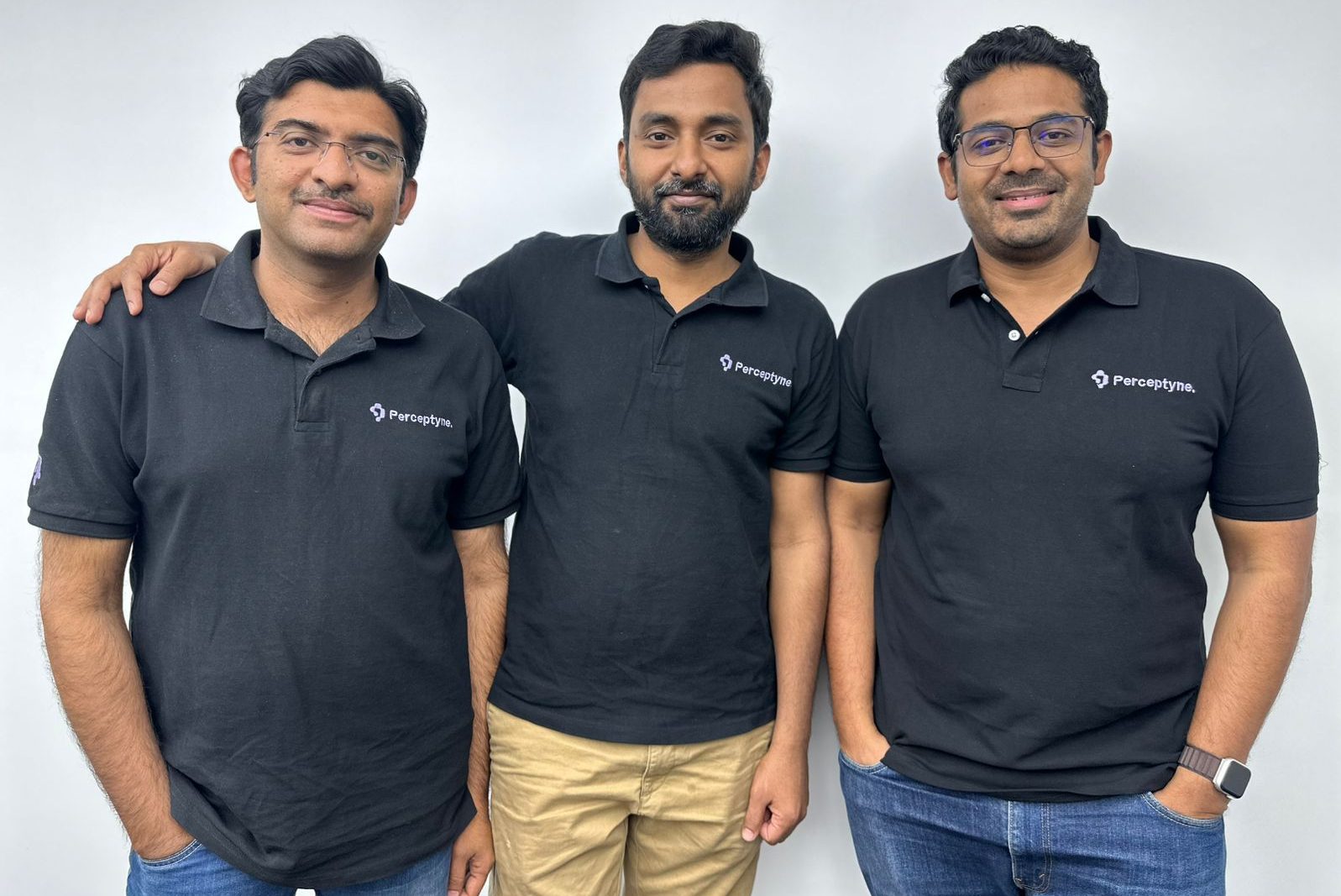
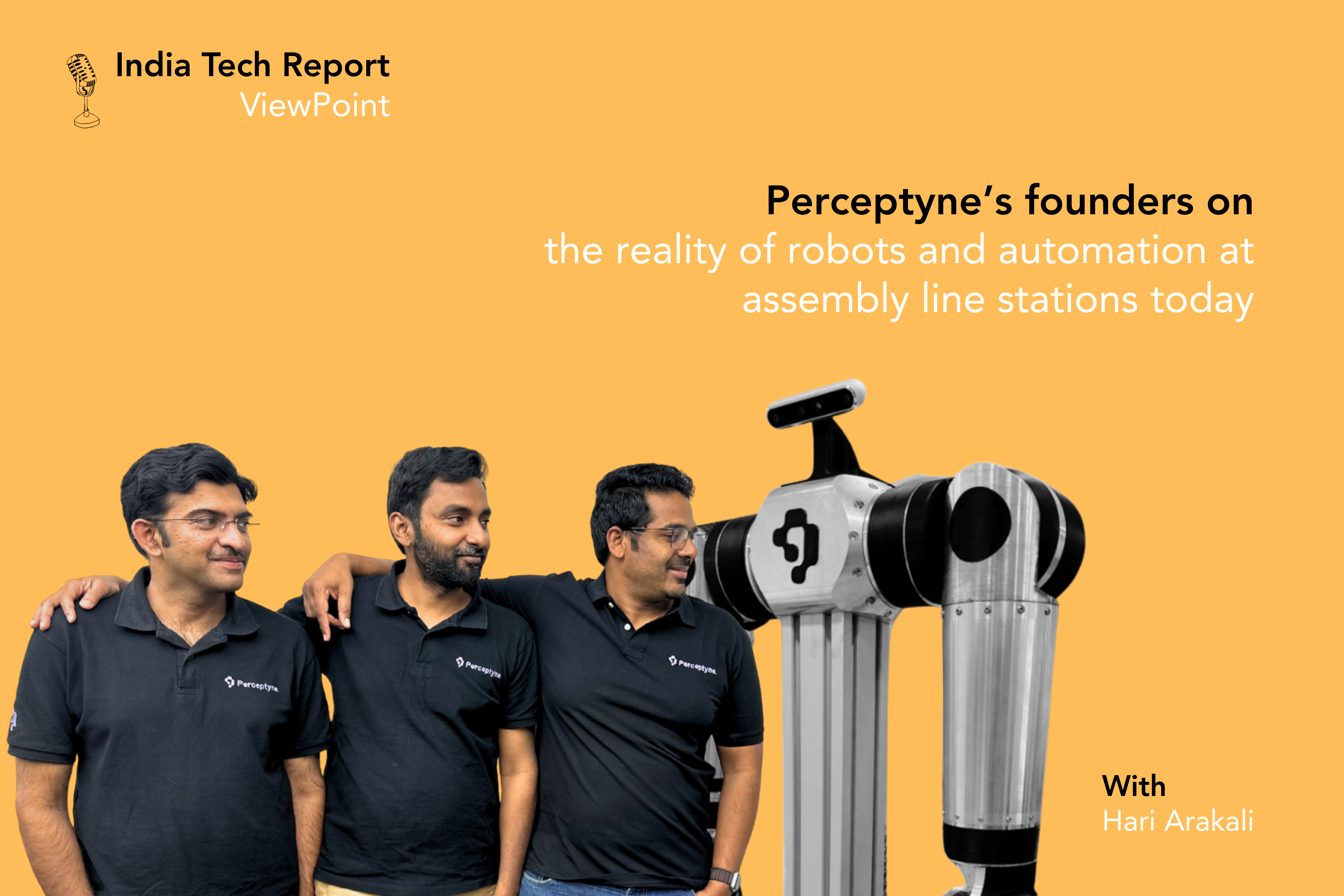
    Founders of Perceptyne Robots, Mrutyunjaya N, Raviteja Chivukala and Jagga Raju N are building autonomous, dexterous robots and the physical AI stack needed.
    Founders of Perceptyne Robots, Mrutyunjaya N, Raviteja Chivukala and Jagga Raju N are building autonomous, dexterous robots and the physical AI stack needed.
    Listen to the audio

    What are some of the practical, seemingly small but truly challenging engineering problems in translating what seems intuitive to humans to robotics automation, today?

    Mrutyunjaya N, Raviteja Chivukala and Jagga Raju N, founders of Perceptyne Robots, explain here in simple terms in just a few minutes.

  • Perceptyne’s founders on why 2026 could be the year of deployment of robots

    Perceptyne’s founders on why 2026 could be the year of deployment of robots

    In this year’s first episode, I’m joined by Mrutyunjaya NRaviteja Chivukala and Jagga Raju N to unpack why and how they started Perceptyne Robots, and what it takes to build an AI-native robotic system out of India.

    Perceptyne is a Hyderabad-based company building dexterous, dual-arm, intelligent robots for industrial automation, currently focused on automotive and electronics manufacturing lines.

    The founders explain the gap they saw on real shop floors, where many assembly stations still rely on manual work because traditional approaches cannot handle unstructured inputs, fine force control, or frequent product changes.

    The conversation goes into their vertically integrated hardware, including mobile configurations, and their PR-PhI “physical intelligence” software layer that orchestrates perception, control, and imitation-learning–based skills like visual servo, slip-free grasping, and force-based assembly.

    You will also hear their take on the state of India’s robotics ecosystem, the evolution of robots as a combined hardware-and-software challenge, and how they are moving from pilots with global automotive and electronics manufacturers toward larger deployments. Perceptyne, which turns four this year, is backed by two well-known deep-tech VC firms,  Yali Capital and Endiya Partners.

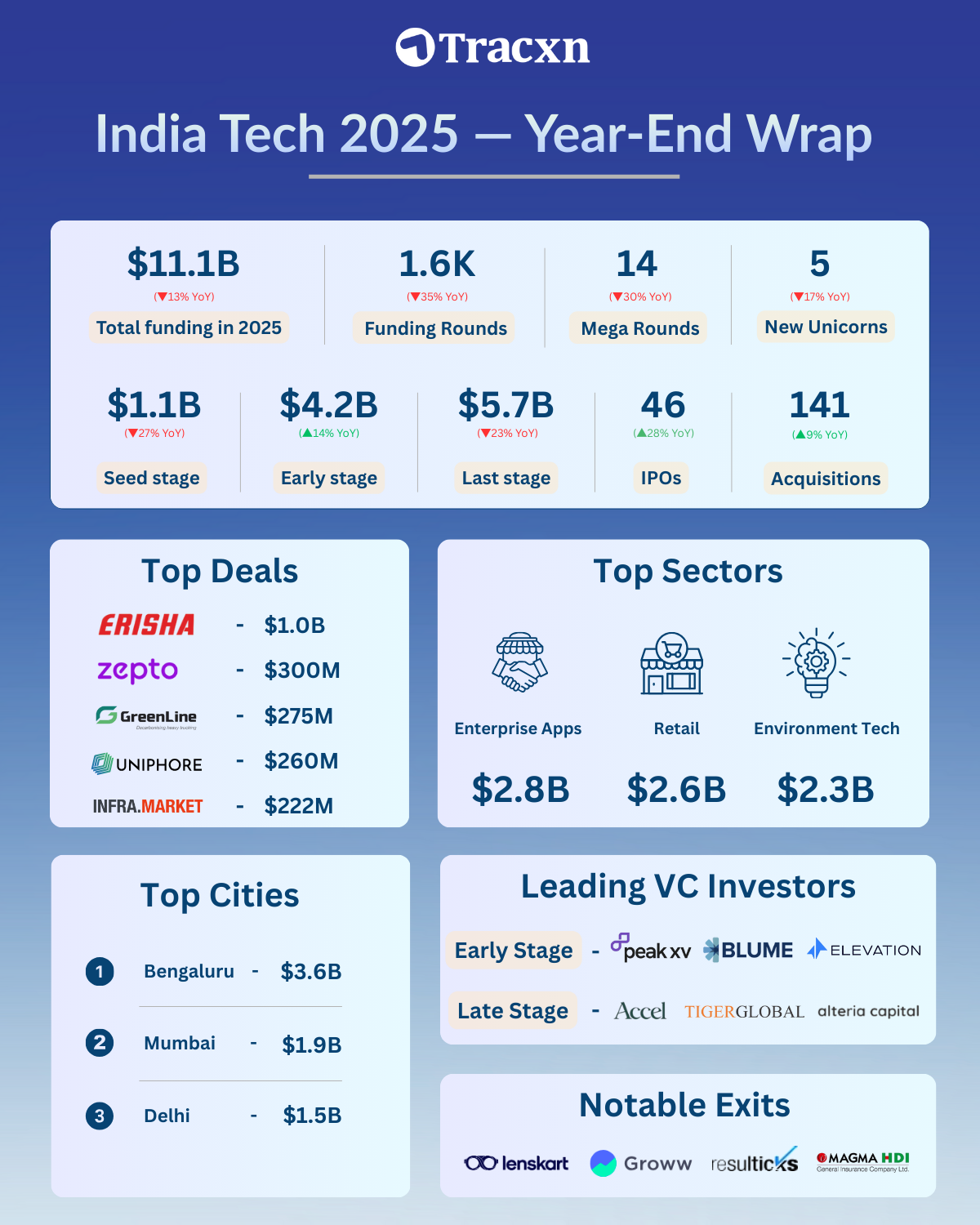
  • How Indian tech startups fared in 2025 – an infographic from Tracxn

    How Indian tech startups fared in 2025 – an infographic from Tracxn

    Happy new year, dear listeners and readers. I bet 2025 was an eventful year for you — it certainly was, for me. As we look ahead at 2026, here’s one more quick look back at how Indian tech startups fared in the year gone by.

    This infographic is courtesy Tracxn, a leading data intelligence provider in India on private markets.

  • IFC backs GFCL EV with $50 mln, Hyundai launches MobED autonomous mobile robot, Viavi, QNu team up

    IFC backs GFCL EV with $50 mln, Hyundai launches MobED autonomous mobile robot, Viavi, QNu team up

    Hyundai Motor Group’s MobED AMR on display at an exhibition. Image source: Hyundai.
    Listen to the episode

    (00:20) Mobile robots market to nearly double by 2030

    Global demand for mobile robots is set to surge, with the market projected to grow from $27.39 billion in 2025 to $52.11 billion by 2030, driven by AI, 5G, e-commerce, and labour shortages, while Asia-Pacific leads adoption and high costs, regulatory hurdles, and integration challenges remain important constraints.

    (00:50) Hyundai debuts MobED autonomous robot platform at iREX 2025

    Hyundai Motor Group has unveiled MobED, a production-ready autonomous mobility robot platform, at the iREX 2025 robotics show in Tokyo, positioning it as the company’s first mass-produced mobility robot for industrial and everyday applications, with Pro and Basic variants set for market launch in the first half of 2026.

    (01:17) IFC backs Gujarat Fluorochemicals’ EV unit with $50 million

    IFC will invest about $50 million in Gujarat Fluorochemicals’ EV venture GFCL EV Products to build India’s first fully integrated battery-materials plant, supporting local production of key inputs for electric vehicle and energy storage batteries and reducing import dependence while strengthening the country’s position in global clean-energy supply chains.

    (01:46) Viavi, QNu Labs team up on quantum-safe network security

    Viavi Solutions and QNu Labs, a quantum cybersecurity startup in India, have formed a strategic R&D partnership to develop test frameworks, standards, and reference architectures for quantum-safe network security, spanning post-quantum cryptography, quantum key distribution, quantum random number generator, and hybrid systems, with plans for a broader industry consortium to help operators and enterprises transition from classical to quantum-resilient infrastructures.

    (02:20) Skylark Drones, WELL Labs ink MoU on data-led water intelligence

    Skylark Drones has signed an MoU with Bengaluru-based WELL Labs to build data-driven water-resource intelligence platforms, according to a press release. The platforms will fuse large-scale drone-based mapping with hydrological science, supporting watershed management, flood resilience, and climate-linked water planning for governments and communities across India.

    (02:46) Shastra VC launches SDEX deep-tech fellowship with $100,000 grants

    Shastra VC has launched SDEX, Shastra Deep-Tech Excellence Fellowship, a 16–24-week programme to help researchers at IITs, IISc, NITs and other labs turn frontier technologies into venture-ready startups, with the first cohort set to pick up to 15 teams and provide each with equity-free funding and resources of up to $100,000 dollars.

    (03:20) Chiratae launches Sonic DeepTech with cheques up to $2 million

    Chiratae, a VC firm in Bengaluru, has launched the Sonic DeepTech programme to back early-stage Indian deep-tech startups with seed cheques of up to $2 million, promising 48-hour investment decisions, and access to domain experts, corporate partners, and portfolio founders to help teams move quickly from lab prototypes to market-ready products.

    (03:45) ChemLex raises $45m for AI-driven autonomous drug discovery lab in Singapore

    ChemLex, an AI-for-science startup, has raised 45 million dollars led by Granite Asia and is establishing its global headquarters and a 24/7 self-driving chemistry lab in Singapore to accelerate small-molecule drug discovery, supported by new technical hires and an MoU with Singapore’s Experimental Drug Development Centre.

  • IIT M celebrates 500 startups, Planys raises Rs. 100 crore

    IIT M celebrates 500 startups, Planys raises Rs. 100 crore

    Generated image for illustration of a startup incubator office space.
    Generated image for illustration of a startup incubator office space.
    Listen to the episode

    (00:21) China’s Zhuque-3 reaches orbit but crashes on landing

    Chinese rocketmaker Landspace’s stainless steel, methalox-fuelled Zhuque-3 reached orbit on its debut flight from Jiuquan, successfully deploying its expendable second stage before the reusable first stage failed during landing and exploded near the target zone. The company said the test still met key recovery objectives and noted Zhuque-3’s Falcon 9–class payload capability to low Earth orbit.

    (00:53) RNA drug TY1 taps hidden DNA repair pathway

    Scientists at Cedars-Sinai have created TY1, an RNA-based therapy that switches on a recently identified DNA repair pathway, enhancing the body’s ability to mend genetic damage and regenerate injured tissue. In preclinical studies, TY1 boosted repair processes without relying on traditional DNA-repair mechanisms, suggesting potential applications in treating cancer, age-related decline and degenerative diseases if future trials confirm its safety and efficacy.

    (01:30) MIT’s light-based sensor aims to replace glucose finger pricks

    MIT researchers have created a shoebox-sized Raman spectroscopy device that measures blood glucose through the skin, matching the accuracy of commercial continuous glucose monitors in an initial study on a healthy volunteer. The team has already built a cellphone-sized wearable prototype and plans larger clinical trials, with a long-term goal of a watch-like, noninvasive glucose monitor for diabetics.

    (02:01) Planys raises Rs. 100 crore for global and defence push

    Underwater robotics startup Planys Technologies has raised Rs. 100 crore in a round led by investors including Ashish Kacholia and Lashit Sanghvi, with participation from existing backers. The capital will support global scale-up of its underwater inspection systems and the launch of defence unit Planys Ark to develop indigenous unmanned underwater vehicles and set up a new production facility near Chennai.

    (02:30) Activate launches $75m fund for early deep tech

    Aakrit Vaish, co-founder of Haptik, and Pratyush Choudhury, former principal investor at Together, have unveiled Activate, a $75 million venture fund targeting India’s earliest-stage deep tech and AI startups, including teams at the ideation stage. The fund plans to write cheques of about $0.5–3 million, supported by a global LP network, and has already begun deploying capital into young AI-first companies.

    (03:02) EU backs 40 women-led deep tech startups

    EU-funded project Women TechEU has selected 40 women-led deep tech startups from 1,107 applicants in its fourth and final call, awarding each a EUR 75,000 non-dilutive grant plus tailored business support. Winners span 20 countries and focus mainly on AI, biotech and clean tech, with a follow-on initiative planned to continue support beyond 2026.

    (03:35) IIT Madras incubator tops 500 deep-tech startups

    IIT Madras Incubation Cell has incubated 511 deep-tech startups with a combined valuation of over Rs. 53,000 crore, creating more than 11,000 direct jobs and cementing its status as India’s largest deep-tech hub. In FY 2024–25, it onboarded 100+ startups under the “Startup Shatam” mission, with portfolio companies spanning space, mobility, climate-tech, semiconductors and frontier AI.