So, this morning, I drove up to the new office that Apoorv Shaligram and Uttam Kumar Sen and their team at e-TRNL Energy have set up – still being given some final touches before a formal inauguration soon.
Sat down with Apoorv to record the next episode of Conversations. And it’s always an awesome experience to do this in-person, in whatever conditions present themselves onsite, in terms of light and sound. (I did carry two Neever panels and my DJI wireless mics, and more on that in a separate note.)
I’ve had the privilege of being acquainted with this deep-tech entrepreneur duo – IIT Bombay alumni – almost from the time they set up e-TRNL and, in one early conversation a few years ago, they’d tried to help me understand the tech innovations they had in mind.
Today, we caught up in the context of their recent announcement of having raised Rs. 27.4 crore (About $3 million) in seed funding, led by IAN Group (Indian Angel Network), with Navam Capital, and existing investors Speciale Invest, Micelio and others also joining in.
We also spoke about the funding experience — what’s changed, what worked, best practices and so on. Catch all of that in the full conversation right here, or wherever you get your podcast, on Friday, Feb. 20.
Here’s a 90-second preview, with Apoorv explaining 3DEA, their 3D electrodes architecture.
By the way, I also just started a WhatsApp channel for anyone who prefers to keep track of their deep tech news and views that way.
Daily brief on deep tech and climate tech from India and around the world.
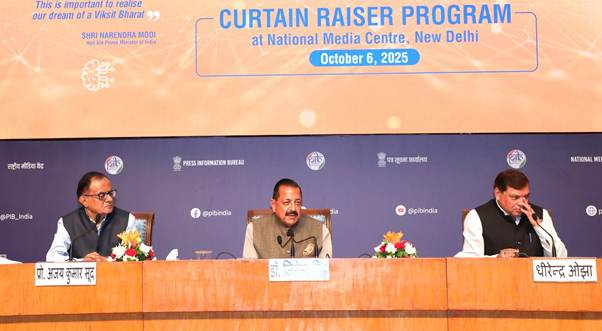
India’s Science and Tech minister Dr. Jitendra Singh (centre) at the curtain raiser for the country’s first science, tech and innovation conclave.
Minister Dr. Jitendra Singh launches Emerging Science, Technology & Innovation Conclave Union Minister Dr. Jitendra Singh launched a curtain-raiser for the Emerging Science, Technology & Innovation Conclave (ESTIC-2025), according to a ministry press release yesterday. The three-day conclave, to be held in Delhi starting Nov. 3, will focus on technologies including semiconductors, AI, quantum computing, biotech, space, and clean energy. It is designed to be a platform for young innovators, startups, and researchers to showcase their solutions and connect with industry leaders.
Listen to the episode
DPIIT and Thermo Fisher Scientific to support 500 biotech startups India’s Department for Promotion of Industry and Internal Trade (DPIIT) has partnered Thermo Fisher Scientific to launch the BioVerse Challenge, a national programme aimed at supporting 500 biotech startups in India over the next three years, according to a press release from the commerce ministry. The collaboration will provide mentorship, access to advanced R&D facilities, and investor connections. This initiative is a key step towards achieving India’s vision of building a $300 billion bioeconomy by 2030.
Eli Lilly to invest over $1 billion in India manufacturing expansion US pharmaceutical company Eli Lilly will invest more than $1 billion to expand its manufacturing and supply capabilities in India, Reuters reports. The investment includes new contract manufacturing facilities and a new manufacturing and quality hub in Hyderabad. The company’s goal is to strengthen its global supply chain and leverage India’s skilled workforce to increase the availability of key medicines for conditions such as diabetes, obesity, and cancer.
RoosterBio and Secretome Therapeutics complete large-scale production for clinical cell therapy RoosterBio and Secretome Therapeutics have successfully completed large-scale bioreactor production of STM-01, a cell therapy candidate for heart failure currently in clinical trials, the US companies said in a press release. This new process, which replaces a less efficient flask-based method, is designed to increase productivity and scalability, and will be transferred to Secretome’s contract manufacturer.
California to create statewide strategy for quantum technology California has enacted a new law, Assembly Bill 940, to establish a statewide strategy for the quantum technology sector, Quantum Insider reports. Led by the Governor’s Office of Business and Economic Development (GO-Biz), the plan aims to attract investment, foster job growth, and coordinate public-private partnerships. The initiative, backed by $4 million in state funding for research, seeks to translate the state’s academic research into commercial applications, ensuring California’s global competitiveness in this transformative field.
Firefly Aerospace acquires SciTec in $855 million deal Firefly Aerospace has acquired SciTec, a national security technology firm, for $855 million to enhance its space services, the two US companies said in a press release. SciTec’s defense software analytics and capabilities in missile warning, tracking, and intelligence will bolster Firefly’s offerings in the growing military-space sector. SciTec will operate as a unit of Firefly, which is now poised to strengthen its position as a major space technology provider, known for its small- to medium-lift launch vehicles, lunar landers, and orbital vehicles.
Einride raises $100 million for autonomous freight deployments Einride, a startup in Sweden specializing in autonomous and electric freight technology, has secured $100 million in new funding, the company said in a press release. The capital will be used to accelerate the deployment of its self-driving trucks, advance its technology, and expand its customer base. The funding follows a year of significant growth for the company, including a doubling of its net sales and expansion into new markets.
In this week’s episode of In Conversation, I spoke with Kunal Khattar, founding managing partner at AdvantEdge Founders, a ‘sector-focused’ early-stage VC firm in New Delhi that’s well known for backing founders in the EV and mobility sectors in India.
AdvantEdge is into its 10th year now and known for backing startups like Rapido, Chalo, ZingBus, Park+, Baaz, Shuttl, and Exponent Energy, with close to 40 companies in its portfolio across its first two funds. The firm is close to announcing the first close of its third fund which has a targeted total of $75 million.
Kunal says his mission is to foster a 100 successful entrepreneurs in the mobility space. We discussed a range of connected topics, including why he expects the EV space to hit the J-curve growth stage over the next three to five years, how replacing the overall ICE economy in India is a trillion-dollar opportunity, and the rise of deep tech and new solutions like clean hydrogen in India’s mobility space.
Here are my top 10 takeaways.
1. AdvantEdge’s sector focus and founder-first philosophy
Khattar explains that AdvantEdge Founders was built with a clear mission: to create 100 successful founders, not just unicorns or high returns. The fund’s North Star metric is founder success, and this ethos shapes everything from team titles to investment decisions. AdvantEdge views itself as a startup, with an operator’s mindset, emphasizing hands-on support and deep partnership with entrepreneurs throughout their early journeys.
2. India’s $1 trillion EV opportunity and the Suzuki 2.0 moment
Khattar draws a parallel between India’s auto sector transformation after Suzuki’s entry and the current EV revolution. He believes the transition from internal combustion engines (ICE) to electric vehicles could create $1 trillion in market value across OEMs, component suppliers, dealerships, financing, insurance, and energy distribution — mirroring the ecosystem Suzuki built, but now cantered on electrification and new business models.
3. Prioritizing commercial vehicle electrification for maximum impact
The fund’s thesis is to focus on electrifying commercial vehicles —two-wheelers, three-wheelers, buses, and trucks — because they represent only 10 percent of vehicles but account for 70 percent of energy consumption and emissions. Khattar argues that targeting commercial fleets first delivers greater environmental, economic, and social returns, including reduced oil imports and improved livelihoods for millions dependent on these vehicles.
Unlike the US or China, India’s mobility market is dominated by two- and three-wheelers, buses, and commercial vehicles. AdvantEdge avoids direct comparisons with Western markets and instead focuses on form factors where India is already a global leader. This approach enables the fund to back solutions tailored to Indian needs and scalable across similar emerging markets.
5. The “picks and shovels” approach to building the EV ecosystem
AdvantEdge invests in the enabling infrastructure of the EV transition — what Khattar calls “picks and shovels” companies. These include EV component makers, charging networks, financing and leasing platforms, insurance providers, and energy distribution businesses. The goal is to support the foundational B2B solutions that will underpin the entire EV value chain, rather than just consumer-facing brands.
6. Timing investments for J-curve growth and sector cycles
Khattar emphasizes the importance of entering sectors at the right time — when J-curve growth is imminent but before valuations become overheated. AdvantEdge is willing to invest in pre-revenue, pre-product companies at the earliest stages, drawing on its operational expertise to help them reach product-market fit. This disciplined timing avoids the pitfalls of entering too early or too late in sector cycles.
7. Deep tech and problem-driven innovation are key differentiators
The fund seeks out deep technology startups that solve fundamental barriers to EV adoption, such as charging speed, range anxiety, and cost. For example, Exponent Energy, a portfolio company, developed proprietary tech to fully charge EVs in under 15 minutes—addressing multiple pain points for commercial operators and accelerating EV adoption in India’s unique market context.
8. Collaborative ecosystem building with other funds and founders
AdvantEdge actively collaborates with larger funds, global investors, and its own portfolio founders to build a thriving ecosystem. “It takes a village,” he says, and believes in sharing research, co-investing, and using complementary strengths is essential. The value of this network compounds with each new investment, creating a snowball effect of knowledge and opportunity.
9. Pragmatic view on hydrogen and next-gen battery tech
Khattar is sceptical about the near-term disruption potential of hydrogen and solid-state batteries in India. He argues that such technologies are at least a decade away from mainstream adoption and that India should focus on indigenous innovation suited to its market realities, rather than chasing the latest breakthroughs from advanced economies.
10. Building for India, not benchmarking against China or the West
Khattar urges Indian founders and investors to avoid direct comparisons with China or the US. Instead, he advocates for building solutions that address India’s unique challenges and opportunities, tapping local strengths in two and three-wheeler markets and focusing on incremental progress. The goal is to create a better India, not to replicate foreign models.
My guest today is Kunal Khattar, founding managing partner at AdvantEdge Founders, an early-stage VC firm in New Delhi that’s well known for backing founders in the EV and mobility sectors in India. Kunal is well known for backing both consumer facing shared mobility ventures like Rapido and technology-led product innovation startups like Exponent Energy, which is a leader in fast-charging tech in India.
It’s now 10 years since AdvantEdge was founded, Kunal says, and the firm is very close to announcing the first close of its third fund, which will likely be in the ballpark of $75 million, to back the next generation of EV entrepreneurs in India.
In this conversation, Kunal talks about why he expects the EV space to hit the J-curve growth stage over the next three to five years and how replacing the overall ICE economy in India is a trillion-dollar opportunity.
Kunal also talks about how because technology-led industry shifts can take decades, some promising technologies, like green hydrogen, for example, will take time to become mainstream.
Bhaktha Ram Keshavachar, founder and CEO of Chara Technologies in Bengaluru, is leading an effort to develop motors that don’t need the conventional permanent magnets, whose make up includes rare-Earth metals, the processing of which is almost entirely controlled by China. The mining and processing of these minerals also has an environmental impact.
Bhaktha and his fellow founders Ravi Prasad and Mahalingam Koushik, bring decades of industry expertise to their venture. Founded in 2019, Chara has engineered what are called reluctance motors. Unlike the traditional motors, reluctance motors don’t have permanent the magnets that need rare Earth minerals such as neodymium or samarium. Magnetic fields are instead created by the electric current in the windings around the stationary part (stator) of these motors.
In my recent conversation with him, Bhaktha discusses Chara’s technical pivots, manufacturing milestones, industry partnerships, and the challenges of deep tech entrepreneurship in India. He also shares insights on talent development, the evolving ecosystem, and Chara’s plans for global expansion. Here are my top six takeaways.
Rare earth-free motor technology addresses a critical global supply chain risk
Most high-efficiency electric motors today rely on rare earth magnets, which are expensive, environmentally damaging to extract, and subject to geopolitical risk — especially as China controls over 90 percent of the global supply chain. Chara’s technology, based on reluctance motors, eliminates the need for rare earths, offering a strategic solution to this problem.
Product-market fit is emerging fastest in off-highway and industrial applications
While Chara initially targeted India’s large two-wheeler and three-wheeler market, Bhaktha notes that the most immediate traction has come from off-highway uses such as agricultural equipment, golf carts, turf care machines, and compressors. These sectors value Chara’s high-efficiency, rare earth-free motors and have helped the company build early credibility.
Strategic partnerships and manufacturing scale are key to customer confidence
A major milestone for Chara is its partnership with Greaves Cotton, which will manufacture and distribute Chara’s motors under license. Bhaktha explains that large customers are wary of “startup risk” and prefer established suppliers; this partnership provides the scale and distribution needed to win bigger deals and accelerate adoption.
Chara’s deep R&D helped the startup develop a market-ready product
The company’s early years involved a challenging pivot from switched reluctance motors, which proved too noisy, to synchronous reluctance motors. Chara invested heavily in core R&D, especially in software algorithms to control non-linear motor behavior, resulting in a certified, field-deployed product that matches the performance of traditional motors.
Building a deep tech team in India requires nurturing core engineering talent
Bhaktha notes a shortage of experienced engineers in electromagnetics and mechanical domains, as most graduates prefer software careers. Chara addresses this by hiring young engineers with some experience and training them further in the requisite foundational physics and engineering, which is essential for their multidisciplinary innovation.
Chara’s next phase is focused on scaling sales and global expansion
With technical challenges largely solved and products certified, Bhaktha says Chara’s top priority is now sales and deployment — both in India and internationally. The company is targeting new product development for larger vehicles and is actively pursuing business in Europe and the US, tapping global interest in rare earth alternatives and recent geopolitical shifts.
My guest today is Bhaktha Ram Keshavachar, founder and CEO of Chara Technologies, in Bengaluru. Chara is at the forefront of a technological shift that could reshape for the better India’s electric mobility landscape, and potentially make an impact overseas as well.
The mission is both urgent and ambitious: to build high-performance electric motors that are free of rare earth magnets — a critical component in most electric vehicles and industrial machines today.
Bhaktha and his fellow founders Ravi Prasad, the chief motor designer, and Mahalingam Koushik, the CTO at Chara, are engineering veterans from industry, each one bringing decades of experience to their entrepreneurial journey.
It started in late 2019, just as the world was heading into the uncertainty of the Covid pandemic. Recognizing the strategic risks posed by global dependence on rare earth minerals — with China controlling about 90 percent of the global refining and processing — and also the environmental impact, he and his team set out to engineer an alternative.
The result is a new generation of reluctance motors, designed and manufactured in India, that match or surpass the efficiency of traditional permanent-magnet motors, while sidestepping the environmental and geopolitical pitfalls of rare earth mining.
L-R: Ravi Prasad, chief motor designer, Mahalingam Koushik, CTO, and Bhaktha Keshavachar, CEO at Chara Technologies are building a new generation of made-in-India reluctance motors
In this conversation, Bhaktha shares the technical and business challenges Chara has overcome — from early R&D pivots and tackling the challenge of torque ripple in reluctance motors, to building a pilot production facility and securing industry partnerships, including a manufacturing and distribution alliance with Greaves Cotton.
He discusses the hurdles of deep tech entrepreneurship in India, the evolving talent landscape, and Chara’s plan to take its products global.
Whether you’re a founder, investor, engineer, or simply curious about the future of cleaner technology, this episode offers an example of how Indian deep tech innovation is rising to meet one of the challenges of our era: building a sustainable, secure, and scalable electric future — one motor at a time.