Hi, wherever you’re reading this, I hope you’re doing well. Thank you for supporting my work by being a subscriber. It means a lot.
A new episode on the podcast: a conversation with the founders of Mitti Labs
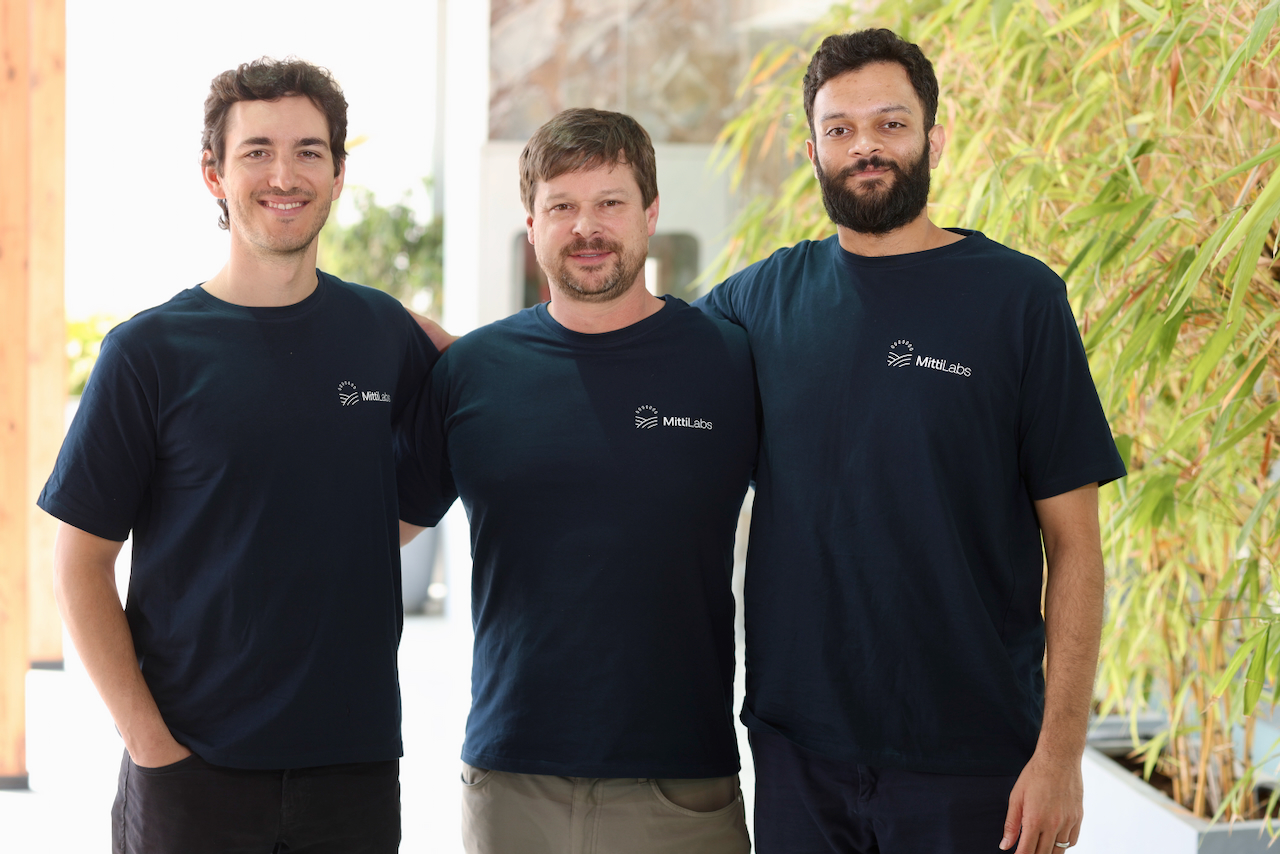
It’s World Environment Day today, and the latest episode on my podcast features a conversation with the founders of Mitti Labs on their carbon project to help rice farmers cut methane emissions from their fields, save water and make money from the sale of the carbon credits generated from the green house gas reduction.
$12.8 billion: Cumulative climate tech funding in India according to a new report
Tracxn, a global private markets data provider, has just released its India Climate Tech Report 2026, saying that the sector is becoming increasingly investible.
On Tuesday, I’ll publish Part 2 of a wonderful conversation with Naganand Doraswamy (managing partner) and Suryaprakash Konanuru (CTO), founders of Ideaspring Capital. We talk about what might represent the ‘Flipkart moment’ of deep tech in India, and plans for the VC firm ahead.
That’s it for today. When you have a minute, please would you share this with friends who might be interested in India’s deep tech and climate tech startups. Here’s wishing you a great rest of the day.
Eka Robotics has emerged from stealth with a Vision-Force-Action model that it says can push robots beyond the long-standing trade-off between generality and speed in manipulation tasks. The Cambridge, Massachusetts startup was co-founded in 2025 by MIT’s Pulkit Agrawal and former DeepMind researcher Tuomas Haarnoja. The deep tech entrepreneurs are pitching force sensing and simulation as the route to more capable machines.
In robotics, much of the recent excitement has centred on vision-language-action systems, which treat language as a bridge to physical control. Eka says that is too indirect for the contact-rich realities of the physical world. Its approach instead tries to make robots learn mass, friction and inertia through practice in high-fidelity simulation, then transfer those skills to the messier settings of factories and homes.
Across the robotics industry, the race is on to build foundation models that can scale across tasks, rather than brittle systems tuned for one environment, and the prize is a larger share of warehouse work, light manufacturing and household assistance. The strategic question is whether the winning path is imitation from human data, reinforcement learning in the real world, or simulation-first training that seeks to compress years of trial and error into computational time.
“We’re building intelligence for the physical world in its native language: forces,” Pulkit Agrawal wrote on LinkedIn. In the same post, he added that robotics has long faced a trade-off between “generality” and “speed,” and that “the real world requires both”.
Eka’s presentation suggests confidence that force-aware control can do more than sort objects or pick up toys. The company has highlighted tasks such as screwing in a light bulb and handling slippery items, small feats that still define the frontier of robotic manipulation. For now, the message is as important as the model: the next leap in robotics, Eka is arguing, will come not from making machines more verbal, but from making them more physical.
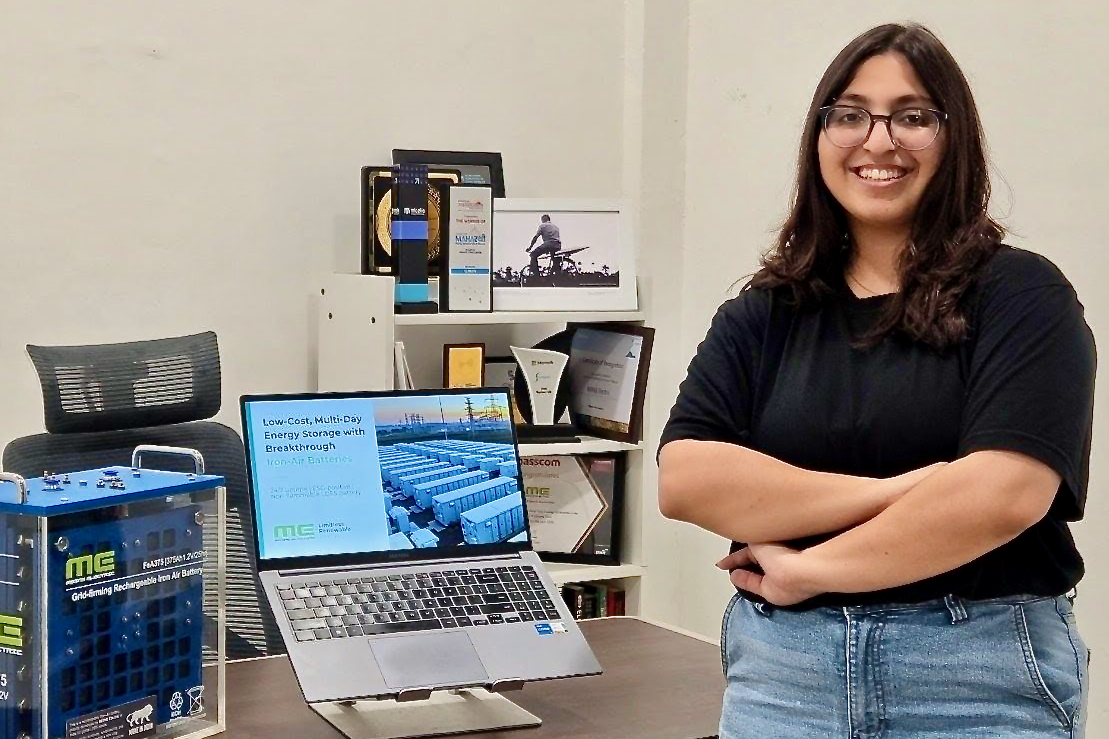
In this episode, Stuti Kakkar, co-founder of MEINE Electric, a battery energy storage tech startup, unpacks the government’s proposed Approved List of Battery Manufacturers (ALBM) that is reportedly in the works as part of its ambitious $38 billion push to deploy 47 gigawatts of battery storage.
Similar to the solar industry’s ALMM framework, this list aims to mandate localised supply chains for government projects, reducing a heavy reliance on imports, particularly from China, which currently controls over 90 percent of the supply chain. Stuti explains why this move is a game-changer for hardware startups.
While traditional lithium-ion batteries face domestic mineral shortages, alternative chemistries like Iron-Air can be up to 95 percent indigenous from day zero, she says.
Stuti also touches upon how these policy shifts provide the demand visibility for hardware-centric startups, which is needed to scale India’s deep-tech ecosystem.
Ati Motors has renamed itself Ati Robotics to better reflect its evolution into a “material orchestration” specialist, the Bengaluru-based provider of autonomous mobile robots said in a recent press release.
The Indian robotics company is moving to win an early lead in this industry-wide shift: the world’s biggest manufacturers, including some of Ati’s customers, are looking at not just deploying robots anymore, but at holistic automation and AI-led solutions that make their overall operations more efficient.
Top manufacturing and factory executives are beginning to understand that in the modern industrial landscape, a machine that moves autonomously isn’t in itself the goal. It’s how one can harness the combination of many such robots, the multiple processes in the factory and the dynamically changing roles of the humans involved to get closer to a “lights out” facility.
“Automation doesn’t stop at the robot,” Founder and CEO Saurabh Chandra, said in the press release, adding the company has built an integrated platform comprising robots, fleet intelligence, AI agents, and the orchestration software that ties them all to the systems running modern factories.
“Ati Robotics is not a new company. It is the honest description of the company we have already become,” Chandra said.
By adopting a name that encompasses its broader ambitions in artificial intelligence and systems orchestration, Ati Robotics is signalling that its own future lies not in the hardware of locomotion, but in the software of intelligence.
Ati was founded in 2017, and has its roots in India’s top scientific research university, the Indian Institute of Science. The company’s Sherpa line of AMRs (tuggers, pallet lifters and so on) have been deployed with more than 70 enterprise customers, and the robots have tracked some 2 million autonomous missions with a success rate of 99 percent, according to the release.
The shift to material orchestration is a necessary one, driven by a chronic shortage of skilled labor and a desperate need for efficiency in the face of fragmented supply chains. Manufacturers want to move away from the “yellow cages” of fixed robotics toward flexible, autonomous systems that can navigate human-centric environments.
For companies such as Ati, this means the competition has shifted from basic hardware reliability to the sophistication of the “digital brains” that can manage fleets — often comprising many different types of robots.
For startups and incumbents alike, the challenge is no longer just making a robot that can carry a pallet, but creating a system that can rethink how that pallet moves in real-time.
One immediate opportunity is the so-called brownfield facility — an existing factory with sunk investments in human-centric infrastructure and equipment. The best solution that can integrate the existing gear effectively at minimal cost will win.
“Customers don’t just buy a robot from us. They buy a material orchestration system – coordination, intelligence, and scalability aligned to how their factory actually works,” says Chris Dolbow, vice president of marketing at Ati. “The shift to Ati Robotics sharpens how we describe what we deliver: the right fit for automation today with intelligent innovation for the future.”
Ati is backed by investors including Walden Catalyst Ventures, NGP Capital and its early-stage investor MFV Partners. The Bengaluru-headquartered company is moving to build on its momentum in the competitive North American and APAC markets. It has also already successfully deployed its orchestration solution at some early customers, CEO Chandra says.
Tracxn Technologies, a leading private markets intelligence provider in India, has released its latest report on India’s startup landscape — as at the end of the fiscal year 2025-26.
Press release
Key highlights
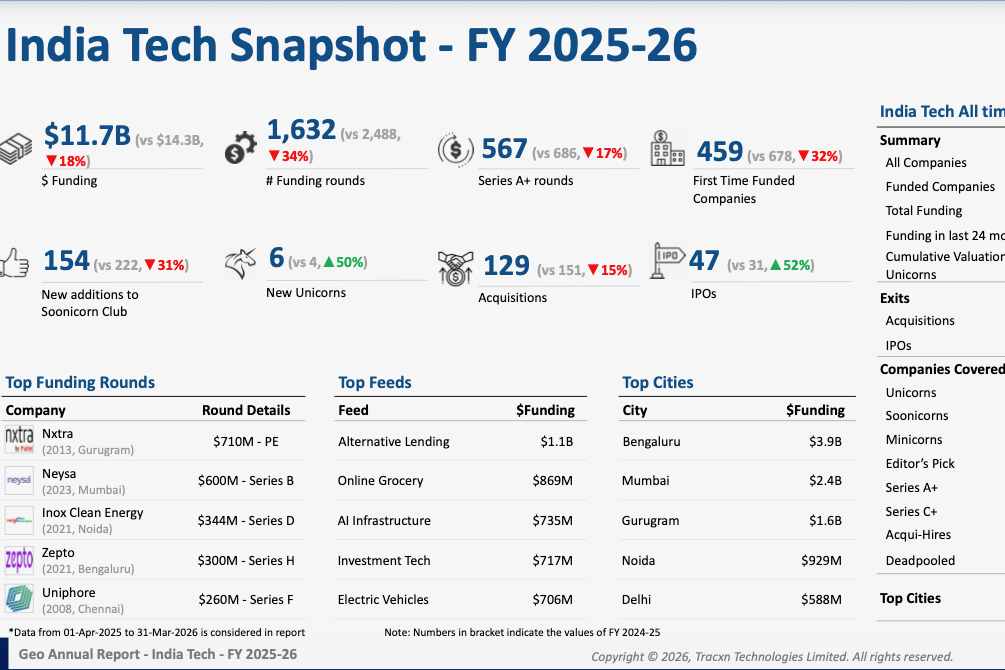
$11.7B raised across 1,632 rounds — deal volume fell 34% but total capital fell only 18%.
Median cheque size grew substantially, confirming that investors are concentrating capital rather than retreating from the market.
Early-stage funding rose 33% to $4.8B even as early-stage rounds fell from 492 to 420.
Fewer companies attracted larger Series A and B rounds — a barometer of rising quality thresholds at the growth stage.
47 IPOs in FY 2025-26, up 52% from 31 the prior year. India’s public markets absorbed the most tech listings in a decade, with Lenskart, Groww, Meesho, Physics Wallah, and Pine Labs among the notable debutants.
Six new unicorns formed in FY 2025-26 — up 50% year-on-year — and reached billion-dollar valuations on an average of $150M raised, nearly half the $294M required by the prior cohort.
74% of India-focused VCs expect conditions to improve in 2026, with AI/ML and Deep Tech as top priorities — and talent shortages, not capital, as the chief execution risk.
Bengaluru, 21st April 2026: Tracxn, a leading startup intelligence and market data platform, today released the Tracxn Geo Annual
Report: India Tech FY 2025-26, providing the most comprehensive data-backed review of India’s startup funding, exits, unicorn formation, and investor activity for the financial year ending 31 March 2026.
India retained its position as the world’s fourth-highest funded startup ecosystem, behind only the United States, United Kingdom, and China, accounting for $11.7B deployed across 1,632
Rounds.
The headline funding figure masks a more important structural story: deal volume compression is running far ahead of funding compression, reflecting an investor base that is making fewer, higher-conviction bets rather than retreating from the market altogether.
Commenting on the insights, Neha Singh, Co-Founder of Tracxn, said, “The FY 2025-26 data tells a story of deliberate recalibration. When deal volume falls 34% but funding fell only 18%, it means investors aren’t leaving — they’re choosing differently. The surge in IPO activity and the 50% rise in new unicorn formation all point to an ecosystem that is growing up: more focused, more fundamentals-driven, and increasingly capable of generating durable value rather than just headline valuations.”
Capital Is Concentrating, Not Retreating
India’s $11.7B represented an 18% decline from $14.3B the prior financial year, but a 20% increase over FY 2023-24’s trough. Early-stage funding grew 33% to $4.8B despite fewer rounds; late-stage fell 38%. Enterprise Applications ($3.6B), FinTech ($2.4B), and Retail ($2.4B) led sectors. The year’s largest rounds — Nxtra ($710M), Neysa ($600M), and Inox Clean Energy ($344M) — signal that India’s most capital-intensive opportunities lie in foundational infrastructure.
Public Markets Come of Age
FY 2025-26 produced 47 tech IPOs — a 52% year-on-year increase and the highest count in the India Tech ecosystem. Notable listings and their respective market capitalisations at the time of IPO included Lenskart ($7.9B), Groww ($7.0B), Meesho ($5.6B), Physics Wallah ($3.6B) — collectively representing some of India’s most prominent VC-backed success stories reaching public scale.
The sector composition of FY 2025-26 IPOs shifted markedly from the prior financial year: Retail led with 15 listings and Enterprise Applications followed with 11, compared to Transportation & Logistics Tech leading in FY 2024-25. Late-stage IPOs rose from 36% to 44% of equity-funded listings, reflecting investor preference for scaled, revenue-generating businesses.
Unicorns: Faster, Leaner, More Capital-Efficient
Six new unicorns emerged in FY 2025-26 — Neysa, Raise, Navi, Jumbotail, JSW One MSME, and Juspay — a 50% increase over the four formed in FY 2024-25. India’s cumulative unicorn count now stands at 125, positioning it as the world’s third-largest unicorn ecosystem. Bengaluru (53) and Mumbai (20) and Gurugram (20) account for over 74% of all unicorns. Of 94 private unicorns with available financials, only 17 are currently profitable, underscoring that margin discipline, not just revenue scale, will define the next phase of the ecosystem.
What India’s Investors Are Signalling for 2026
A survey of ~30 India-focused VC investors found 74% expect conditions to improve in 2026, with AI/ML and Deep Tech tied as top sector priorities (71% each), and Vertical AI (79%) and Enterprise AI (54%) as preferred deployment categories — signalling that the next growth phase will be defined by where intelligence gets embedded, not just deployed.
(00:22) Microsoft clarifies stance on carbon credits purchases
Microsoft issued a clarification after reports earlier this month that it had informed carbon credit developers of a temporary halt in new purchases. That news, reported first by Heatmap News, had caused immediate ripples in the carbon removal sector, as Microsoft has been the market’s dominant force, representing roughly 90 percent of global durable carbon removal purchases in 2025.
Microsoft Chief Sustainability Officer Melanie Nakagawa clarified that the “carbon removal program has not ended,” according to reports including those from ESG Dive and ESG Today. The company remains committed to its goal of becoming carbon negative by 2030.
(01:20) Fission startup X-energy files for $800 million IPO
Nuclear energy startup X-energy has officially launched its investor roadshow, filing for an initial public offering to raise up to $800 million, TechCrunch reports. The Maryland-based company is targeting a valuation of approximately $7.5 billion, with shares priced between $16 and $19.
(02:13) Inertia partners US national lab to commercialise fusion science
Inertia Enterprises has signed a landmark strategic partnership with Lawrence Livermore National Laboratory (LLNL) to transition experimental fusion science into a commercial energy source. The collaboration includes a licensing agreement for nearly 200 patents and joint research focused on scaling the laser-driven technology used to achieve “ignition” at the National Ignition Facility.
(03:30) Battery recycler Ascend Elements files for bankruptcy
Ascend Elements, a leading U.S. battery recycling startup, has officially filed for Chapter 11 bankruptcy protection to address a critical liquidity crisis, MLQ.ai reports. Despite raising over $500 million from high-profile investors like Honda and SK On, the company faced insurmountable financial pressure from plummeting lithium-ion material prices and significant construction delays at its primary facilities.
(04:47) US Department of Energy restores $1.2 billion for carbon removal
The US Department of Energy (DOE) has reversed its decision to cancel funding for major climate initiatives, restoring support for carbon direct air capture (DAC) projects previously awarded under the Biden administration, World Energy News reports. The move, confirmed in a report to Congress, ensures that nearly 2,000 projects will retain their funding after a period of intense review by the current administration.
(05:37) India officially withdraws bid to host UN climate summit in 2028
The Indian government has formally rescinded its offer to host the 33rd United Nations Climate Change Conference (COP33) in 2028, Reuters reports. Ministry of External Affairs spokesperson Randhir Jaiswal confirmed the withdrawal after a press briefing on Friday last, stating that “several issues” were considered following a review of the country’s commitments for that year.
(06:26) Steel emissions reduction target
India’s own efforts continue, towards meeting its target of hitting net zero by 2070. The Indian government has drafted a comprehensive National Steel Policy roadmap aiming to double the nation’s crude steel capacity to 400 million tonnes by 2035-36. According to internal documents and recent ministry briefings at the Bharat Steel 2026 summit, this expansion will be paired with a mandatory 25% reduction in carbon emissions intensity, Reuters reported earlier this month.
(07:37) World Bank shareholders seek solution to preserve climate strategy
International shareholders of the World Bank, led by France, are urgently seeking ways to maintain the lender’s climate change financing strategy after its official expiration in June, Reuters reports. French development minister Éléonore Caroit stated during the IMF-World Bank spring meetings in Washington that letting the current action plan lapse is “unacceptable.”