Hi, wherever you’re reading this, I hope you’re doing well. Thank you for supporting my work by being a subscriber. It means a lot.
A new episode on the podcast: a conversation with the founders of Mitti Labs
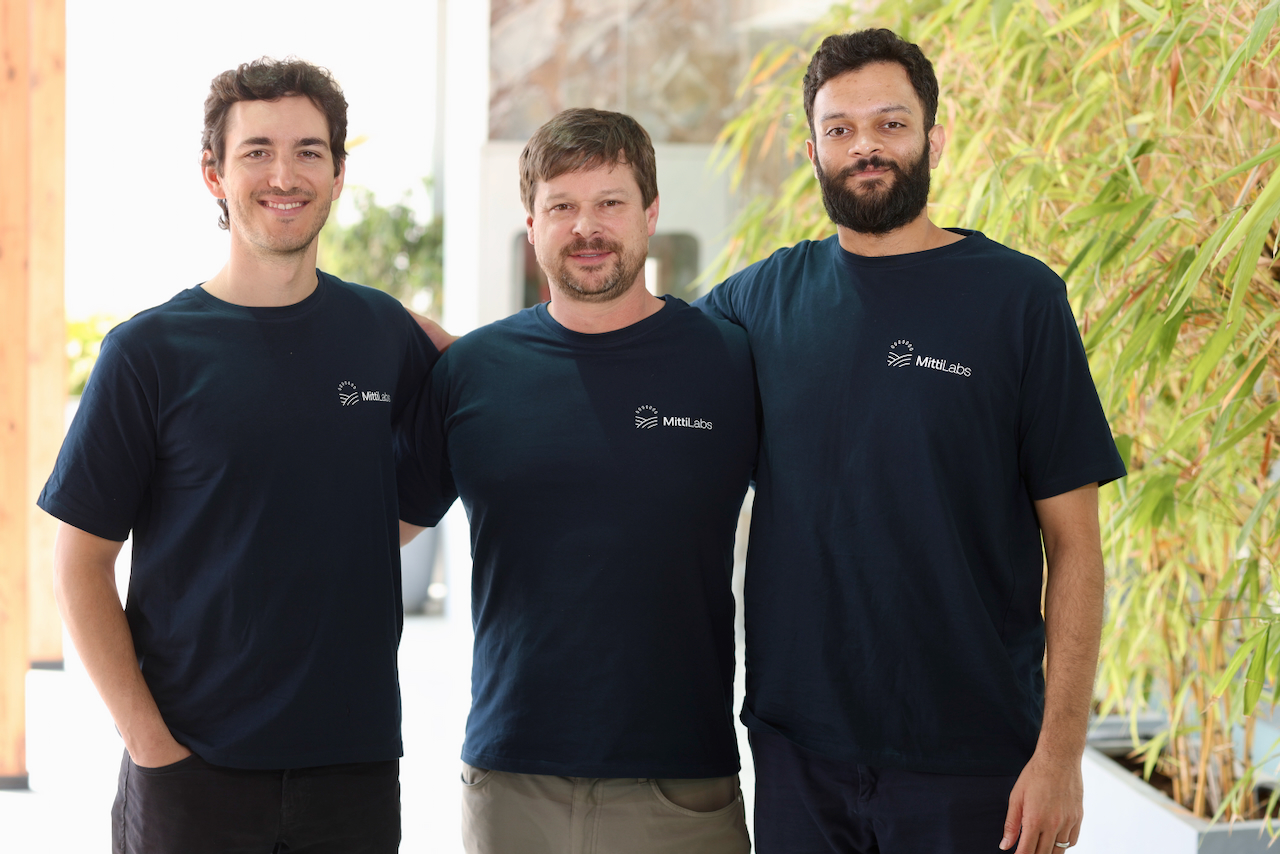
It’s World Environment Day today, and the latest episode on my podcast features a conversation with the founders of Mitti Labs on their carbon project to help rice farmers cut methane emissions from their fields, save water and make money from the sale of the carbon credits generated from the green house gas reduction.
$12.8 billion: Cumulative climate tech funding in India according to a new report
Tracxn, a global private markets data provider, has just released its India Climate Tech Report 2026, saying that the sector is becoming increasingly investible.
On Tuesday, I’ll publish Part 2 of a wonderful conversation with Naganand Doraswamy (managing partner) and Suryaprakash Konanuru (CTO), founders of Ideaspring Capital. We talk about what might represent the ‘Flipkart moment’ of deep tech in India, and plans for the VC firm ahead.
That’s it for today. When you have a minute, please would you share this with friends who might be interested in India’s deep tech and climate tech startups. Here’s wishing you a great rest of the day.
Arjun Dutt, a partner at Bain & Company, spoke with me a couple of weeks ago on the global consultancy’s views on how robotics technologies are evolving.
Arjun recently co-authored a note on the impact of early commercialisation of humanoid robots — how that will likely play out in three waves, from ‘brownfield’ plants to eventually, our homes. You can catch the full conversation via the related post below. Here’s a short chapter with Arjun briefly explaining the four critical areas in which advancements are needed before humanoids can be more human-like.
And one technology might be holding back even faster adoption of these robots. It might surprise you to know that it’s not intelligence.
In this episode, I’m joined by Manish Singhal, founding partner of pi Ventures, a Bengaluru-based early-stage venture capital firm backing some of India’s most ambitious deep tech startups.
India’s start-up story is often told through software and services. Yet a quieter transformation is under way in laboratories, machine shops and clean rooms. And Manish has been one of the earliest investors consistently supporting this gradual change, first as an angel investor and then through pi Ventures.
Over the past decade, pi Ventures has gone from backing AI-led software plays to financing startups in sectors such as space, semiconductors, robotics, clean energy and electric mobility. From its first fund, pi Ventures backed companies such as Zenatix, Niramai, Sigtuple, Locus, and Wysa, but also Agnikul Cosmos.
The firm is currently investing from its second fund, which, at $85 million, is almost three times the first fund. Its portfolio now includes startups building 3D-printed rocket engines, optical interconnects for data centres, electric tractors designed from first principles and in-orbit satellite “jetpacks” that extend the life of multi-million-dollar assets.
“Founders in India are dreaming big. Founders in India are not thinking India. Founders in India are thinking global from day one.”
Manish Singhal
Prior to pi Ventures, which turns 10 in March, Manish started out as an electrical engineer from IIT Kanpur, and accumulated two decades of operating experience – building products and teams at companies including Motorola, Ittiam Systems, and Sling Media, where he helped scale the company’s India R&D centre.
His firm’s recent investments such as Moonrider (electric tractors), LightSpeed Photonics (optical interconnects for AI data centers), and Aule Space (in-orbit satellite servicing) reflect Manish’s conviction that Indian startups can build globally relevant deep tech products.
He is not unaware of the still entrenched and considerable challenges in the way those dreaming of deep tech success from India. And he’s also clear-eyed about the limits of industrial policy, and wary of fads in “indigenous” technology.
But Manish is optimistic, when he talks about how deep tech founders in India are becoming more audacious in their aspirations and how India is on the cusp of being seen as a genuine deep-tech nation.
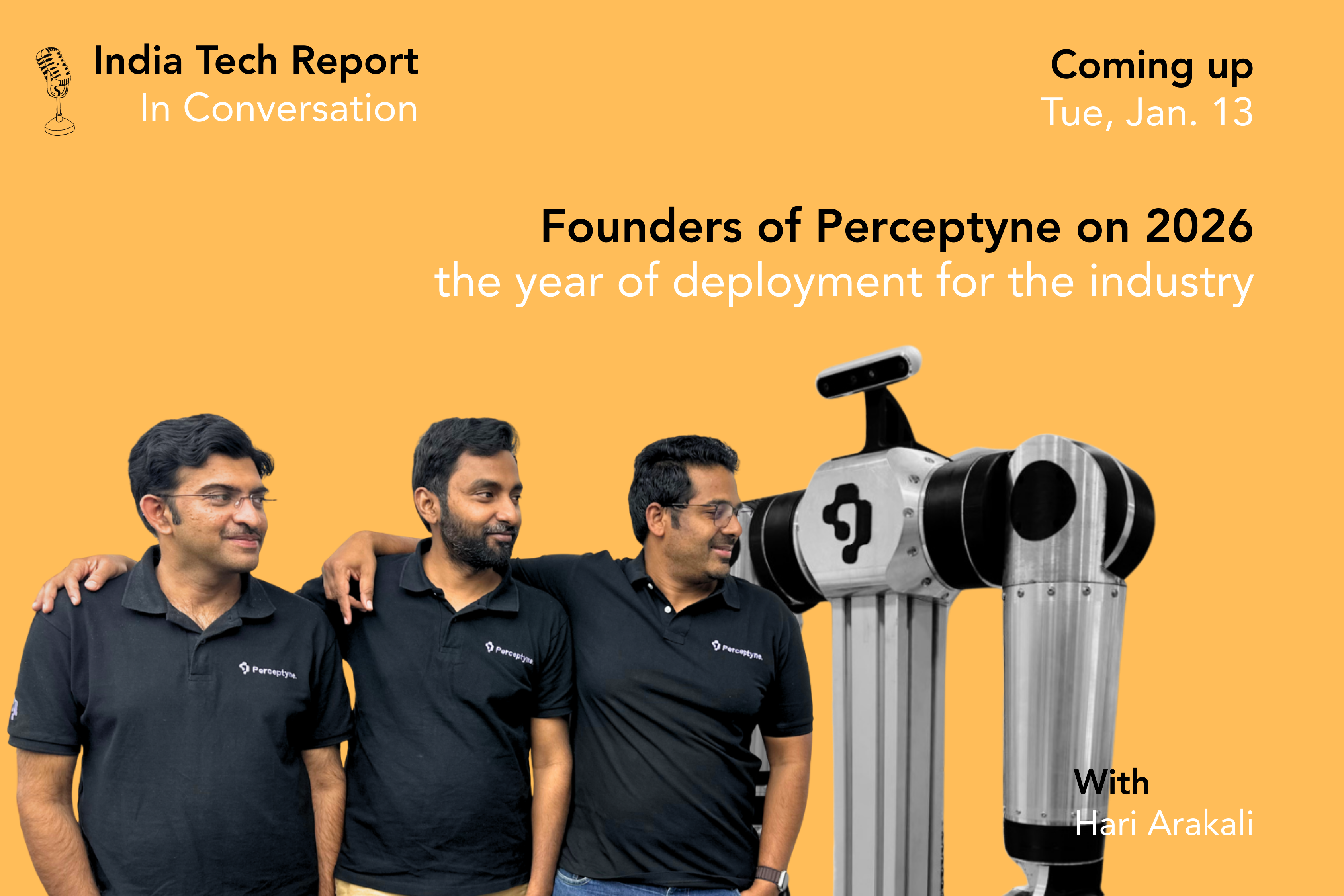
Founders of Perceptyne Robots, Mrutyunjaya N, Raviteja Chivukala and Jagga Raju N are building autonomous, dexterous robots and the physical AI stack needed.
Happy new year to all of you deep tech enthusiasts in India. An area in which 2026 is already shaping up to be one that will likely see advances, is robotics and automation and the AI needed for this, being called physical AI or even ’embodied AI’.
If you caught Boston Dynamics CSO Marc Theermann recently saying the company’s Atlas humanoid is “not designed for YouTube” but for the real world, what’s your view on that — premature or prophetic? Will 2026 show us?
Listen to the preview
To kick off my reports this year, I got a chance to chat with a dynamic entrepreneur trio building what they say will be autonomous and dexterous robots for the real world — at Perceptyne Robots.
So, coming up on Tuesday, Jan. 13, this year’s first episode of India Tech Report: In Conversation, will feature Mrutyunjaya N, Raviteja Chivukala and Jagga Raju N, co-founders of this Hyderabad-based robotics and physical AI startup.
Their venture, which turns four this year, is backed a couple of well-known deep-tech VC firms, Yali Capital and Endiya Partners. Catch the full conversation right here, or wherever you get your podcasts. Here’s a less-than-a-minute preview.
In this week’s episode of In Conversation, I spoke with Kunal Khattar, founding managing partner at AdvantEdge Founders, a ‘sector-focused’ early-stage VC firm in New Delhi that’s well known for backing founders in the EV and mobility sectors in India.
AdvantEdge is into its 10th year now and known for backing startups like Rapido, Chalo, ZingBus, Park+, Baaz, Shuttl, and Exponent Energy, with close to 40 companies in its portfolio across its first two funds. The firm is close to announcing the first close of its third fund which has a targeted total of $75 million.
Kunal says his mission is to foster a 100 successful entrepreneurs in the mobility space. We discussed a range of connected topics, including why he expects the EV space to hit the J-curve growth stage over the next three to five years, how replacing the overall ICE economy in India is a trillion-dollar opportunity, and the rise of deep tech and new solutions like clean hydrogen in India’s mobility space.
Here are my top 10 takeaways.
1. AdvantEdge’s sector focus and founder-first philosophy
Khattar explains that AdvantEdge Founders was built with a clear mission: to create 100 successful founders, not just unicorns or high returns. The fund’s North Star metric is founder success, and this ethos shapes everything from team titles to investment decisions. AdvantEdge views itself as a startup, with an operator’s mindset, emphasizing hands-on support and deep partnership with entrepreneurs throughout their early journeys.
2. India’s $1 trillion EV opportunity and the Suzuki 2.0 moment
Khattar draws a parallel between India’s auto sector transformation after Suzuki’s entry and the current EV revolution. He believes the transition from internal combustion engines (ICE) to electric vehicles could create $1 trillion in market value across OEMs, component suppliers, dealerships, financing, insurance, and energy distribution — mirroring the ecosystem Suzuki built, but now cantered on electrification and new business models.
3. Prioritizing commercial vehicle electrification for maximum impact
The fund’s thesis is to focus on electrifying commercial vehicles —two-wheelers, three-wheelers, buses, and trucks — because they represent only 10 percent of vehicles but account for 70 percent of energy consumption and emissions. Khattar argues that targeting commercial fleets first delivers greater environmental, economic, and social returns, including reduced oil imports and improved livelihoods for millions dependent on these vehicles.
Unlike the US or China, India’s mobility market is dominated by two- and three-wheelers, buses, and commercial vehicles. AdvantEdge avoids direct comparisons with Western markets and instead focuses on form factors where India is already a global leader. This approach enables the fund to back solutions tailored to Indian needs and scalable across similar emerging markets.
5. The “picks and shovels” approach to building the EV ecosystem
AdvantEdge invests in the enabling infrastructure of the EV transition — what Khattar calls “picks and shovels” companies. These include EV component makers, charging networks, financing and leasing platforms, insurance providers, and energy distribution businesses. The goal is to support the foundational B2B solutions that will underpin the entire EV value chain, rather than just consumer-facing brands.
6. Timing investments for J-curve growth and sector cycles
Khattar emphasizes the importance of entering sectors at the right time — when J-curve growth is imminent but before valuations become overheated. AdvantEdge is willing to invest in pre-revenue, pre-product companies at the earliest stages, drawing on its operational expertise to help them reach product-market fit. This disciplined timing avoids the pitfalls of entering too early or too late in sector cycles.
7. Deep tech and problem-driven innovation are key differentiators
The fund seeks out deep technology startups that solve fundamental barriers to EV adoption, such as charging speed, range anxiety, and cost. For example, Exponent Energy, a portfolio company, developed proprietary tech to fully charge EVs in under 15 minutes—addressing multiple pain points for commercial operators and accelerating EV adoption in India’s unique market context.
8. Collaborative ecosystem building with other funds and founders
AdvantEdge actively collaborates with larger funds, global investors, and its own portfolio founders to build a thriving ecosystem. “It takes a village,” he says, and believes in sharing research, co-investing, and using complementary strengths is essential. The value of this network compounds with each new investment, creating a snowball effect of knowledge and opportunity.
9. Pragmatic view on hydrogen and next-gen battery tech
Khattar is sceptical about the near-term disruption potential of hydrogen and solid-state batteries in India. He argues that such technologies are at least a decade away from mainstream adoption and that India should focus on indigenous innovation suited to its market realities, rather than chasing the latest breakthroughs from advanced economies.
10. Building for India, not benchmarking against China or the West
Khattar urges Indian founders and investors to avoid direct comparisons with China or the US. Instead, he advocates for building solutions that address India’s unique challenges and opportunities, tapping local strengths in two and three-wheeler markets and focusing on incremental progress. The goal is to create a better India, not to replicate foreign models.