Tag: podcast

  • Indian scientists advance zinc-ion battery tech, Minister Vaishnav opens US manufacturer Jabil’s Pune hub

    Indian scientists advance zinc-ion battery tech, Minister Vaishnav opens US manufacturer Jabil’s Pune hub

    Hi,

    Wherever you’re reading this, I hope you’re doing well. Thank you for supporting my work by being a subscriber. It means a lot.

    The Lede

    Indian scientists develop an electrolyte additive to improve commercial viability of zinc-ion batteries

    Indian researchers have reported an electrolyte additive that could make aqueous zinc-ion batteries safer, longer-lasting and more affordable, a modest but potentially useful advance for large-scale energy storage. The work, led by scientists at the Institute of Nano Science and Technology under the Department of Science and Technology, targets the interface problems that have slowed commercial adoption.

    Aqueous zinc batteries have long looked like a practical alternative to lithium-ion systems because they use cheaper materials and are inherently safer, but their promise has been blunted by dendrite growth, corrosion and hydrogen evolution. The new approach does not rely on expensive redesigns of the battery itself; instead, it uses a small additive, BDIM, to alter surface behaviour where the chemistry matters most.

    The broader significance lies in the world’s urgent search for grid storage that is inexpensive, durable and easy to scale as renewables expand. If zinc-based batteries can be made to last longer without sacrificing safety, they could find a niche in backup power, renewable integration and other stationary applications where cost and reliability matter more than energy density.

    “BDIM selectively adsorbs on zinc metal surfaces and regulates the Inner Helmholtz Plane of aqueous zinc ion batteries,” the release says, describing the mechanism behind the advance. It adds that the additive displaces water molecules at the interface, reducing hydrogen evolution, corrosion and dendrite formation. The research, led by Dr Ramendra Sundar Dey, has been published in ACS Electrochemistry.

    The practical appeal is clear: an incremental materials fix may prove more scalable than a wholesale rethink of battery chemistry. That is the sort of advance energy storage needs, not a breakthrough in search of a market, but a careful engineering tweak aimed at making existing ideas work better.

    One other headline

    Union Minister Ashwini Vaishnaw inaugurates US manufacturer Jabil’s Pune hub

    Union minister Ashwini Vaishnaw inaugurated Jabil’s advanced manufacturing facility and export-focused data centre ecosystem in Pune, highlighting high employment potential and India’s electronics push.

    This week’s episode in Conversations

    If you missed the latest episode’s release on Tuesday, here’s a chat with Ramamurthy Sivakumar, co-founder and CEO at HrdWyr, a semiconductor startup in Bengaluru.

    And coming up
    Today’s Pick

    A daily recommendation of a conversation with a founder, VC investor or industry executive, or an interesting text read as well

    Founder Spotlight

    A weekly recommendation of interviews with founders. From the Conversations section of ITR’s archive. Changes every Friday.

    That’s it for today. When you have a minute, please would you share this with friends who might be interested in India’s deep tech and climate tech startups. Here’s wishing you a great rest of the day.

  • What’s a Wankel engine and why India’s advancing it’s indigenisation

    What’s a Wankel engine and why India’s advancing it’s indigenisation

    Hi,

    Wherever you’re reading this, I hope you’re doing well. Thank you for supporting my work by being a subscriber. It means a lot.

    The Lede

    This headline I stumbled upon is courtesy G S Madhusudhan at Incore Semiconductors and IIT Madras. He’d posted it with a couple of pithy comments on LInkedIn on the significance of this development for India’s UAV ecosystem.

    India is making significant strides in indigenisation of engines for UAVs (unmanned aerial vehicles) by developing and certifying a variety of indigenous version. Collaborative efforts between government bodies such as CSIR-NAL and private companies such as Solar Defence and TridenTech have led to the made-in-India versions of Wankel rotary engines and high-power diesel systems.

    The Indian-made power plants are being integrated into diverse platforms, including the TAPAS-BH-201 for long-range surveillance and the 150 kg class “Loitering Munition” for precision strikes. As India’s drone ecosystem takes off, it will also support applications in agriculture and disaster rescue operations.

    The Wankel engine derives its name from the German engineer Felix Wankel who invented and developed it between the late 1920s and 1950s. And automakers like Mazda really took to it. Today the engine is seeing use in Indian UAVs.

    This week’s episode in Conversations

    If you missed the latest episode’s release on Tuesday, here’s a chat with Ramamurthy Sivakumar, co-founder and CEO at HrdWyr, a semiconductor startup in Bengaluru.

    And coming up

    Today’s Pick

    A daily recommendation of a conversation with a founder, VC investor or industry executive, or an interesting text read as well

    Founder Spotlight

    A weekly recommendation of interviews with founders. From the Conversations section of ITR’s archive. Changes every Friday.

    That’s it for today. When you have a minute, please would you share this with friends who might be interested in India’s deep tech and climate tech startups. Here’s wishing you a great rest of the day.

  • Coming up: Vinod Shankar at Java Capital challenges India’s ultra rich to back deep innovation

    Coming up: Vinod Shankar at Java Capital challenges India’s ultra rich to back deep innovation

    Coming up in the next episode of Conversations at India Tech Report, Vinod Shankar, founding managing partner at Java Capital, discusses a note he wrote recently, calling on India’s ultra rich to back deep innovation in the country with just 10 percent of their money.

    They can afford this, and he does so with his own money, Vinod says. The result of this collective effort, if it happens, could be the transformation of India’s science and engineering innovation landscape, he argues.

    Catch the full interview right here on Tuesday, June 23 at 6 a.m. IST. Here’s a 90 second preview.

  • A deep tech VC’s impassioned plea to the desi ultra rich to unlock startups’ true potential

    A deep tech VC’s impassioned plea to the desi ultra rich to unlock startups’ true potential

    Hi,

    Wherever you’re reading this, I hope you’re doing well. Thank you for supporting my work by being a subscriber. It means a lot.

    The Lede

    Chances are, you’ve already come across this piece on LinkedIn, especially if you track India’s deep tech ecosystem. If not, it’s worth reading:
    https://www.linkedin.com/pulse/i-want-india-win-just-my-money-vinod-shankar-cjkac/

    Vinod Shankar, founding managing partner at Java Capital, posted this piece about three weeks ago. I’m bringing it to your attention today because we caught up this morning at the Beehive on Church Street to record an episode around the points he makes in the essay. That’s coming up Tuesday next week.

    And, as he points out himself, he’s not the first to raise these issues with the dearth of capital for India’s deep tech startups, even as the RDI fund begins to boost the momentum for the flywheel. The back of the envelope math he’s pointing to is that the government has committed tens of billions to these new initiatives, from the semiconductor mission to frontier technologies, but trillions dollars in wealth are locked away in real estate and gold in rich households.

    He calls for the ultra affluent to consider investing a tenth of their wealth in backing deep tech, and argues the returns for them, and the country’s economy could be transformative. Please read his original essay and the many thoughtful comments also that several senior figures have responded with, spanning industry, VC and entrepreneurship.

    I’ve also pasted below an AI-generated bullet point summary here.

    In his essay, Vinod Shankar argues that India’s path to becoming a developed nation is being stifled by a systemic refusal of its wealthiest citizens and corporations to invest in domestic innovation.

    Here is a summary of the key points:

    • The “Sediment” of Wealth: India’s wealthiest 1 percent hold roughly 60 percent of their $11.6 trillion in wealth in real estate and gold, which the author describes as “sediment”—unproductive capital that has stopped moving and does not fund the future.
    • Funding the Past, Not the Future: While the “SIP boom” has increased financial participation, most of this capital flows into the Nifty 50, an index dominated by legacy sectors like finance and oil. These companies are “indices of the present” rather than the global technological frontiers.
    • Corporate R&D Abdication: Indian corporations are “structurally allergic” to R&D risk, spending only 0.88 percent of turnover on innovation. In contrast, global giants like NVIDIA spend more on R&D in a single quarter than India’s entire corporate sector spends in a year.
    • The Innovation Funding Gap: India’s total R&D spend remains stagnant at 0.65 percent of GDP, significantly lower than China (2.65 percent) or Israel (6.33 percent). Furthermore, unlike successful tech nations where the private sector leads R&D, the Indian private sector contributes only 36.4 percent of that total.
    • Outsourcing Equity Ownership: Due to a lack of domestic risk-takers, the funding for Indian deep tech often comes from foreign entities. This creates a paradox where India builds the rockets, but foreign investors own the equity and extract the eventual returns.
    • The “Colonial” Mindset of Capital: The author compares the current HNI preference for rent-seeking and gold to a “feudal” or “colonial” mindset, contrasting it with the high-risk “adventurism” that originally built global empires and Silicon Valley.
    • The 10 percent Call to Action: To achieve the goal of “Viksit Bharat 2047,” Shankar challenges India’s wealthy to allocate 10 percent of their net worth to early-stage deep tech. He argues that technological sovereignty cannot be built on slogans, but requires patient, domestic, risk-tolerant capital.

    The latest episode in Conversations

    If you missed the latest episode’s release yesterday, here’s a chat with Ramamurthy Sivakumar, co-founder and CEO at HrdWyr, a semiconductor startup in Bengaluru.

    Today’s Pick

    A daily recommendation of a conversation with a founder, VC investor or industry executive, or an interesting text read as well

    Founder Spotlight

    A weekly recommendation of interviews with founders. From the Conversations section of ITR’s archive. Changes every Friday.

    That’s it for today. When you have a minute, please would you share this with friends who might be interested in India’s deep tech and climate tech startups. Here’s wishing you a great rest of the day.
  • Shipping custom silicon from India, ambition must get practical and other lessons from an Intel veteran

    Shipping custom silicon from India, ambition must get practical and other lessons from an Intel veteran

    Hi,

    Wherever you’re reading this, I hope you’re doing well. Thank you for supporting my work by being a subscriber. It means a lot.

    A couple of headlines that caught my attention

    HCLTech to acquire 10.46 percent stake in Sarvam AI

    HCLTech will invest Rs. 1,427.25 crore for a 10.46 percent stake in Sarvam AI, leading its $234 million Series B funding round to advance sovereign AI.

    India and France adopt Innovation Roadmap 2030

    India and France have adopted the Innovation Roadmap 2030, establishing a framework for bilateral cooperation in trusted AI, critical technologies, and academic mobility.

    The Lede

    It boils down to what is viable, especially when it comes to an endeavour like making a semiconductor chip from a nascent ecosystem like the one in India, with the expectation that customers will actually buy it in volume.

    That means, even if two founders are industry veterans and they’ve assemble a strong team of engineers, designers and marketers, everything gets determined by how much money is available. In India, a Series A is in the range of $10-15 million for a chip design company, and sometimes less. And, it takes a long time to raise even this.

    Siva and Ganesh, who’ve together close to half a century of experience under their belt, look at HrdWyr as a commercial enterprise for sure — they have VC investors, after all — but also as a “nation building” contribution.

    And the investors who led their Series A are like-minded. Naganand Doraswamy and Suryaprakash Konanuru at Ideaspring Capital, would like to back ventures like HrdWyr with as long a runway as they can make possible, but with the limited resources of an early stage VC firm.

    HrdWyr, founded in 2023, is following through by year end on the small, but historic, milestone it announced August last, as you’ll hear in the conversation. I’d love to hear your thoughts.

    Custom silicon: Ramamurthy Sivakumar at HrdWyr on the opportunity to build from India for the world

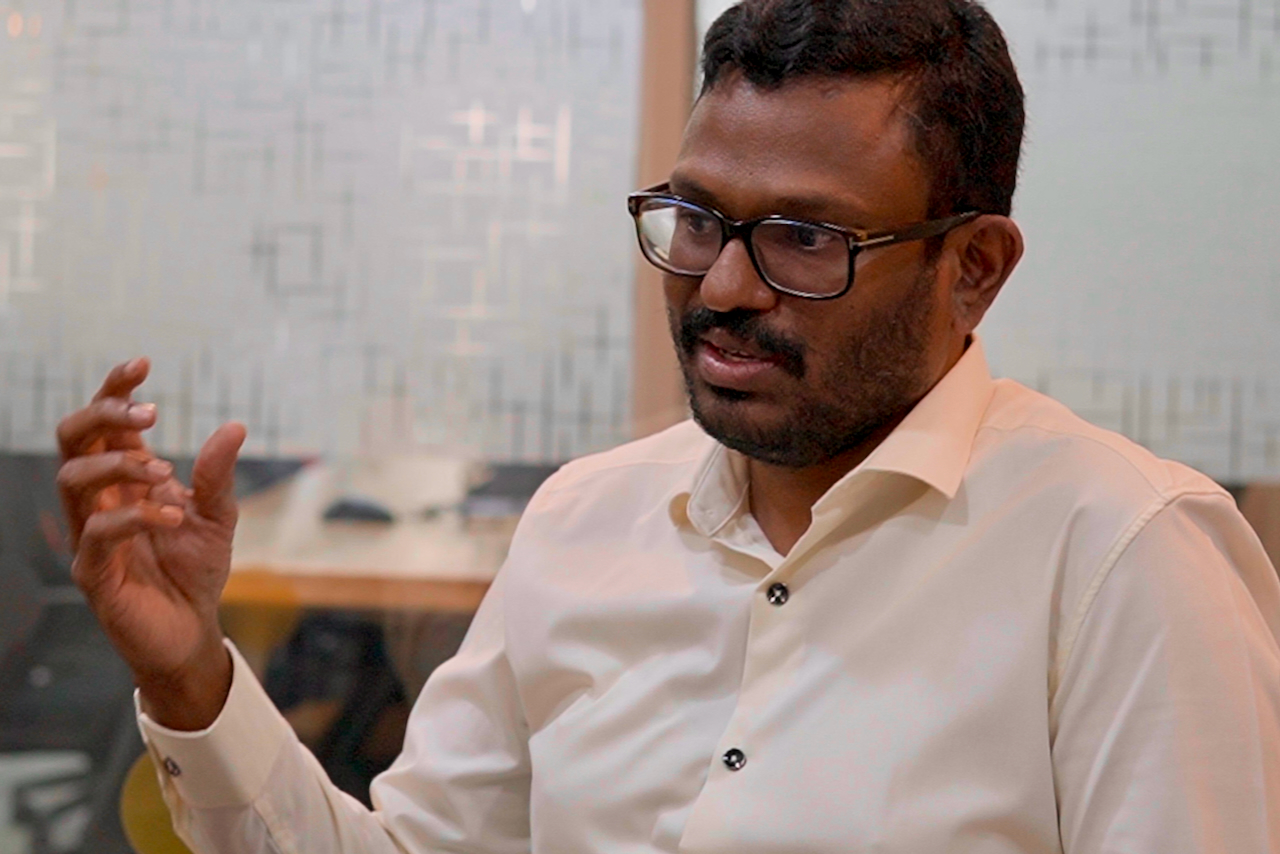
    In today’s episode, Ramamurthy Sivakumar, co-founder and CEO at HrdWyr, a semiconductor design startup in Bengaluru, talks about the company’s plans after recently raising $13 million in Series A funding, in an investment led by Ideaspring Capital. The company was co-founded in 2023 by Siva and Ganesh Guruswamy, both industry veterans spanning companies including Intel,…

    Today’s Pick

    A daily recommendation of a conversation with a founder, VC investor or industry executive, or an interesting text read as well

    Founder Spotlight

    A weekly recommendation of interviews with founders. From the Conversations section of ITR’s archive. Changes every Friday.

    That’s it for today. When you have a minute, please would you share this with friends who might be interested in India’s deep tech and climate tech startups. Here’s wishing you a great rest of the day.

  • What building from India means for a semiconductor veteran founder

    What building from India means for a semiconductor veteran founder

    Hi,

    Wherever you’re reading this, I hope you’re doing well. Thank you for supporting my work by being a subscriber. It means a lot.

    The lede

    Coming up: Ramamurthy Sivakumar at HrdWyr on the implications of building chips from India

    In August last year, a little known semiconductor startup (at the time) founded by two industry veterans from India, announced a small, but historic milestone. Not just for themselves, but the country.

    The startup, HrdWyr Ventures, now more popularly, just HrdWyr, had struck two partnerships, one with Tata Electronics for the packaging of its first chip, and the other with boAt, the consumer electronics company, as an anchor customer for the new processor.

    boAt would use their chip, named Indus 1011, in its truly wireless stereo earbuds charging cases, the companies had announced. Earlier this month, HrdWyr announced the successful close of its Series A funding round, raising $13 million in an investment led by the well known Bengaluru deep tech VC firm Ideaspring Capital.

    Last week, I got a chance to sit down with Ramamurthy Sivakumar, co-founder and CEO of HrdWyr to get a sense of what next for him, Ganesh Guruswamy, and their team of 18 engineers.

    Catch the full interview right here tomorrow, 6 a.m. IST. Here’s a quick preview, in which Siva talks about the practical decisions semiconductor entrepreneurs have to make, especially when they decide to go build in a nascent ecosystem such as the one in India.

    Today’s Pick

    A daily recommendation of a conversation with a founder, VC investor or industry executive, or an interesting text read as well

    Founder Spotlight

    A weekly recommendation of interviews with founders. From the Conversations section of ITR’s archive. Changes every Friday.

    That’s it for today. When you have a minute, please would you share this with friends who might be interested in India’s deep tech and climate tech startups. Here’s wishing you a great rest of the day.