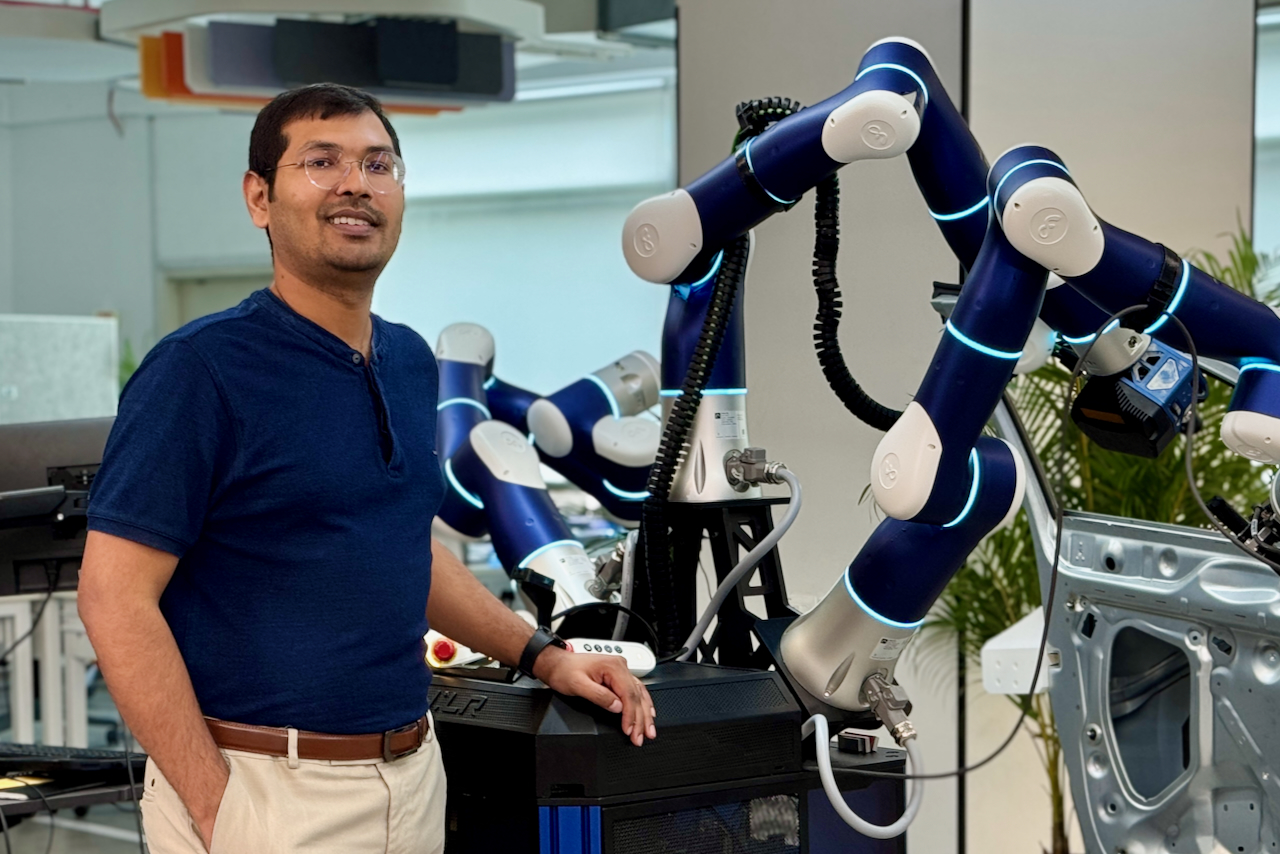
Coming up, a conversation with Gokul NA, founder and head of product, design & brand at CynLr (Cybernetics Laboratories), a robotics startup in Bengaluru.
Gokul, his fellow founder Nikhil Ramaswamy, and their team at CynLr, have recently released what he described as an Object Intelligence Stack. The technology aims to mimic the curiosity and adaptability of a human infant, allowing robots to manipulate unfamiliar items without specific prior training.
By collaborating with the Centre for Neuroscience at the Indian Institute of Science, CynLr is translating brain-function research into a sophisticated software and sensor framework. Their long-term vision involves creating a manipulation operating system and an “object store” and a “task store” to transform flexible manufacturing, just as the App Store transformed the smartphone.
Currently, they are deploying these solutions in the automotive and semiconductor industries to automate some complex manual assembly processes. You can catch the full conversation on Friday, March 6 right here or wherever you get your podcasts.
Here’s a one-minute preview with Gokul envisioning a future “manipulation OS” for robots of which the object intelligence stack is the precursor.
Coming up, a conversation with Gokul NA, founder and head of product, design & brand at CynLr (Cybernetics Laboratory), a robotics startup in Bengaluru.
Gokul, his fellow founder Nikhil Ramaswamy, and their team at CynLr, have recently released what he described as an Object Intelligence Stack. The technology aims to mimic the curiosity and adaptability of a human infant, allowing robots to manipulate unfamiliar items without specific prior training.
By collaborating with the Centre for Neuroscience at the Indian Institute of Science, CynLr is translating brain-function research into a sophisticated software and sensor framework. Their long-term vision involves creating a manipulation operating system and an “object store” and a “task store” to transform flexible manufacturing, just as the App Store transformed the smartphone.
Currently, they are deploying these solutions in the automotive and semiconductor industries to automate some complex manual assembly processes. You can catch the full conversation on Friday, March 6 right here or wherever you get your podcasts.
Here’s a 90-second preview with Gokul giving a brief description of the object intelligence stack.
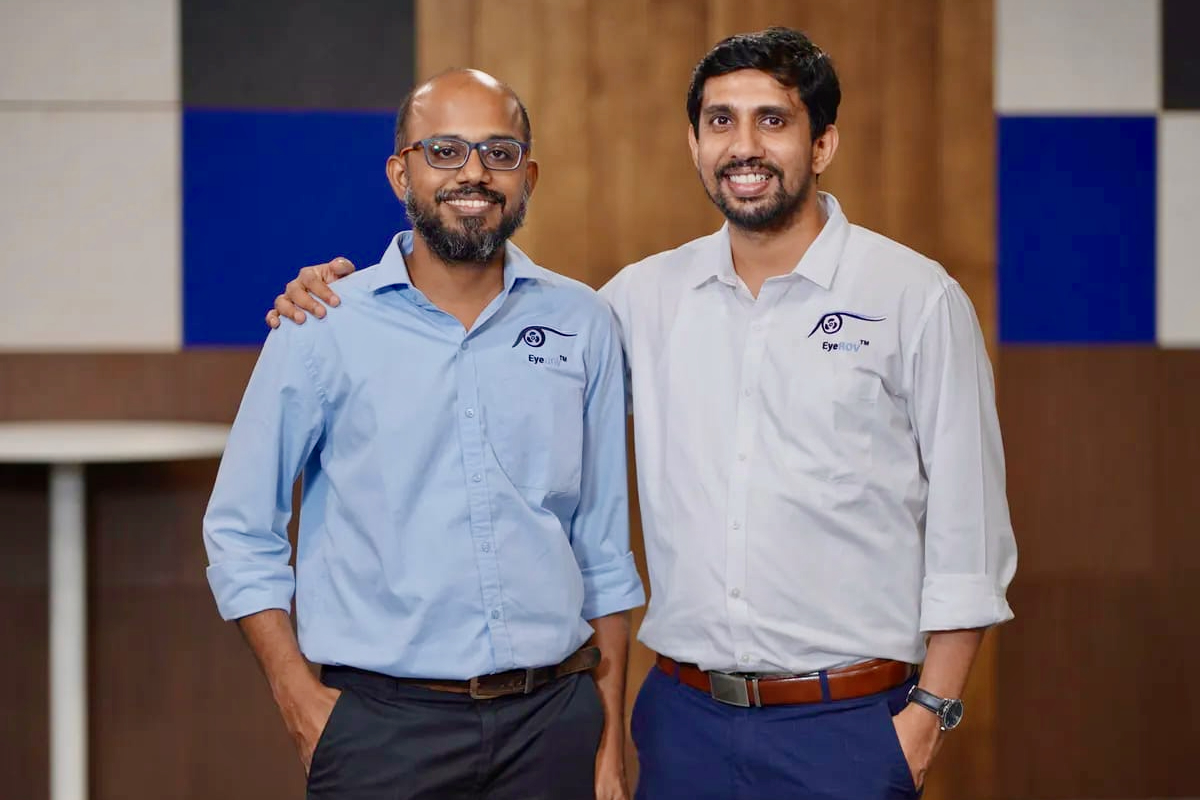
EyeROV Founders (L-R) Kannappa Palaniappan P (CTO) and Johns T. Mathai (CEO). Image source: Company. Editing by Hari Arakali.
For a start-up navigating the murky depths of the Indian Ocean, IROV Technologies (EyeROV) is beginning to see quite clearly. The Kochi-based marine robotics startup has raised Rs. 13 crore in pre-Series-A funding, co-led by AWE Funds and Unicorn India Ventures, according to a press release.
The money is intended to bolster research and development as EyeROV seeks to expand beyond its domestic shores into global markets.
Since its founding in 2017 by IIT alumni Johns T. Mathai (CEO) and Kannappa Palaniappan P (CTO), EyeROV has carved out a niche in the high-stakes world of underwater inspection. With a portfolio that includes a proprietary 10km long-tunnel inspection capability, the company has already completed over 150 projects for industrial heavyweights such as Maersk, ONGC, and Adani.
Its Robotics-as-a-Service model aims to replace high-risk manual diving with autonomous, sustainable electric systems, a shift underscored by a recent Rs. 47 crore order from the Indian Navy.
Indian startups such as EyeROV are developing products to win a share of the global market for maintenance of offshore assets which is seeing a shift from manual, hazardous operations to automated surveillance.
EyeROV estimates a $13 billion global addressable market for underwater infrastructure inspection. Deep-tech companies are increasingly viewed as essential for the long-term viability of the aging energy pipelines, subsea cables, and ports that underpin international trade.
“Some of the world’s most critical infrastructure such as energy pipelines, subsea cables, ports are offshore assets. They are all beneath the ocean’s surface and historically maintained through high-risk, manual, and expensive operations. We believe this is precisely where deep technology creates both outsized returns and meaningful impact,” Seema Chaturvedi, Founder and Managing Partner of AWE Funds, said in the press release.
The broader environment for Indian deep tech is warming, spurred by government grants and a burgeoning innovation ecosystem. For EyeROV, this round is a strategic precursor to a planned $10 million Series A, as it seeks to capture a larger share of the $800 million Indian market.
“With our recent Rs. 47 crore Indian Navy order and the surging demand for specialized inspections in the energy and infrastructure sectors, EyeROV has reached a clear inflection point,” CEO Mathai said in the press release. “This funding will accelerate our trajectory as we scale our technology and expand our footprint internationally.”
In a recent episode of Conversations at India Tech Report, Jay Panchal, founder and CEO at Aule Space spoke about his young space-tech startup’s vision to help build India’s robot workforce in space.
Aule is starting on that journey with the aim of launching a fleet of “jetpacks” that will work as mission extension vehicles for geostationary satellites and offer other applications in the defense sector as well.
You can find the full conversation at indiatechreport.in or wherever you get your podcasts.
Here’s a quick chapter on some of Jay’s important formative experiences that set him on the path to entrepreneurship in the space economy.
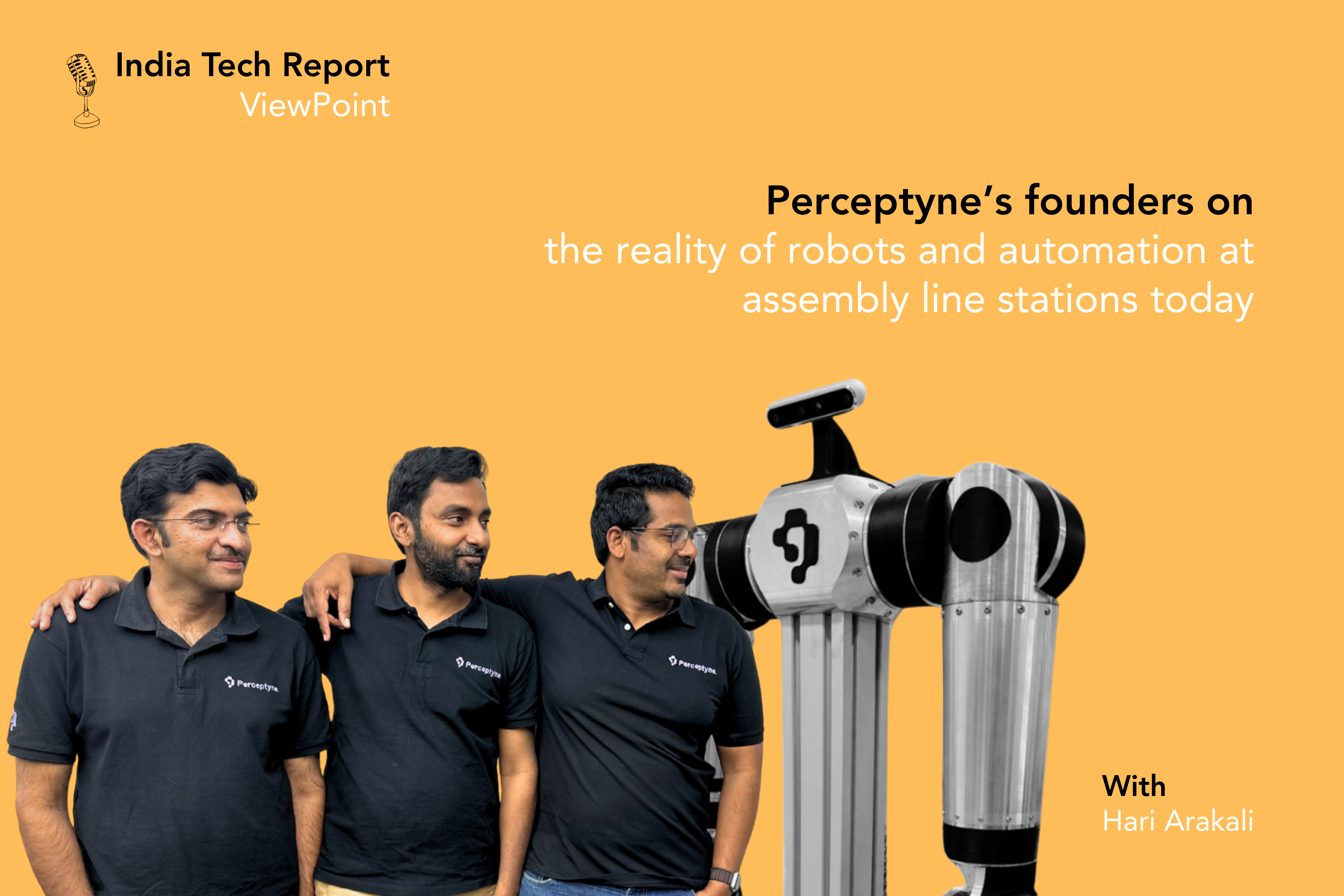
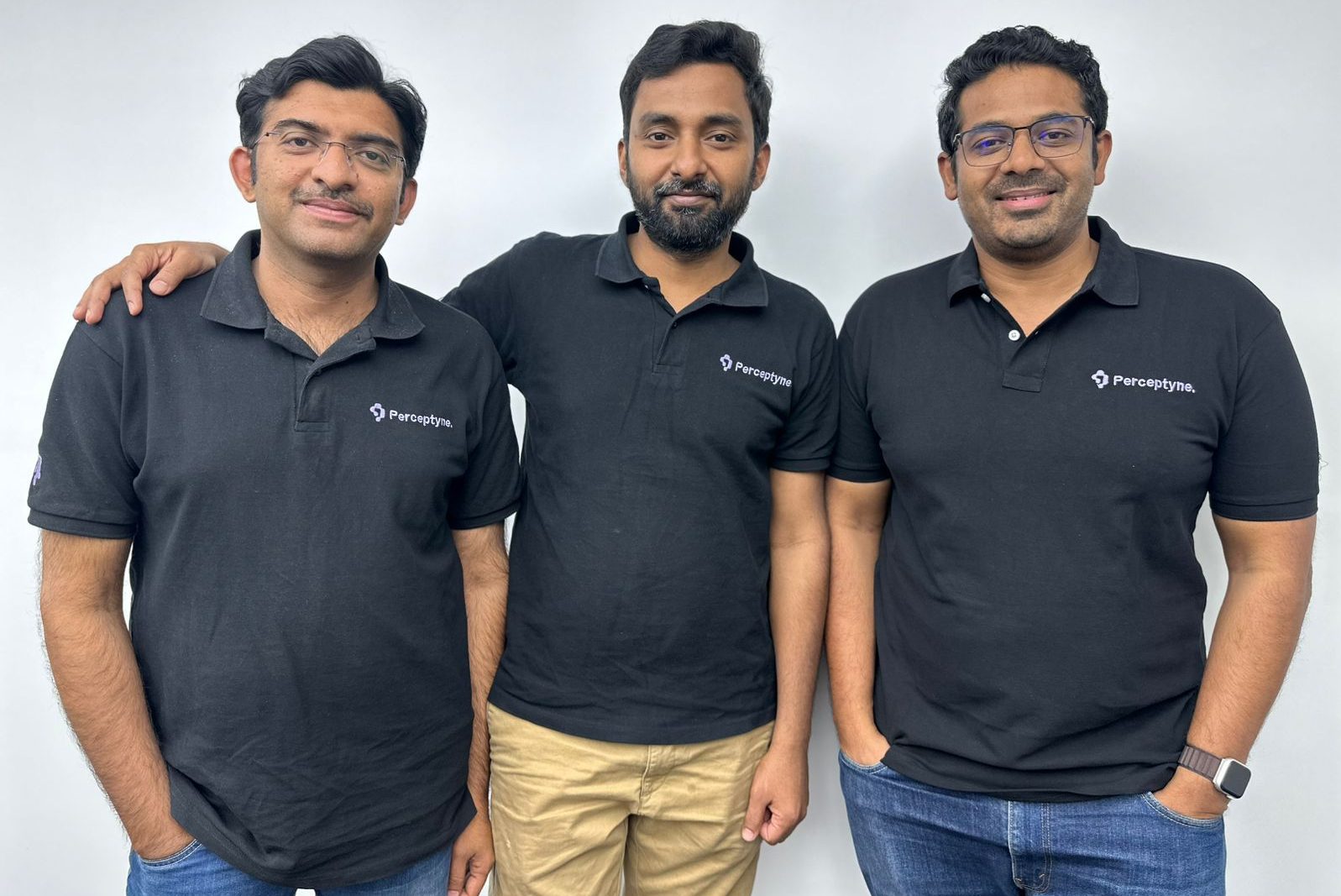
Founders of Perceptyne Robots, Mrutyunjaya N, Raviteja Chivukala and Jagga Raju N are building autonomous, dexterous robots and the physical AI stack needed.Listen to the audio
What are some of the practical, seemingly small but truly challenging engineering problems in translating what seems intuitive to humans to robotics automation, today?
Mrutyunjaya N, Raviteja Chivukala and Jagga Raju N, founders of Perceptyne Robots, explain here in simple terms in just a few minutes.
Perceptyne is a Hyderabad-based company building dexterous, dual-arm, intelligent robots for industrial automation, currently focused on automotive and electronics manufacturing lines.
The founders explain the gap they saw on real shop floors, where many assembly stations still rely on manual work because traditional approaches cannot handle unstructured inputs, fine force control, or frequent product changes.
The conversation goes into their vertically integrated hardware, including mobile configurations, and their PR-PhI “physical intelligence” software layer that orchestrates perception, control, and imitation-learning–based skills like visual servo, slip-free grasping, and force-based assembly.
You will also hear their take on the state of India’s robotics ecosystem, the evolution of robots as a combined hardware-and-software challenge, and how they are moving from pilots with global automotive and electronics manufacturers toward larger deployments. Perceptyne, which turns four this year, is backed by two well-known deep-tech VC firms, Yali Capital and Endiya Partners.