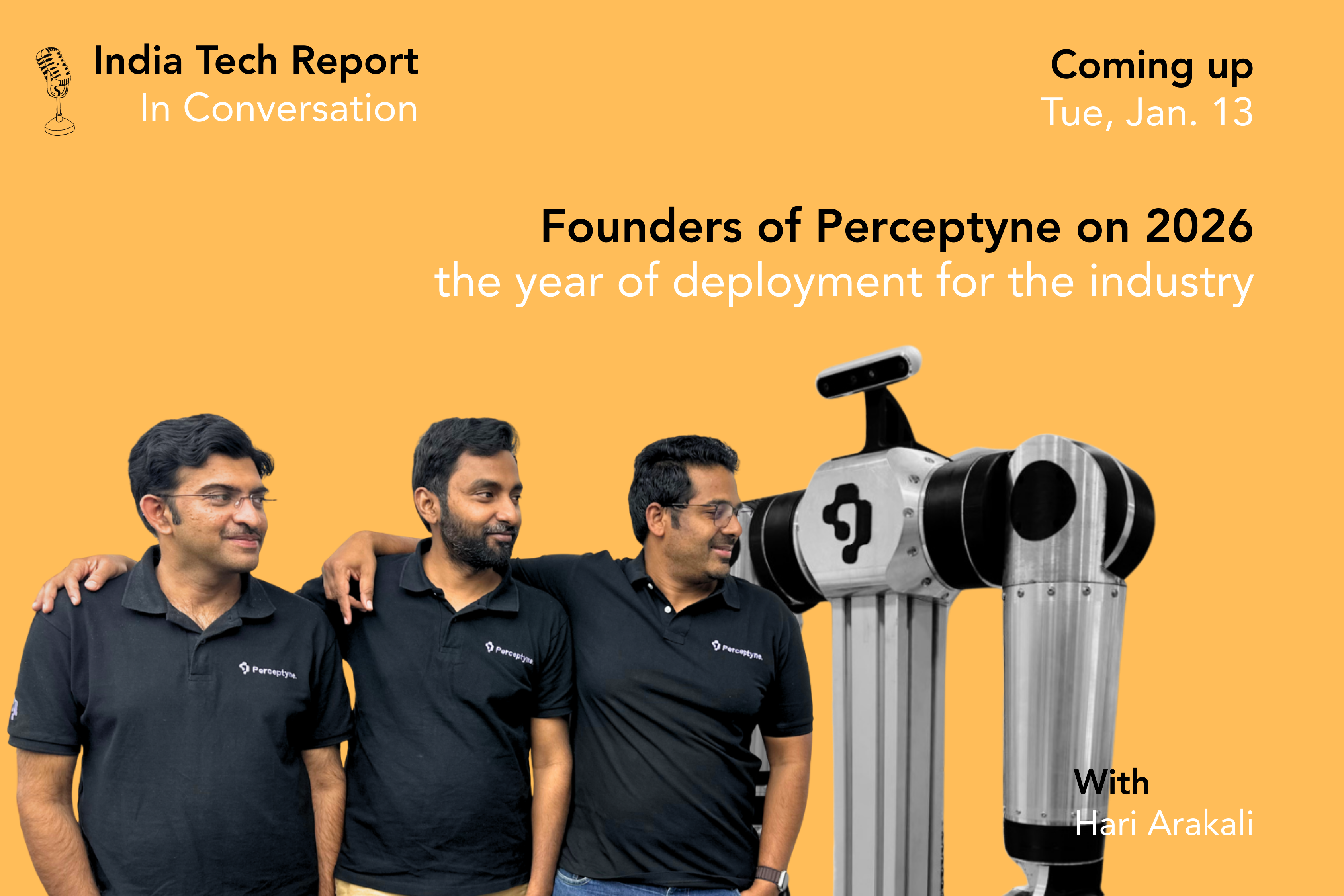
Founders of Perceptyne Robots, Mrutyunjaya N, Raviteja Chivukala and Jagga Raju N are building autonomous, dexterous robots and the physical AI stack needed.
Happy new year to all of you deep tech enthusiasts in India. An area in which 2026 is already shaping up to be one that will likely see advances, is robotics and automation and the AI needed for this, being called physical AI or even ’embodied AI’.
If you caught Boston Dynamics CSO Marc Theermann recently saying the company’s Atlas humanoid is “not designed for YouTube” but for the real world, what’s your view on that — premature or prophetic? Will 2026 show us?
Listen to the preview
To kick off my reports this year, I got a chance to chat with a dynamic entrepreneur trio building what they say will be autonomous and dexterous robots for the real world — at Perceptyne Robots.
So, coming up on Tuesday, Jan. 13, this year’s first episode of India Tech Report: In Conversation, will feature Mrutyunjaya N, Raviteja Chivukala and Jagga Raju N, co-founders of this Hyderabad-based robotics and physical AI startup.
Their venture, which turns four this year, is backed a couple of well-known deep-tech VC firms, Yali Capital and Endiya Partners. Catch the full conversation right here, or wherever you get your podcasts. Here’s a less-than-a-minute preview.
(00:20) Mobile robots market to nearly double by 2030
Global demand for mobile robots is set to surge, with the market projected to grow from $27.39 billion in 2025 to $52.11 billion by 2030, driven by AI, 5G, e-commerce, and labour shortages, while Asia-Pacific leads adoption and high costs, regulatory hurdles, and integration challenges remain important constraints.
(00:50) Hyundai debuts MobED autonomous robot platform at iREX 2025
Hyundai Motor Group has unveiled MobED, a production-ready autonomous mobility robot platform, at the iREX 2025 robotics show in Tokyo, positioning it as the company’s first mass-produced mobility robot for industrial and everyday applications, with Pro and Basic variants set for market launch in the first half of 2026.
(01:17) IFC backs Gujarat Fluorochemicals’ EV unit with $50 million
IFC will invest about $50 million in Gujarat Fluorochemicals’ EV venture GFCL EV Products to build India’s first fully integrated battery-materials plant, supporting local production of key inputs for electric vehicle and energy storage batteries and reducing import dependence while strengthening the country’s position in global clean-energy supply chains.
(01:46) Viavi, QNu Labs team up on quantum-safe network security
Viavi Solutions and QNu Labs, a quantum cybersecurity startup in India, have formed a strategic R&D partnership to develop test frameworks, standards, and reference architectures for quantum-safe network security, spanning post-quantum cryptography, quantum key distribution, quantum random number generator, and hybrid systems, with plans for a broader industry consortium to help operators and enterprises transition from classical to quantum-resilient infrastructures.
(02:20) Skylark Drones, WELL Labs ink MoU on data-led water intelligence
Skylark Drones has signed an MoU with Bengaluru-based WELL Labs to build data-driven water-resource intelligence platforms, according to a press release. The platforms will fuse large-scale drone-based mapping with hydrological science, supporting watershed management, flood resilience, and climate-linked water planning for governments and communities across India.
(02:46) Shastra VC launches SDEX deep-tech fellowship with $100,000 grants
Shastra VC has launched SDEX, Shastra Deep-Tech Excellence Fellowship, a 16–24-week programme to help researchers at IITs, IISc, NITs and other labs turn frontier technologies into venture-ready startups, with the first cohort set to pick up to 15 teams and provide each with equity-free funding and resources of up to $100,000 dollars.
(03:20) Chiratae launches Sonic DeepTech with cheques up to $2 million
Chiratae, a VC firm in Bengaluru, has launched the Sonic DeepTech programme to back early-stage Indian deep-tech startups with seed cheques of up to $2 million, promising 48-hour investment decisions, and access to domain experts, corporate partners, and portfolio founders to help teams move quickly from lab prototypes to market-ready products.
(03:45) ChemLex raises $45m for AI-driven autonomous drug discovery lab in Singapore
ChemLex, an AI-for-science startup, has raised 45 million dollars led by Granite Asia and is establishing its global headquarters and a 24/7 self-driving chemistry lab in Singapore to accelerate small-molecule drug discovery, supported by new technical hires and an MoU with Singapore’s Experimental Drug Development Centre.
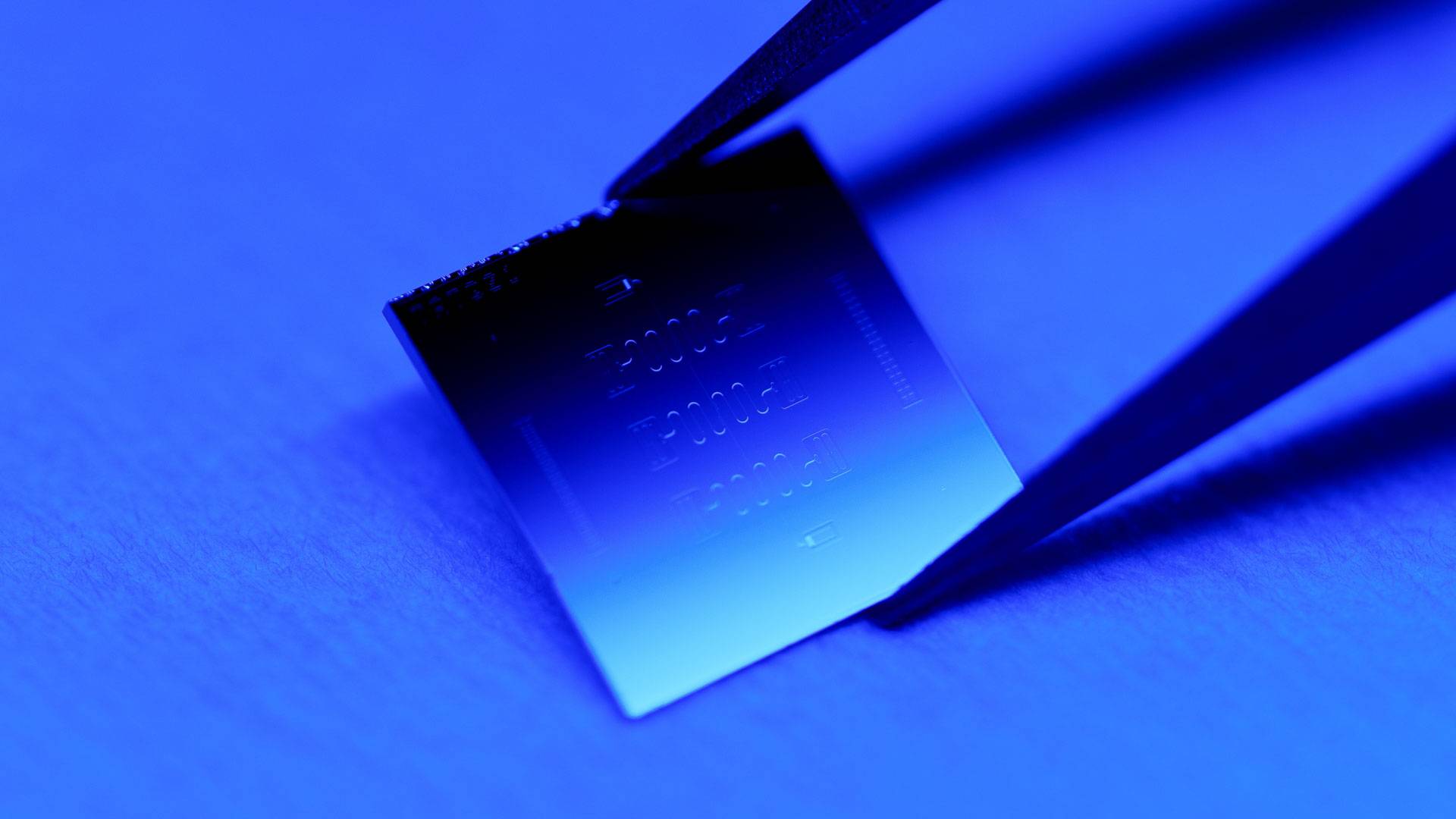
A chip built by Princeton’s Nathalie de Leon, Andrew Houck, Robert Cava and their research teams supports qubits with coherence times longer than 1 millisecond — three times longer than the best ever reported in a lab setting, and nearly 15 times longer than the industry standard. Image by Matthew Raspanti, Office of Communications, Princeton University.
(00:21) Princeton’s qubit breakthrough extends coherence threefold Princeton University researchers have demonstrated a quantum qubit with coherence times exceeding one millisecond — triple the laboratory record and fifteen times the industry standard, Science Daily reports. The team built a functioning quantum chip proving the design supports error correction at scale, addressing the fundamental challenge limiting quantum processors.
Their architecture is compatible with systems used by Google and IBM. According to analysis, replacing key components in Google’s Willow processor with Princeton’s approach could yield a thousandfold performance increase, signalling meaningful progress toward fault-tolerant quantum systems essential for practical applications.
Listen to the episode
(01:10) Google quantum AI achieves 13,000× speedup on physics Separately, some of you may recall that last month Google announced that its Willow quantum processor executed a physics simulation 13,000 times faster than classical supercomputers using a novel “Quantum Echoes” algorithm published in Nature. The breakthrough demonstrates the first verifiable quantum advantage running a physically meaningful algorithm — measuring quantum interference effects called out-of-time-order correlators.
Beyond raw speed, the work establishes quantum computing’s practical relevance to experimental science, particularly nuclear magnetic resonance spectroscopy, validating a path toward real-world quantum applications within five years.
(01:54) Sentinel-6B launches to continue climate monitoring mission
The European Space Agency and NASA successfully launched Copernicus Sentinel-6B aboard a SpaceX Falcon 9 rocket on Nov. 17, continuing a decades-long mission tracking sea-level rise — a critical indicator of climate change, Spaceflight Now reports.
The satellite carries advanced altimetry instruments measuring ocean surface heights with centimetre precision, directly supporting climate science and international efforts to understand planetary warming. This mission exemplifies the growing convergence of space infrastructure and environmental monitoring, with satellite data becoming indispensable for climate policy and adaptation planning worldwide.
(02:43) Emulate launches organ-on-chip platform for drug development
Emulate, a leader in organ-on-chip technology, unveiled its Brain-Chip R1 in partnership with FUJIFILM Cellular Dynamics to accelerate neurological drug discovery, the company said in a press release. The platform uses living human brain cells to model central nervous system responses, addressing a critical gap in preclinical testing where traditional methods fail to predict clinical outcomes.
This technology promises faster, more reliable validation of neurological therapeutics while reducing dependence on animal testing—positioning Emulate at the intersection of biotechnology and advanced manufacturing innovation.
(03:27) Cornerstone Robotics raises $200 million for surgical robot platform
Hong Kong’s Cornerstone Robotics secured $200 million in fresh funding to accelerate global commercialization of its multi arm Sentire Endoscopic Surgical System, Fierce Biotech reports.
Recently approved in China and now in UK clinical trials, the platform targets colorectal and urologic surgeries. The round, backed by major global funds, affirms demand for accessible next-gen surgical robotics as the company deepens its global footprint.
In today’s episode, Neil Shah, co-founder and vice president at Counterpoint Technology Market Research, gives us a quick take on Intel’s new Panther Lake processor and its potential use cases in robotics and physical AI.
Intel’s new Panther Lake SoC marks a defining turn in the company’s roadmap toward robotics-ready edge computing. In this quick-take episode, Neil explains how the chip’s modular ‘chiplet’ design, delivering up to 180 trillion operations per second (TOPS), could make Intel a contender below Nvidia’s high-end robotics tier.
He also weighs in on the ‘physical AI’ applications for robots that sense, analyze, and act locally. And is there an opportunity here for India’s fabless chip design startups? Stay on to hear Neil’s views on this.
Daily brief on deep tech and climate tech news from India and around the world.
India’s Prime Minister Narendra Modi and Electronics and IT Minister Ashwini Vaishnav with the first made-in-India semiconductor chips, at the Semicon India 2025 meet in New Delhi.
First Made-in-India chips as semiconductor mission accelerates
Prime Minister Narendra Modi received India’s first homegrown semiconductor chips at the opening of the Semicon India 2025 conference in New Delhi yesterday, marking rapid progress in the nation’s semiconductor mission, according to a government press release.
Multiple MoUs were signed at the meet to boost manufacturing, skills, and innovation, according to the release. The government’s push includes talent development, global partnerships, and deep tech investment, positioning India as a future global leader in semiconductors.
Listen to the podcast
US and Indian VCs unite for $1 billion deep tech alliance in India
Eight leading venture firms from the US and India have launched a $1 billion alliance to support India’s deep tech startups, pledging long-term capital and mentorship, according to multiple reports. The coalition will work with the Indian government to leverage new incentives, boost innovation, and strengthen cross-border tech ties despite ongoing geopolitical tensions.
Called the India Deep Tech Investment Alliance, the group brings together Celesta Capital, Accel, Blume Ventures, Gaja Capital, Ideaspring Capital, Premji Invest, Tenacity Ventures, and Venture Catalysts, TechCrunch reports, citing a joint statement from the firms. Each member will commit private capital over a 5-10-year period to India-domiciled deep tech startups, according to TechCrunch.
WisdomTree debuts quantum ETF as sector nears viability
WisdomTree, a New York based global asset manager, has launched a Quantum Computing UCITS ETF as quantum information processing approaches commercial viability. The ETF allows investors broad access to quantum hardware and software leaders, focusing on sectors like drug discovery, climate science, and AI.
WisdomTree asserts that with exponential advances in quantum mechanics, the fund enables early participation in what may soon be one of the most transformative technological frontiers. A UCITS ETF is an Exchange-Traded Fund that complies with the EU’s Undertakings for Collective Investment in Transferable Securities regulatory framework.
Quantum computer modules snap together like LEGOs for scalable, high-fidelity systems
University of Illinois scientists have created a modular quantum processor—devices connect via superconducting cables and achieve ~99 percent operation fidelity, SciTech Daily reports. This architecture enables scalability, easier upgrades, and reconfigurability, overcoming limits of monolithic designs and paving the way for larger, fault-tolerant quantum computers and advanced quantum networks.
AI-driven drug discovery accelerates as FDA aims to cut animal testing
Pharmaceutical companies are rapidly adopting AI for drug discovery and safety testing, aligning with the US FDA’s initiative to reduce animal testing, Reuters reports. Experts say combining AI and reduced animal testing could halve both costs and timelines within three to five years, though animal studies will likely remain necessary for some drugs in the near term.
MIT develops self-assembling material to enable easily recyclable EV batteries
MIT researchers have created a battery electrolyte that self-assembles and quickly dissolves in common organic liquids, allowing entire batteries to be taken apart for recycling, according to a news post on the institute’s website. Tested in solid-state cells, the material simplifies sorting of battery components and could make recycling easier and cleaner, addressing future electronic waste from the rise of electric vehicles.
Musk predicts Optimus humanoid will drive 80 percent of Tesla’s value
Elon Musk recently stated that Tesla’s future value will depend far more on its Optimus humanoid robots than on its electric cars, predicting that up to 80 percent of Tesla’s worth will derive from Optimus, CNBC reports. The company’s new strategy focuses on robotics and AI, with plans to produce 5,000 Optimus units in 2025 and target a $20,000–$30,000 price point. Musk envisions Optimus becoming core to Tesla’s operations and the global robotics market, despite continuing technical and adoption challenges.
Sixty percent of Earth’s land is now outside safe biosphere limits
A new study finds that 60 percent of the world’s land is beyond safe biosphere boundaries due to expanding human use of biomass, SciTech Daily reports. The research tracks changes since 1600, showing Europe, Asia, and North America are most affected. Scientists urge global action as ecological disruption, land conversion, and declining photosynthetic activity raise risks for planetary stability.
In today’s episode, Rishabh Agarwal, Co-founder and CEO of PeerRobotics, gives us a sense of how automation is changing for small and mid-sized manufacturers and outlines his vision for collaborative robotics. Rishabh shares his experience and perspective on the factory floor transition to advanced robotics.
With a background in manufacturing and technical training from IIT Delhi and the University of Maryland, Agarwal built PeerRobotics with the aim of simplifying human-robot interaction and making automation intuitive for even non-technical users. The six-year-old company’s systems are designed for practical deployment in diverse industrial settings, where robots learn routes through human demonstration and adapt to existing workflows.
Agarwal also describes how PeerRobotics approaches product development, aiming to own the whole stack. The company takes advantage of doing much of its engineering and development at its centres in India, while also tapping advanced R&D experience in the US in certain areas like computer vision.