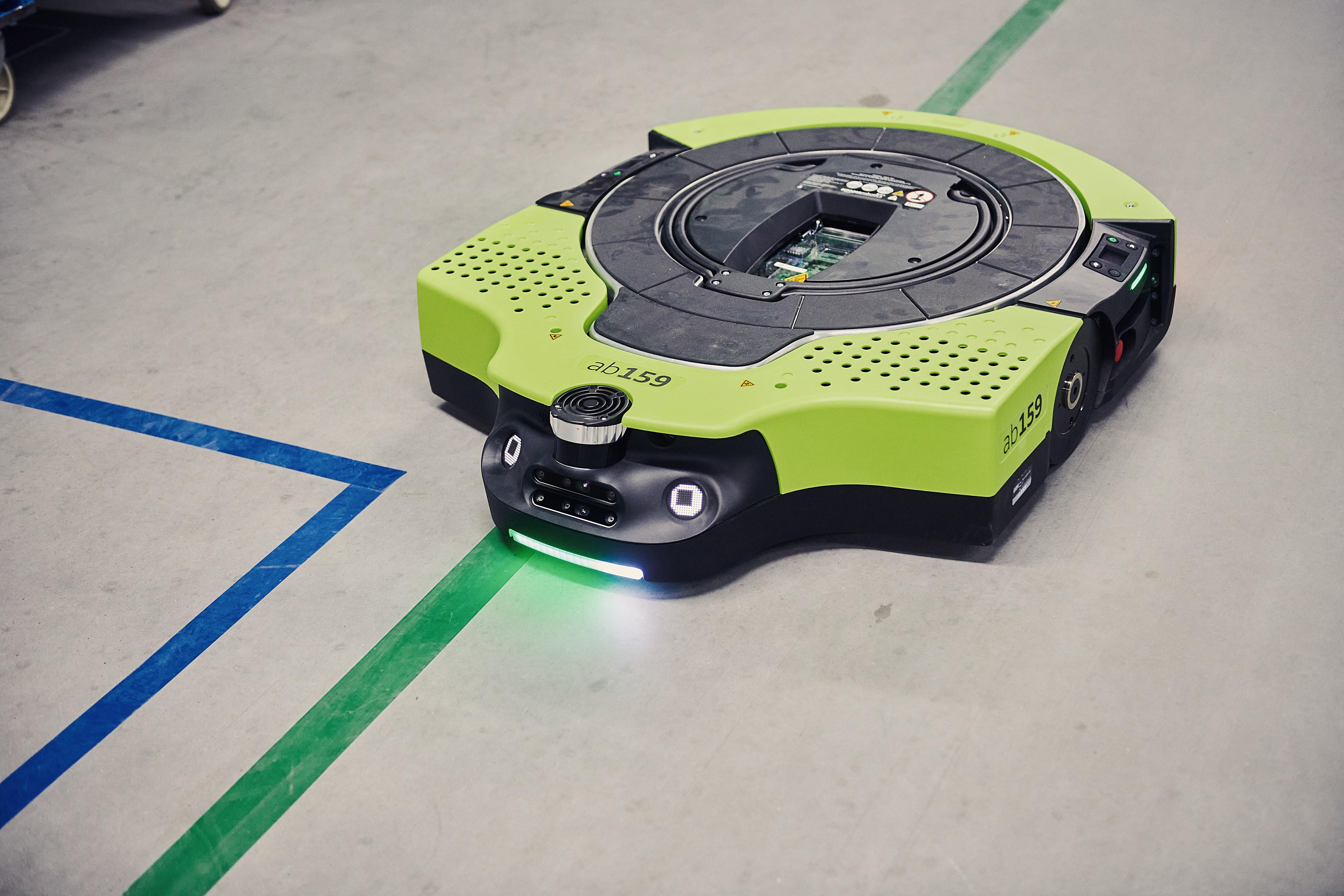
In today’s episode, Rishabh Agarwal, Co-founder and CEO of PeerRobotics, gives us a sense of how automation is changing for small and mid-sized manufacturers and outlines his vision for collaborative robotics. Rishabh shares his experience and perspective on the factory floor transition to advanced robotics.
With a background in manufacturing and technical training from IIT Delhi and the University of Maryland, Agarwal built PeerRobotics with the aim of simplifying human-robot interaction and making automation intuitive for even non-technical users. The six-year-old company’s systems are designed for practical deployment in diverse industrial settings, where robots learn routes through human demonstration and adapt to existing workflows.
Agarwal also describes how PeerRobotics approaches product development, aiming to own the whole stack. The company takes advantage of doing much of its engineering and development at its centres in India, while also tapping advanced R&D experience in the US in certain areas like computer vision.
Daily brief on deep tech and climate tech news from India and around the world
Proteus, Amazon’s first fully autonomous robot.
Amazon deploys one million robots, launches AI to boost warehouse efficiency
Amazon has surpassed the deployment of one million industrial robots, marking a major automation milestone as its latest system began operations in a Japanese fulfillment center, the Association for Advancing Automation reports.
Amazon also introduced DeepFleet, a generative AI model designed to optimize robot coordination across more than 300 global facilities, improving travel efficiency by 10 percent. More than 700,000 employees have been retrained to work alongside robots, reflecting Amazon’s ongoing integration of advanced robotics and AI into its operations.
Listen to the podcast
Genesis AI emerges from stealth with $105 million to build universal robotics AI platform
Genesis AI, a global physical AI research lab, has launched with $105 million in seed funding co-led by Eclipse Ventures and Khosla Ventures, the Canadian venture said in a press release.
The company aims to develop a universal robotics foundation model and a horizontal platform for general-purpose physical AI, using a proprietary physics simulation engine to generate high-quality synthetic data.
Genesis AI’s approach seeks to automate a broad range of physical tasks, addressing the vast, largely unautomated global labor market.
Catalio Capital closes $400 million fourth fund to back innovative healthcare startups
Catalio Capital Management has closed its fourth venture fund, Catalio Nexus Fund IV, with over $400 million in commitments from global institutional investors, the New York firm said in a press release. The fund will support breakthrough biomedical technology companies, including 16 early investments such as PinkDx and Superluminal Medicines.
Catalio’s strategy focuses on partnering with leading scientists and entrepreneurs to launch and grow life sciences startups, even as the biotech sector faces a challenging funding environment.
Flexible zinc–ion batteries with new hydrogel electrolyte maintain stable voltage even when bent
Researchers at the Hefei Institutes of Physical Science, Chinese Academy of Sciences, have developed a flexible aqueous zinc–ion battery using a novel hydrogel electrolyte made from urea and zinc acetate, Tech Xplore reports.
The battery’s hydrogel can stretch up to 557% and withstand significant compression, maintaining stable voltage even when bent to 180°. This innovation addresses durability and leakage issues, making the battery ideal for portable and wearable devices while remaining cost-effective and eco-friendly.
Indian scientists develop lanthanum-doped silver niobate for next-generation supercapacitors
A team led by Dr. Kavita Pandey at Bengaluru’s Centre for Nano and Soft Matter Sciences, in collaboration with Aligarh Muslim University, has engineered a lanthanum-doped silver niobate material that dramatically boosts supercapacitor performance, according to a press release from India’s Ministry of Science and Technology.
The innovation delivers 118 percent energy retention and 100 percent coulombic efficiency, which is a measure of total charge extracted from an electrochemical device during discharge versus the total charge put in during charging.
The research team demonstrated a prototype successfully powering an LCD display. This breakthrough, published in the Journal of Alloys and Compounds, could advance high-efficiency, eco-friendly energy storage for electronics and renewable systems.
Climeworks raises $162 million to expand direct air capture tech for carbon removal
Climeworks has raised $162 million in equity funding, bringing its total raised to more than $1 billion, according to a press release from the Swiss venture. This is the most for any pure-play carbon removal venture, Tech Funding News notes.
The investment, led by BigPoint Holding and Partners Group, will accelerate Climeworks’ rollout of its Generation 3 direct air capture technology and global expansion. Climeworks aims to capture 1 billion tons of CO₂ by 2050, positioning itself as a leader in permanent, verifiable carbon removal solutions.
“Direct Air Capture has gone from experiment to essential, and we’re focused on scaling it,” Christoph Gebald, co-CEO and co-founder of Climeworks said in the press release. The company has a hybrid business model that combines long-term innovation and present-day commercial applications of its technology to generate revenue, he added.
In Conversation
In-depth conversations with entrepreneurs, investors, industry leaders and other stakeholders building India’s deep tech and climate tech ecosystems.
Takeaways from conversations with entrepreneurs, investors, industry leaders and other stakeholders building India’s deep tech and climate tech ecosystems.
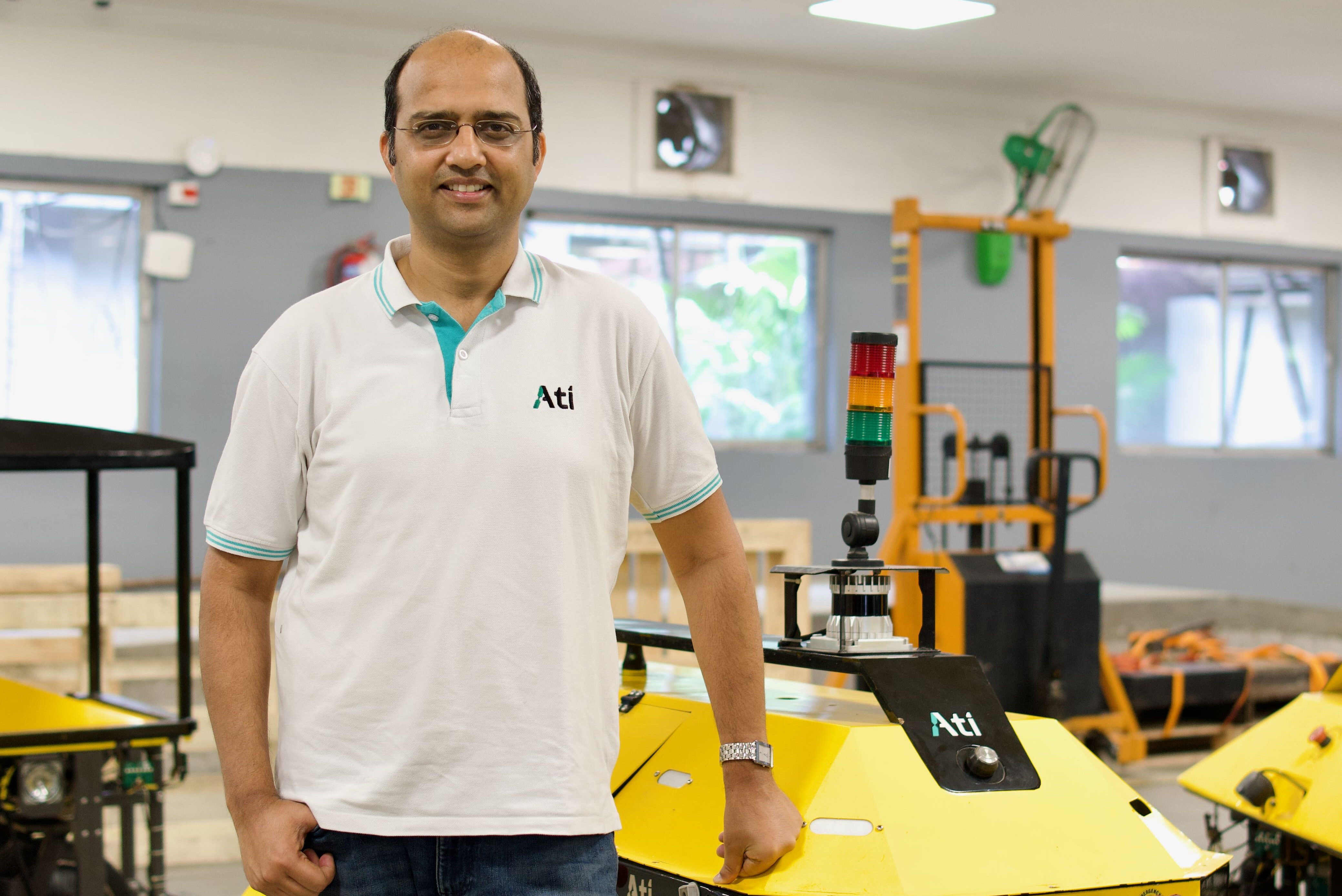
My guest today is Saurabh Chandra, co-founder and CEO of Ati Motors, an autonomous mobile robots (AMRs) venture in Bengaluru. In this conversation, Saurabh talks about how the robots are coming – changing the industrial manufacturing landscape forever.
He talks about Ati’s own family of robots, named Sherpa, some early engineering decisions that have stood the company in good stead, and how Ati can go from shipping hundreds of robots to thousands, and more. We also briefly touched upon lessons from building a deep tech robotics company out of India.
Under Chandra’s leadership, Ati Motors has become a pioneer in developing AMRs for material movement in factories and warehouses. Unlike traditional automated guided vehicles (AGVs), Ati’s Sherpa robots are engineered to perform in the most challenging industrial environments — handling gradients, potholes, clutter, and even outdoor conditions.
This is made possible by a full-stack, first-principles approach and the use of advanced 3D LiDAR-based navigation, which allows Sherpa robots, today best known for their tugging capabilities, to operate without any external markers, reflectors, or teleoperation. All autonomy is processed onboard, ensuring robust performance even in environments with unreliable connectivity.
Ati’s current portfolio of AMRs include the Sherpa Tug, Sherpa Lifter, Sherpa Pallet Mover, and Sherpa Pivot. The company has some 50 customers in India, Southeast Asia and North America, Chandra says, including names such as Forvia and Hyundai.
On building AMRs out of India, Chandra credits Bengaluru’s multidisciplinary talent pool and thriving manufacturing ecosystem as important advantages that support innovation. The day isn’t that far away when, in factories and warehouses and other such complexes, “whatever moves is going to be autonomous,” he says.
Daily brief on deep tech and climate tech from India and around the world.
Texas Instruments commits $60 billion to semiconductor expansion
The investment will build seven fabs across Texas and Utah, boosting U.S. production of 300mm chips for companies like Apple and Nvidia. Supported by $1.6B in CHIPS Act funding, the project will create 60,000 jobs and manufacture hundreds of millions of chips daily.
Embedl secures €5.5 million to scale its edge AI platform
The Swedish deep tech startup, spun out from Chalmers University, raised pre-Series A funding to make edge-AI deployment accessible for developers in robotics, defense, and automotive. Their platform optimizes AI inference for local hardware, reducing cloud dependency and energy use. Chalmers Ventures led the round, bringing total funding to €12 million.
Listen to the podcast
OrangeQS sets Dutch record with €12 million seed round
The Delft-based quantum startup raised the largest seed investment in the Netherlands’ quantum sector to scale automated testing systems for quantum chips. Funding will accelerate the transition from lab prototypes to industrial quantum computers, leveraging deep academic expertise.
Neoclease wins Merck’s biotech grant for its AI gene-editing tech
The Boston startup won Merck’s 2025 North American Advance Biotech Grant for its AI-designed platform targeting Parkinson’s disease. The grant provides access to Merck’s manufacturing tech and regulatory support to scale therapies for 6,000+ genetic disorders.
Fervo and Form Energy advance energy projects for AI
Fervo is building the world’s largest geothermal plant in Utah to power data centers, while Form Energy raised $400 million to scale iron-air batteries. Both startups are fast-tracking deployments amid surging AI-driven energy demand, with Constellation Energy restarting nuclear plants for Microsoft.
Typedef raises $5.5 million for AI data infrastructure
The startup’s platform automates data pipeline management for LLM workloads, enabling faster AI deployment. Pear VC led the seed round to target the $200B AI infrastructure market, simplifying prompt experimentation and pipeline optimization for enterprises.
L&T considers second ESG bond after strong demand for debut issue
Indian infrastructure giant Larsen & Toubro is exploring a second round of ESG (environmental, social, and governance) bonds after its inaugural ₹500 crore ($58 million) issue sold at a premium under India’s new ESG debt framework. The three-year notes, rated AAA by Crisil, were priced at a 6.35 percent coupon—lower than comparable bonds—reflecting high demand from banks and mutual funds. SBI Mutual Fund was a key investor in the debut.
In Conversation
In-depth conversations with entrepreneurs, investors, industry leaders and other stakeholders building India’s deep tech and climate tech ecosystems.
Daily brief on deep tech and climate tech from India and around the world.
US scientists alarmed as Trump’s proposed budget slashes NASA science funding by half
US scientists have condemned President Trump’s fiscal 2026 budget proposal, which seeks to cut NASA’s science funding by 47 percent and reduce its workforce by a third. The plan would cancel 41 missions, including the Mars Sample Return and OSIRIS-APEX, and halt collaborations like the Rosalind Franklin rover.
Key Earth and astrophysics projects would also be axed, risking $12 billion in taxpayer investment, in operating missions alone, and undermining climate research. While the proposal faces bipartisan opposition in the US Congress, scientists warn that even temporary enactment could cause lasting damage to US space science and international partnerships.
Listen to the podcast
IonQ to acquire Oxford Ionics in $1.08 billion deal to boost quantum capabilities
IonQ, a leading US quantum computing company, yesterday announced an agreement to acquire UK-based Oxford Ionics for $1.08 billion, mostly in stock. The deal aims to combine IonQ’s quantum hardware and software expertise with Oxford Ionics’ quantum chip technology, accelerating advances in the field. The transaction, which includes $10 million in cash, is expected to close in 2025 pending regulatory approvals.
Founded in 2015 by physicists Christopher Monroe and Jungsang Kim, IonQ became the first pure-play quantum computing company to go public on the New York Stock Exchange in October 2021. The company is credited with advancing the use of trapped-ion technology, which is said to offer higher stability of qubits, the building blocks of quantum computers, and coherence, which refers to the ability of a quantum system, such as a qubit, to maintain a well-defined phase relationship between its different states.
Bhashini to build AI-powered multilingual services for Indian Railways
In some news on India’s population-scale AI efforts, the Digital India Bhashini Division and Centre for Railway Information Systems have signed an MoU to integrate advanced multilingual AI solutions into Indian Railways’ digital platforms, the ministry of electronics and IT said in a statement yesterday.
Using Bhashini’s technology stack — including speech recognition, translation, and text-to-speech — railway services such as the National Train Enquiry System and RailMadad will become accessible in 22 Indian languages.
The partnership aims to improve accessibility, efficiency, and transparency for millions of passengers, with plans to roll out chatbots, voice assistants, and multilingual interfaces across web, mobile, kiosks, and call centers. Pilot deployments and technical workshops will begin in the coming months.
Vecmocon, EV tech startup, raises $18 million from EIF, Aavishkaar, BII
Okay, some news from the world of EVs in India. Vecmocon Technologies, an EV components startup in New Delhi, has secured $18 million in Series A funding led by Ecosystem Integrity Fund, with participation from Aavishkaar Capital, British International Investment, and existing investor Blume Ventures.
Vecmocon develops advanced battery management and vehicle intelligence systems for electric vehicles, with its technology already equipping some 100,000 EVs in India, the company said in a press release. It was founded in 2016 by Peeyush Asati, Adarshkumar Balaraman, and Shivam Wankhede, and incubated at IIT Delhi.
The new investment will help the entrepreneurs fund market expansion and R&D.
Shipping industry faces hurdles as it navigates new net zero rules
The shipping industry, responsible for about 3 percent of global emissions, faces a pivotal period as it seeks scalable zero-emission solutions and adapts to stricter climate policies, Reuters reported last week.
The sector must cut the greenhouse gas intensity of its fuel by 30 percent by 2035 and 65 percent by 2040 under new global regulations, with the International Maritime Organization introducing emissions thresholds and a pricing mechanism starting in 2028. While innovations like wind-assisted propulsion and biofuels are emerging, concerns remain over the sustainability of some fuels and market uncertainty, according to Reuters.
Listen to the episode
Microsoft’s deal for low-carbon cement from MIT-spinout Sublime
Microsoft recently agreed to buy up to 622,500 metric tonnes of low-carbon cement from Sublime Systems, a US startup, over the next six to nine years, aiming to reduce emissions from its data center and infrastructure construction. The deal uses new environmental certificates to claim emissions reductions, even when the cement isn’t used directly by Microsoft.
Sublime’s electrochemical process avoids the carbon emissions of traditional cement production. The agreement will help scale Sublime’s technology and accelerate the adoption of cleaner construction materials in an industry responsible for about 8 percent of global CO₂ emissions.
Sublime was founded at MIT by Dr. Leah Ellis and Prof. Yet-Ming Chiang, both respected experts in materials science, electrochemical systems, and sustainability research. The company has raised over $200M in funding from leading climate tech investors, global cement incumbents, and cooperative agreements with the U.S. Department of Energy.
Gridcare uses AI to unlock hidden grid capacity for data centers
Gridcare, a US startup founded by entrepreneur Amit Narayan, uses generative AI to map and analyze the US electrical grid, according to a TechCrunch report. The startup, which has raised $13.5 million in seed funding recently, could potentially identify more than 100 gigawatts of untapped capacity for data centers, Narayan tells TechCrunch.
By matching data center developers with utilities and factoring in variables such as fiber connectivity, weather, and regulations, Gridcare aims to help hyperscalers bypass long waits for grid connection. It charges developers based on the megawatts it unlocks, offering a cost-effective alternative to building private power plants.
So far, North American startups have secured over $22.37 billion in funding for carbon capture, utilization, and storage (CCUS) technologies, altenergymag.com reports. Some $130 million of that was raised in 2025 to date.
Investors grow cautious on direct air capture despite climate tech boom
Once a darling of climate tech, direct air capture (DAC) startups in the US have seen a 60 percent drop in venture investment this year amid political uncertainty and wavering corporate commitments, Bloomberg reported early last month.
With government incentives at risk and high costs per tonne, the DAC sector faces a challenging path to scale, even as overall climate tech investment rises. This shift raises concerns about the sector’s ability to deliver on long-term carbon removal goals, Bloomberg Reporter Coco Liu writes in that insightful piece.
Stride Green raises $3.5 million to boost tech-enabled clean energy asset financing
Stride Green, in New Delhi, has secured $3.5 million in seed funding to expand its innovative financing and leasing solutions for renewable energy, electric mobility, and battery storage. The company’s green finance portfolio now exceeds $120 million, supporting more than 3,000 cleantech assets and reflecting India’s surging climate tech investment.
Stride Green was started last year by the well-known venture debt focused VC, Ishpreet Singh Gandhi, founder and managing partner at Stride Ventures, along with Vivek Jain, co-founder and chief business officer.