Coming up, tomorrow, a conversation with Apoorv Shaligram, founder and CEO at e-TRNL Energy in Bengaluru, where he and fellow founder Uttam Sen are innovating the next generation battery cell architectures and advanced manufacturing processes.
Apoorv and Uttam recently announced raising Rs. 27.4 crore (About $3 million) in seed funding, led by IAN Group (Indian Angel Network), with Navam Capital, and existing investors Speciale Invest, Micelio and others also joining in. You can catch the full conversation right here, or wherever you get your podcasts. Here’s a 60-second preview with Apoorv talking about how the deep tech landscape in India is undergoing a government-led transformation.
So, this morning, I drove up to the new office that Apoorv Shaligram and Uttam Kumar Sen and their team at e-TRNL Energy have set up – still being given some final touches before a formal inauguration soon.
Sat down with Apoorv to record the next episode of Conversations. And it’s always an awesome experience to do this in-person, in whatever conditions present themselves onsite, in terms of light and sound. (I did carry two Neever panels and my DJI wireless mics, and more on that in a separate note.)
I’ve had the privilege of being acquainted with this deep-tech entrepreneur duo – IIT Bombay alumni – almost from the time they set up e-TRNL and, in one early conversation a few years ago, they’d tried to help me understand the tech innovations they had in mind.
Today, we caught up in the context of their recent announcement of having raised Rs. 27.4 crore (About $3 million) in seed funding, led by IAN Group (Indian Angel Network), with Navam Capital, and existing investors Speciale Invest, Micelio and others also joining in.
We also spoke about the funding experience — what’s changed, what worked, best practices and so on. Catch all of that in the full conversation right here, or wherever you get your podcast, on Friday, Feb. 20.
Here’s a 90-second preview, with Apoorv explaining 3DEA, their 3D electrodes architecture.
By the way, I also just started a WhatsApp channel for anyone who prefers to keep track of their deep tech news and views that way.
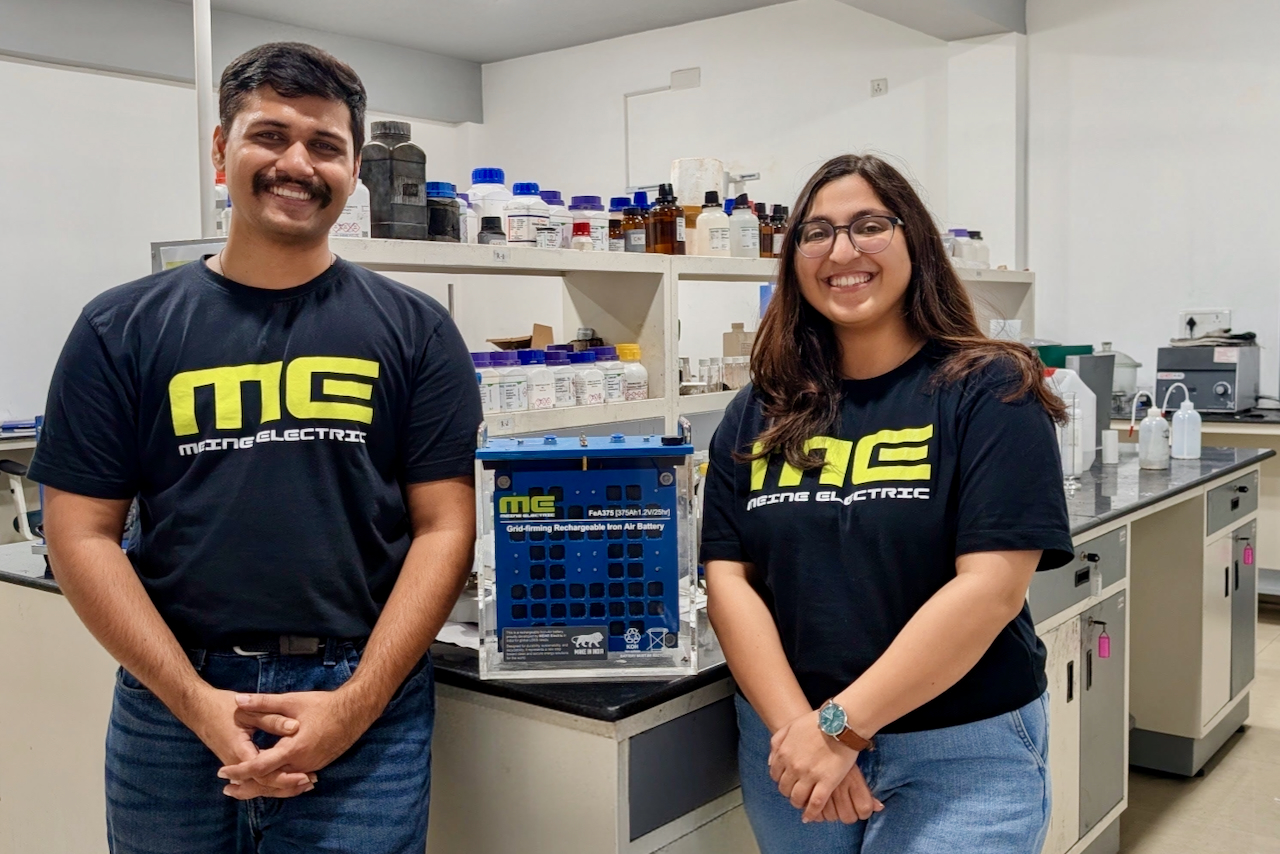
MEINE Electric is an Indian deep-tech startup in Chennai, developing iron-air battery systems designed for long-duration energy storage of 16 to 24 hours. Founders Priyansh Mohan and Stuti Kakar hope that these batteries will help accelerate India’s transition to net zero carbon emissions.
They use a process of controlled reversible rusting to create a cost-effective, sustainable alternative to lithium-ion batteries and pumped hydro storage. By utilizing abundant materials like iron, air, and water, they aim to provide 100 percent renewable energy reliability for energy-intensive industries such as mining and data centres.
Their proprietary innovations include fast-charging capabilities and a unique gas-diffusion electrode that is compatible with high-volume manufacturing. The venture has secured pre-seed funding and plans to showcase its first product pilot later this year. Ultimately, they envision building a renewable energy ecosystem to stabilize the grid as global power demands shift toward green sources.
You can catch the full conversation right here, or wherever you get your podcasts. Here’s a quick point on how the founders are innovating to develop their product for scale.
In this episode, I’m joined by Priyansh Mohan and Stuti Kakkar, school friends turned co-founders at MEINE Electric, to talk about their innovations in developing iron-air battery energy storage systems (BESS) for long duration energy storage (LDES).
Renewable energy in India faces a fundamental problem of timing. Solar panels and wind turbines produce electricity when nature dictates, not necessarily when industrial factories require it. For the green transition to succeed, power must be stored for the long hours when the sun is down or the wind is still. While lithium-ion batteries serve short durations, they remain too costly for day-long storage.
Priyansh and Stuti are innovating in the area of controlled, reversible rusting, with the aim of providing energy storage for 16 to 24 hours at prices lower than with current options such as pumped hydro storage and of course lithium-ion batteries. Their approach uses materials abundantly available — iron, air, and water — to avoid the complicated supply chains associated with rarer metals.
“At the core of it, it’s just reversible rusting. We all know that iron rusts — it’s not a reaction that’s unknown to humanity — but to do it in a controlled fashion at a greater efficiency so it acts as a battery is where our innovation and the whole magic lies.”
Stuti Kakkar and Priyansh Mohan
In this episode, we get a peek into the engineering innovations behind their technology and some of the challenges that remain in the way of building deep tech companies from India. Backed by Rebalance, Antler, Venture Catalysts, gradCapital, and Anna Incubator, Stuti and Priyansh have recently raised a pre-seed investment in their venture.
They expect to showcase a pilot-ready version of their first product as early as later this year.
Priyansh Mohan and Stuti Kakkar, founders of MEINE Electric in Chennai, are developing an Iron-air battery energy storage system that they hope will help reduce curtailment of renewables-based power.Listen to the preview
Renewable energy in India faces a fundamental problem of timing. Solar panels and wind turbines produce electricity when nature dictates, not necessarily when industrial factories require it. For the green transition to succeed, power must be stored for the long hours when the sun is down or the wind is still. While lithium-ion batteries serve short durations, they remain too costly for day-long storage.
Coming up on Feb. 10, in my next episode of Conversations at India Tech Report, I speak with Priyansh Mohan and Stuti Kakkar, friends from school turned co-founders – at MEINE Electric, to talk about their innovations in developing iron-air batteries for longer duration storage.
By controlling the process of reversible rusting, the duo aims to provide energy storage for 16 to 24 hours at a fraction of current prices. Their approach uses abundant materials — iron, air, and water — to avoid the complicated supply chains associated with rarer metals.
In this episode, we get a peek into the engineering innovations behind their technology and some of the challenges that remain in the way of building deep tech companies from India. Backed by Rebalance, Antler, Venture Catalysts and gradCapital, Stuti and Priyansh have raised a pre-seed funding recently.
They are working to release a pilot-ready version of their first product as early as later this year.
You can catch the full conversation right here, or wherever you get your podcasts. Here’s a 90-second preview.
(00:20) Mobile robots market to nearly double by 2030
Global demand for mobile robots is set to surge, with the market projected to grow from $27.39 billion in 2025 to $52.11 billion by 2030, driven by AI, 5G, e-commerce, and labour shortages, while Asia-Pacific leads adoption and high costs, regulatory hurdles, and integration challenges remain important constraints.
(00:50) Hyundai debuts MobED autonomous robot platform at iREX 2025
Hyundai Motor Group has unveiled MobED, a production-ready autonomous mobility robot platform, at the iREX 2025 robotics show in Tokyo, positioning it as the company’s first mass-produced mobility robot for industrial and everyday applications, with Pro and Basic variants set for market launch in the first half of 2026.
(01:17) IFC backs Gujarat Fluorochemicals’ EV unit with $50 million
IFC will invest about $50 million in Gujarat Fluorochemicals’ EV venture GFCL EV Products to build India’s first fully integrated battery-materials plant, supporting local production of key inputs for electric vehicle and energy storage batteries and reducing import dependence while strengthening the country’s position in global clean-energy supply chains.
(01:46) Viavi, QNu Labs team up on quantum-safe network security
Viavi Solutions and QNu Labs, a quantum cybersecurity startup in India, have formed a strategic R&D partnership to develop test frameworks, standards, and reference architectures for quantum-safe network security, spanning post-quantum cryptography, quantum key distribution, quantum random number generator, and hybrid systems, with plans for a broader industry consortium to help operators and enterprises transition from classical to quantum-resilient infrastructures.
(02:20) Skylark Drones, WELL Labs ink MoU on data-led water intelligence
Skylark Drones has signed an MoU with Bengaluru-based WELL Labs to build data-driven water-resource intelligence platforms, according to a press release. The platforms will fuse large-scale drone-based mapping with hydrological science, supporting watershed management, flood resilience, and climate-linked water planning for governments and communities across India.
(02:46) Shastra VC launches SDEX deep-tech fellowship with $100,000 grants
Shastra VC has launched SDEX, Shastra Deep-Tech Excellence Fellowship, a 16–24-week programme to help researchers at IITs, IISc, NITs and other labs turn frontier technologies into venture-ready startups, with the first cohort set to pick up to 15 teams and provide each with equity-free funding and resources of up to $100,000 dollars.
(03:20) Chiratae launches Sonic DeepTech with cheques up to $2 million
Chiratae, a VC firm in Bengaluru, has launched the Sonic DeepTech programme to back early-stage Indian deep-tech startups with seed cheques of up to $2 million, promising 48-hour investment decisions, and access to domain experts, corporate partners, and portfolio founders to help teams move quickly from lab prototypes to market-ready products.
(03:45) ChemLex raises $45m for AI-driven autonomous drug discovery lab in Singapore
ChemLex, an AI-for-science startup, has raised 45 million dollars led by Granite Asia and is establishing its global headquarters and a 24/7 self-driving chemistry lab in Singapore to accelerate small-molecule drug discovery, supported by new technical hires and an MoU with Singapore’s Experimental Drug Development Centre.