In this episode, I’m joined by Simmi Sareen and Shravan Shankar, co-founders of Climake, a climate finance platform and advisory, to talk about their fifth annual report on the state of climate finance in India – 2025 edition.
In 2024, equity capital deployed reached $9.4 billion, about double from the previous year, with public markets absorbing 60 percent of all funding. Simmi and Shravan also talk about some consequential shifts: such as the emergence of a public capital ecosystem that routes money to climate solutions that can be vital while not being attractive to venture capital investors.
The two co-founders have formally tracked this evolution ever since they founded Climake in the middle of the Covid pandemic, and much longer in various capacities before that. Simmi brings to Climake two decades of mainstream finance experience, including at a global investment bank, and she’s previously built a climate-focused fintech and debt platform.
Shravan has built his career across sustainability policy, innovation ecosystems, and climate entrepreneurship. Their annual State of Climate Finance reports are increasingly widely accepted in the industry as investor look at India-specific decisions.
In this conversation they talk about what their fifth report reveals: a $2 trillion capital requirement through 2035, a substantive shift toward adaptation financing, and the expanding role of public markets in sectors like wastewater treatment and solar components that aren’t attractive from a VC’s perspective.
The discussion spans emerging technologies from sustainable fuels and flow batteries to seaweed-based biochar solutions, the persistent gaps in growth-stage capital for asset-heavy climate enterprises, and how adaptation will reshape investment contours as it becomes increasingly urgent.
Daily brief on deep tech and climate tech news from India and around the world.
Shilpa Kumar, MD, BII India, with Priya Shah , Founder, Theia Ventures. BII is backing Theia’s $30 million clean energy fund in India. Image source: press release.
ABB sells robotics unit to SoftBank for $5.375 billion
ABB has announced it will divest its Robotics division to SoftBank Group for $5.375 billion, a decision made as an alternative to spinning off the business, the company said in a press release. The move is expected to create immediate value for ABB shareholders and use the proceeds to improve its capital allocation. The transaction is expected to close in mid-to-late 2026.
Listen to the episode
Honeywell and LS Electric partner to innovate data center solutions
Honeywell and LS Electric have announced a global partnership to develop and market hardware and software for data centers and battery energy storage systems, the companies said in a press release. The collaboration will create integrated power solutions to simplify management and improve efficiency, helping data centers avoid costly downtime. They will also create a new grid and building-aware battery energy storage system.
Space Ocean signs deal to explore nuclear power for deep space
Space Ocean Corp and Space Nuclear Power Corporation have signed a Letter of Intent to explore using advanced nuclear power systems for deep space missions, the companies said in a press release. The collaboration will test a 10-kilowatt nuclear reactor on Space Ocean’s ALV-N satellite. If successful, Space Nukes could become a primary supplier for Space Ocean’s future lunar and planetary missions.
India’s space economy projected to reach $44 billion by 2033
India’s space economy is projected to reach $44 billion by 2033, up from $8.4 billion in 2022, according to Union Minister Dr. Jitendra Singh, addressing the “Satcom” at the India Mobile Congress 2025, according to a press release from the department of space. Regulatory reforms and private sector participation have driven this growth, leading to over 300 space startups.
The Minister noted that satellite communication will be critical for digital connectivity and financial inclusion in rural areas. India has commercially launched 433 foreign satellites, generating substantial revenue. The long-term roadmap includes establishing the Bharatiya Antariksh Station by 2035 and landing an Indian astronaut on the Moon by 2040.
Theia Ventures secures funding to boost India’s clean energy transition
Theia Ventures has achieved the first close of its new $30 million fund, with British International Investment as the anchor investor, the VC firm said in a post. The fund will support around 20 early-stage Indian startups focused on decarbonizing sectors like heavy industry and mobility. The firm, which has already begun deploying capital, will invest between $500,000 and $1 million per company.
Daily brief on deep tech and climate tech news from India and around the world.
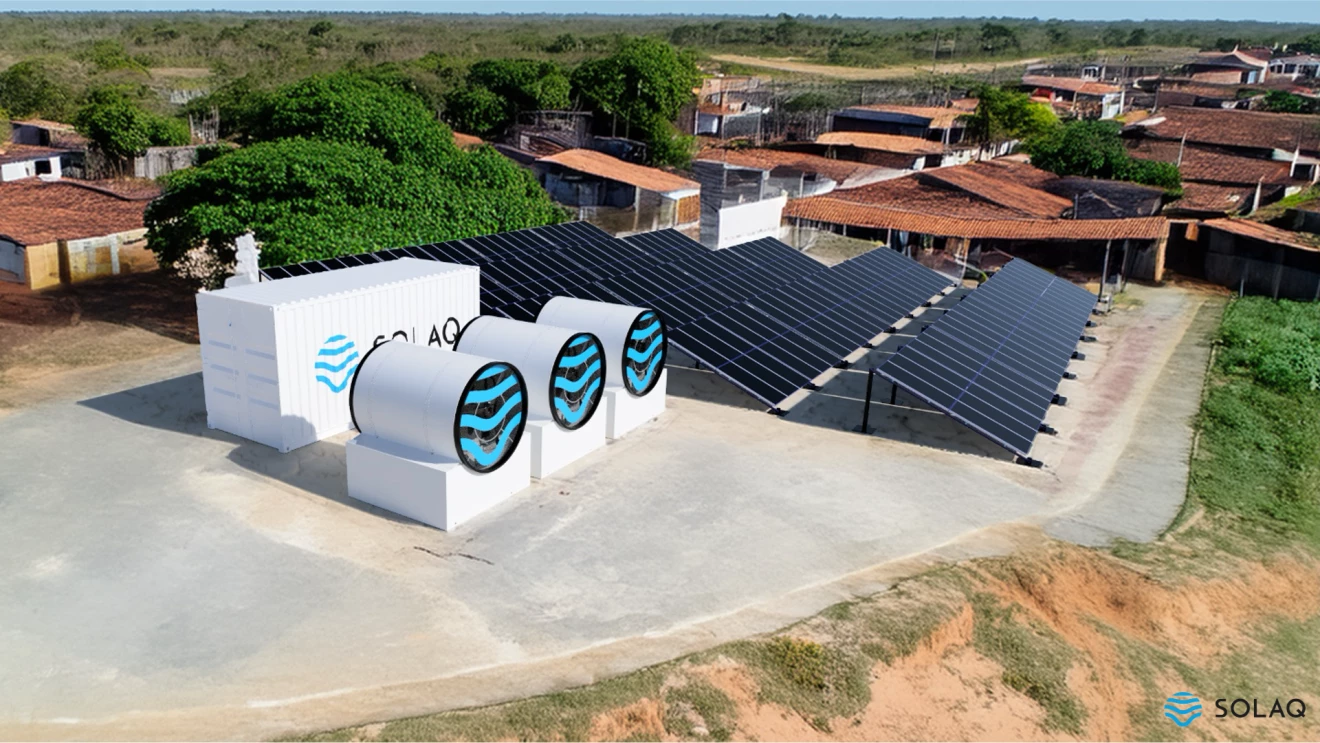
Solaq’s water from atmosphere system, one of the innovations selected to Amazon’s ClimateTech cohort in its Sustainability Accelerator. Image source: Amazon sustainability stories.
Union Minister Gadkari unveils roadmap for sustainable transport at SIAM meet
Union Minister for Road Transport and Highways Nitin Gadkari set out India’s sustainable transport vision at the 65th annual convention of the Society of Indian Automobile Manufacturers, stressing global alignment on BS7 (Bharat Stage 7) and CAFE (corporate average fuel efficiency) norms to cut air pollution, according to a press release from the transport ministry. He highlighted biofuel adoption, the vehicle scrappage policy, and plans to lower logistics costs, while announcing rewards and insurance for road accident helpers to improve road safety and industry sustainability.
Listen to the podcast
Coal ministry spotlights gasification for India’s clean energy future
The Ministry of Coal hosted a Mumbai roadshow on coal gasification, highlighting its role in India’s energy transition and industrial growth, according to a press release from the ministry. Officials stressed using coal gasification—including underground technologies—to create clean energy, chemicals, and hydrogen, while reducing imports and boosting economic self-reliance. The government is scaling R&D, innovation, and private partnerships to ensure safe, sustainable deployment of gasification projects nationwide.
IIT Madras start-up deploys cleaner, cost-saving wastewater tech
JSP Enviro, incubated at IIT Madras, has launched and field-proven its BEADS wastewater treatment system in industries in Tamil Nadu, according to a press release from the Press Information Bureau. The technology, which operates anaerobically without electricity or chemicals, reduces sludge and recovers energy. Each 100m³/day installation avoids 80 tons of CO₂ annually, promising ROI in 3–4 years. JSP Enviro aims to scale nationwide, unlocking climate and financial gains for manufacturers.
Bartronics India enters climate tech with carbon credit push
Bartronics India has partnered RenewCred, a climate-tech start-up, to launch blockchain-based carbon credit solutions for Indian farmers, according to a press release. The collaboration will enable over 40 million rural farmers to earn revenue by adopting sustainable practices, verified via drones and blockchain. The move marks Bartronics’ pivot from rural fintech to agri- and climate-tech, aiming to boost rural incomes and climate action.
IFC boosts responsAbility Asia climate tech fund past $400M
UK money manager M&G’s responsAbility Investments has raised more than $414 million for its Asia Climate Strategy, following a $50 million IFC investment, ESG Today reports. The fund targets renewable energy, battery storage, e-mobility, and circular economy, aiming to cut 16 million tons of CO₂. With completion near its $500 million goal, it mobilizes capital for Asia’s energy transition and offers diversification for institutional investors.
Vireo Ventures closes €50M fund to back Europe’s clean electrification
Berlin-based Vireo Ventures has closed its €50 million Electrification Fund I to support early-stage startups in Europe’s energy transition, Tech Funding News reports. The fund targets pre-seed to Series A companies advancing grid electrification, storage, and decarbonization. Investors range from pension funds to corporates, and the portfolio includes innovators in energy management, storage, and e-mobility—boosting the region’s path to net zero.
Solenery raises $750K to scale AI-powered clean energy platform
Toronto-based Solenery raised $750,000 in pre-seed funding to expand its AI platform, which streamlines clean energy adoption for Canadian homeowners and businesses, Clean Energy reports. Solenery delivers local feasibility, savings, and incentives by postal code, connecting users to vetted installers and rebates. The company aims to accelerate Canada’s net-zero transition by making solar and clean tech adoption more accessible and frictionless.
UNICEF backs climate tech to protect world’s most vulnerable
UNICEF is investing in frontier climate tech solutions, focusing on open-source and local innovations that protect children from climate change impacts like extreme heat and pollution, the UN children’s unit said in a recent post. Its Venture Fund supports early-stage startups using AI, data, and digital tools for health and resilience, aiming for scalable, equitable impact in emerging markets. The initiative also shapes global digital policy on child-centered climate action.
Amazon picks 11 startups for its latest ClimateTech cohort
Amazon has invited 11 new start-ups and scale-ups to join the second edition of the ClimateTech cohort of the Amazon Sustainability Accelerator, a programme designed to accelerate the development of climate breakthrough technologies, the company said in a post last week.
The four-week programme combines expert-led workshops, mentoring sessions, and leadership panels. It also gives some participating companies the opportunity to run a pilot with Amazon’s European operations. Selected from more than 550 applications, these innovative companies address three crucial environmental challenges: energy efficiency, waste reduction, and water management.
The selected startups are:
Mhor Energy (UK): Flow batteries storing energy in liquid for long-term, high-temperature use.
Cartesian (Norway): State-changing thermal batteries storing and releasing energy for grid management.
Over Easy Solar (Norway): Lightweight, upright solar panels for buildings unable to use conventional panels.
Active Surfaces (US): Ultra-thin, flexible perovskite solar sheets for quick, material-efficient installations.
Blue Frontier (US): Air conditioners using liquid desiccant to cut energy use by up to 90%.
Shayp (Belgium): AI water monitoring solution to reduce leaks and cut consumption in buildings.
Solaq (Netherlands): Shipping container-based systems converting atmospheric moisture into drinking water.
NANDO (Italy): Smart waste monitoring for bins, using real-time sensors and cameras to spot contamination.
Greyparrot (UK): AI vision for real-time waste conveyor analysis and material categorization.
Vuala (UK): On-site “artificial stomach” for food waste, turning it into biogas and hydrogen energy.
The Amazon Sustainability Accelerator, launched in 2022, is supported by Founders Intelligence, which is part of the consulting and tech services giant Accenture. Initially focusing on creating more sustainable consumer products, the accelerator has expanded to include climate tech solutions. Including this year’s cohort, the programme has supported more than 70 companies across six cohorts.
Daily brief on deep tech and climate tech news from India and around the world.
AI generated illustrative image of a micro farm in space. Production of medicines and nutrients in space is an example of frontier technologies that global venture capital is backing.
Nobel laureate urges open sharing of climate technologies
Joseph Stiglitz, a Nobel Prize winning economist, has called for climate technologies to be shared freely to accelerate global decarbonization and ensure equitable access to solutions worldwide, Research Professional News reports. The appeal highlights concerns that restricting climate tech through patents or proprietary deals could slow progress on emissions reduction and sustainability goals, especially for developing nations, and urges collective action to overcome barriers to technology transfer.
Listen to the podcast
UN climate chief urges nations to submit climate goals before deadline
UN climate chief Simon Stiell has called on governments to urgently present new national climate action plans, warning that fewer than 30 countries have submitted their NDCs ahead of the looming deadline, Climate Change News reports. Countries including China, India, and the EU are yet to announce targets. Stiell stressed robust climate plans are vital for tackling global warming and capturing economic benefits from the clean energy transition.
WMO warns air pollution and climate change create a vicious cycle
The World Meteorological Organization has published its latest annual air quality bulletin, which underscores how air quality and climate change are tightly linked, impacting health, economies and ecosystems, according to a press release from the organisation. It highlights risks from wildfires, winter fog, shipping, and urban pollution, and calls for integrated action and improved monitoring. International coordination is crucial to address aerosol hazards and enhance forecasts for effective risk management.
Dutch pension giant drops US asset managers in green revamp
PFZW, the world’s 11th largest pension fund, has pulled €33.5bn from BlackRock, Legal & General, and AQR Capital Management to focus on sustainability and market-level returns, Green Central Banking reports. The move comes as climate risk pressures mount and activists push for greener investments. PFZW will now lean on Robeco, UBS, PGGM and others for its €50bn equity portfolio, signaling a wider EU pivot away from US climate policies.
Commonwealth Fusion Systems raises $863m for fusion push
MIT spinoff Commonwealth Fusion Systems closed an $863 million Series B2 round, bringing its total funding near $3 billion, Latitude Media reports. The capital will accelerate progress on its SPARC fusion demonstrator and commercial ARC plant in Virginia, backed by investors including Nvidia, Bill Gates, and Jeff Bezos. The company aims for continuous fusion and $50/MWh energy costs, but economic viability depends on breakthroughs in technology and manufacturing.
Breakthrough Energy, Khosla and DCVC launch $300m climate tech coalition
Breakthrough Energy, Khosla Ventures, and DCVC have launched the All Aboard Coalition, a $300 million fund to support climate tech startups amid declining US funding, PE Insights reports. Backed by over $40 billion in investor assets, the group will target emissions reduction technologies like carbon removal, green hydrogen, and long-duration storage. The fund aims to address the capital gap leaving many early-stage companies struggling to scale.
RMI’s Third Derivative adds 18 global startups to climate tech accelerator
Third Derivative, the RMI climate tech accelerator, has welcomed 18 new startups from six countries to its portfolio, which now totals over 280 companies, RMI said in a press release. Selected firms span innovations from bamboo building systems and green hydrogen to recyclable wind turbines and zero-emission cooling. Third Derivative aims to bridge finance and resource gaps for market-ready decarbonization tech, with portfolio startups raising $3.7 billion and creating 4,400 jobs since inception.
Singapore’s TLC 2026 opens with S$4m climate tech funding boost
The Liveability Challenge 2026 has launched in Singapore with a record S$4 million (US$3.1m) funding for climate tech startups, Eco Business reports. This 9th edition has a new partner A*Star, which has pledged S$2 million annually to support pilot decarbonisation projects, while Temasek Foundation anchors the initiative. Finalists will access testbeds and pitch at Ecosperity Week 2026. Catalytic funding and policy reforms are highlighted as key to scaling climate solutions amid global venture funding challenges.
Sinbon invests in Swobbee to accelerate green urban mobility
Taiwanese electronics firm Sinbon has made a minority investment in Berlin-based Swobbee, giving the climate tech company access to Sinbon’s global manufacturing and engineering expertise, the companies said in a press release. The partnership aims to advance battery swapping infrastructure for sustainable last-mile urban transport and will support broader adoption of swappable batteries. The deal underscores rising collaboration in e-mobility and green tech between Europe and Asia.
Climafix Summit 2025 to spotlight 400+ climate startups in Chennai
CLIMAFIX Summit 2025, among India’s largest climate startup events, will gather over 400 startups, 150 investors, and 250 corporates at IIT Madras Research Park on Sep 11-12. The agenda spans bio-solutions, energy efficiency, deep tech, and translational research, featuring expert talks, startup journeys, curated pitches, and AI for climate sessions to accelerate climate innovation and cross-sector partnerships. Key speakers include Ashok Jhunjhunwala (IITMRP), Suhas Baxi (Biofuel Circle), and Janani Mittal (Technip).
Daily brief on deep tech and climate tech news from India and around the world.
Illustrative image to reflect India’s net zero efforts. Proud Indian Farmer Standing by Solar Panels Promoting Renewable and Sustainable Energy.
For today’s episode of The Climate on Monday, I thought I’d bring you a brief conversation with some of the key people at The Sustainability Mafia, or SusMafia, about their upcoming SusCrunch 2025 event for anyone who’s a stakeholder in India’s efforts to hit net zero.
Joining me on this episode are three leaders from SusMafia — Anirudh Gupta, Saksham Bansal, and Rajat Kukreja — to discuss SusCrunch 2025, a climate collaborative summit, happening in Bengaluru.
Listen to the podcast
SusCrunch 2025, organized by SusMafia, is envisioned as more than just another conference. It’s a founder-led gathering designed to accelerate climate solutions by connecting some 400 decision-makers—founders, investors, corporates, and ecosystem leaders — in an action-focused, no-panels, all-collaboration format.
Hosted at the Bangalore Creative Circus, on the 19th, the event promises a blend of hands-on sessions, giving-oriented networking, and the launch of the India Climate Opportunity Map, a resource spotlighting 25 high-potential startup white spaces rooted in real market gaps and founder insights.
Whether you’re a climate entrepreneur, investor, or simply passionate about sustainable innovation, this episode offers a glimpse into the conversations and collaborations shaping the future of climate tech in India.
In Conversation
In-depth conversations with entrepreneurs, investors, industry leaders and other stakeholders building India’s deep tech and climate tech ecosystems.
Takeaways from conversations with entrepreneurs, investors, industry leaders and other stakeholders building India’s deep tech and climate tech ecosystems.
In a recent episode, I spoke with Murari Ramkumar and Dr. Nagesh Kini, founders of Vimano, a deep-tech startup specializing in advanced nanotechnology and materials science. The company focuses on developing ion-conductive membranes that are critical components for energy transition applications, including redox flow batteries, electrolysers for green hydrogen production and proton exchange membrane (PEM) fuel cells.
In our conversation, Murari and Dr. Nagesh touched upon everything from how a chance meeting led to Vimano years later, the story behind the name of their startup and the various lessons from building a deep tech hardware company out of India. Here are my top 10 takeaways.
1. Founders’ journey: From Thermax to deep-tech entrepreneurship
Murari and Dr. Nagesh first met at Thermax, where Murari interned and Nagesh led R&D in emerging energy technologies. Their shared expertise in material science and exposure to energy conversion technologies inspired them to launch Vimano.
After years in academia and industry, they combined their experiences to address critical challenges in the energy transition, ultimately founding Vimano to develop advanced membrane technologies for clean energy applications.
2. The genesis and meaning behind the name Vimano
The name ‘Vimano’ is a blend of three words: ‘Virya’ (energy or intensity in Sanskrit), ‘ma’ from materials, and ‘no’ from nano. This reflects the company’s mission to create sustainable, efficient, and cost-effective materials through nanoscience for energy applications. The founders sought a name that reflected their focus on energy, materials, and nanotechnology.
Vimano’s innovation lies in its proprietary ion-conductive membranes, which are engineered for high performance in electrochemical devices like flow batteries, electrolysers, and fuel cells.
Their technology taps nanoscale features and custom material formulations. The team has developed specialized methods to scale up production while retaining nanoscale properties, enabling tailored solutions for specific industrial applications.
4. Real-world applications: Batteries, hydrogen, and satellites
Vimano’s membranes are targeted at uses including stationary power via flow batteries, hydrogen production and fuel cells, and satellite thermal management that India’s space agency ISRO is testing out as a potential import substitute product.
Flow batteries enable long-duration energy storage for grids, while hydrogen applications support green fuel generation and cleaner power from hydrocarbons. In satellites, these membranes provide passive thermal management, acting as efficient heat shields to protect sensitive electronics from extreme temperature variations in space.
5. Overcoming manufacturing challenges through ingenuity
Operating with limited funding, and bootstrapped for its first five years, Vimano built most of its manufacturing tools in-house, using local vendors and partners.
The founders’ backgrounds in both academia and industry enabled them to innovate frugally, scaling up from small lab samples to half-meter membranes. This hands-on approach allowed them to control costs, iterate quickly, and develop expertise in scaling nanomaterial-based products for industrial use.
6. Achieving product-market fit and commercialization milestones
Vimano is progressing through key commercialization stages, measuring success by technology readiness, manufacturing readiness, and adoption readiness levels. Their membranes are already in pilots at ISRO and are being evaluated by device manufacturers. While some applications are closer to full market adoption, others require further validation. The company’s focus is on demonstrating consistent quality and performance at scale to secure broader industry buy-in and achieve lasting product-market fit.
7. VC funding and growth trajectory
The company recently closed a $2.9 million seed round led by Ankur Capital, with additional support from syndicate partners. This funding will enable Vimano to expand manufacturing capacity, support R&D, and pursue pilot projects with industry partners.
Prior to this, Vimano operated with founder capital, grants, and early-stage investments. The current round provides a runway for 24 months, with the team remaining opportunistic about future fundraising as they scale.
8. Building a globally relevant supply chain from Bengaluru
Vimano’s headquarters and core team are based in Bengaluru, with plans to expand both domestically and in the US. While India offers cost advantages and a growing talent pool, the company also seeks to leverage advanced infrastructure and industry networks in the US and Europe.
Their business model is B2B, supplying device manufacturers and system integrators worldwide, with a strong export orientation due to the concentration of device makers abroad.
9. Focus on team and infrastructure for the next growth phase
Currently, Vimano has about 10 full-time and six part-time employees, with a strong emphasis on R&D and application development. The next phase involves building out manufacturing infrastructure, creating controlled environments for consistent production, and strengthening the team with both technical and commercial talent.
Achieving repeatable, high-quality manufacturing at scale is a top priority for enabling global supply and long-term competitiveness.
10. Vision: Turning a good product into a great, sticky solution
The founders are committed to transforming their promising technology into a “great product” that is indispensable to customers, even in legacy sectors with entrenched incumbents. Their goal is to build a globally relevant, resilient supply chain and become a key enabler in the clean energy transition.
Over the next two years, Vimano aims to consolidate its technological advances, scale production, and deepen customer relationships to secure a lasting foothold in the global energy market.