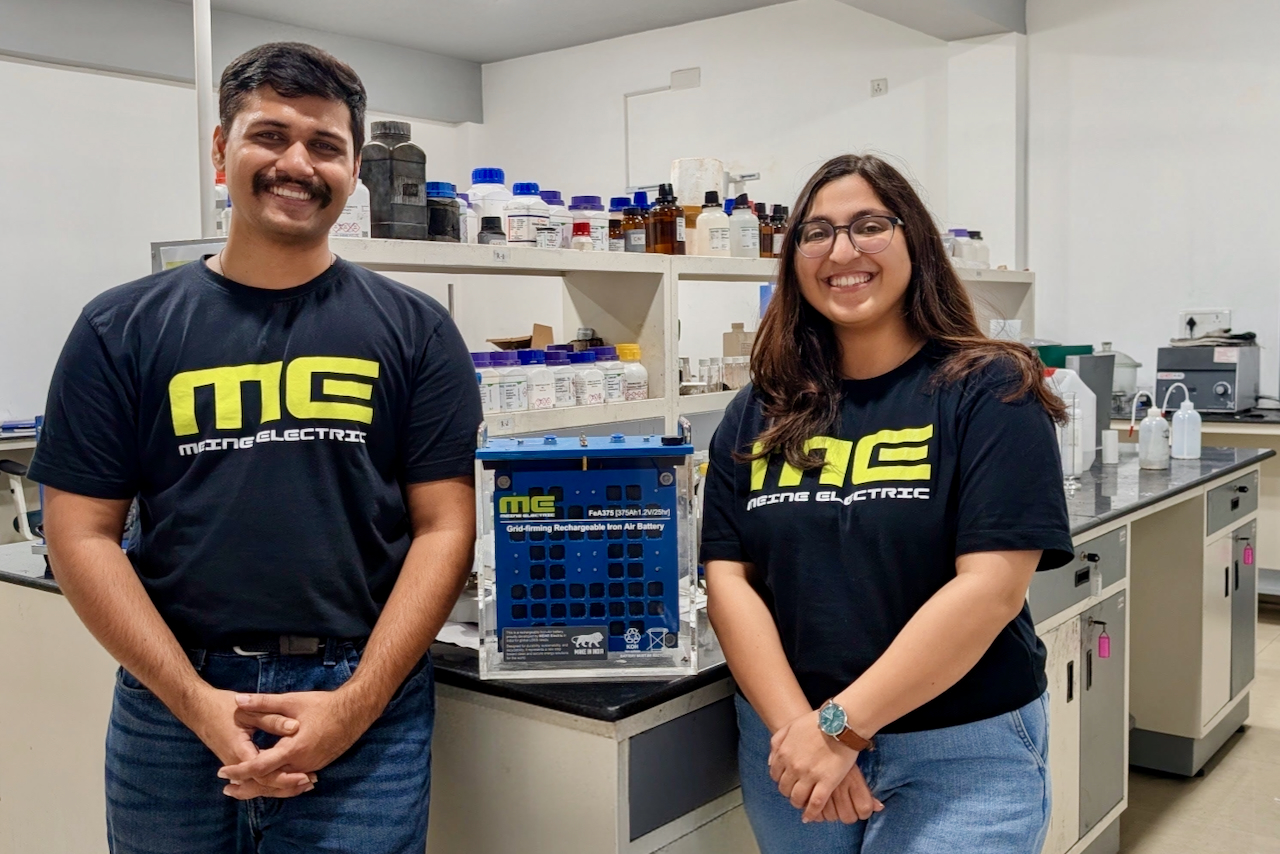
In this episode, I’m joined by Priyansh Mohan and Stuti Kakkar, school friends turned co-founders at MEINE Electric, to talk about their innovations in developing iron-air battery energy storage systems (BESS) for long duration energy storage (LDES).
Renewable energy in India faces a fundamental problem of timing. Solar panels and wind turbines produce electricity when nature dictates, not necessarily when industrial factories require it. For the green transition to succeed, power must be stored for the long hours when the sun is down or the wind is still. While lithium-ion batteries serve short durations, they remain too costly for day-long storage.
Priyansh and Stuti are innovating in the area of controlled, reversible rusting, with the aim of providing energy storage for 16 to 24 hours at prices lower than with current options such as pumped hydro storage and of course lithium-ion batteries. Their approach uses materials abundantly available — iron, air, and water — to avoid the complicated supply chains associated with rarer metals.
“At the core of it, it’s just reversible rusting. We all know that iron rusts — it’s not a reaction that’s unknown to humanity — but to do it in a controlled fashion at a greater efficiency so it acts as a battery is where our innovation and the whole magic lies.”
Stuti Kakkar and Priyansh Mohan
In this episode, we get a peek into the engineering innovations behind their technology and some of the challenges that remain in the way of building deep tech companies from India. Backed by Rebalance, Antler, Venture Catalysts, gradCapital, and Anna Incubator, Stuti and Priyansh have recently raised a pre-seed investment in their venture.
They expect to showcase a pilot-ready version of their first product as early as later this year.
Priyansh Mohan and Stuti Kakkar, founders of MEINE Electric in Chennai, are developing an Iron-air battery energy storage system that they hope will help reduce curtailment of renewables-based power.Listen to the preview
Renewable energy in India faces a fundamental problem of timing. Solar panels and wind turbines produce electricity when nature dictates, not necessarily when industrial factories require it. For the green transition to succeed, power must be stored for the long hours when the sun is down or the wind is still. While lithium-ion batteries serve short durations, they remain too costly for day-long storage.
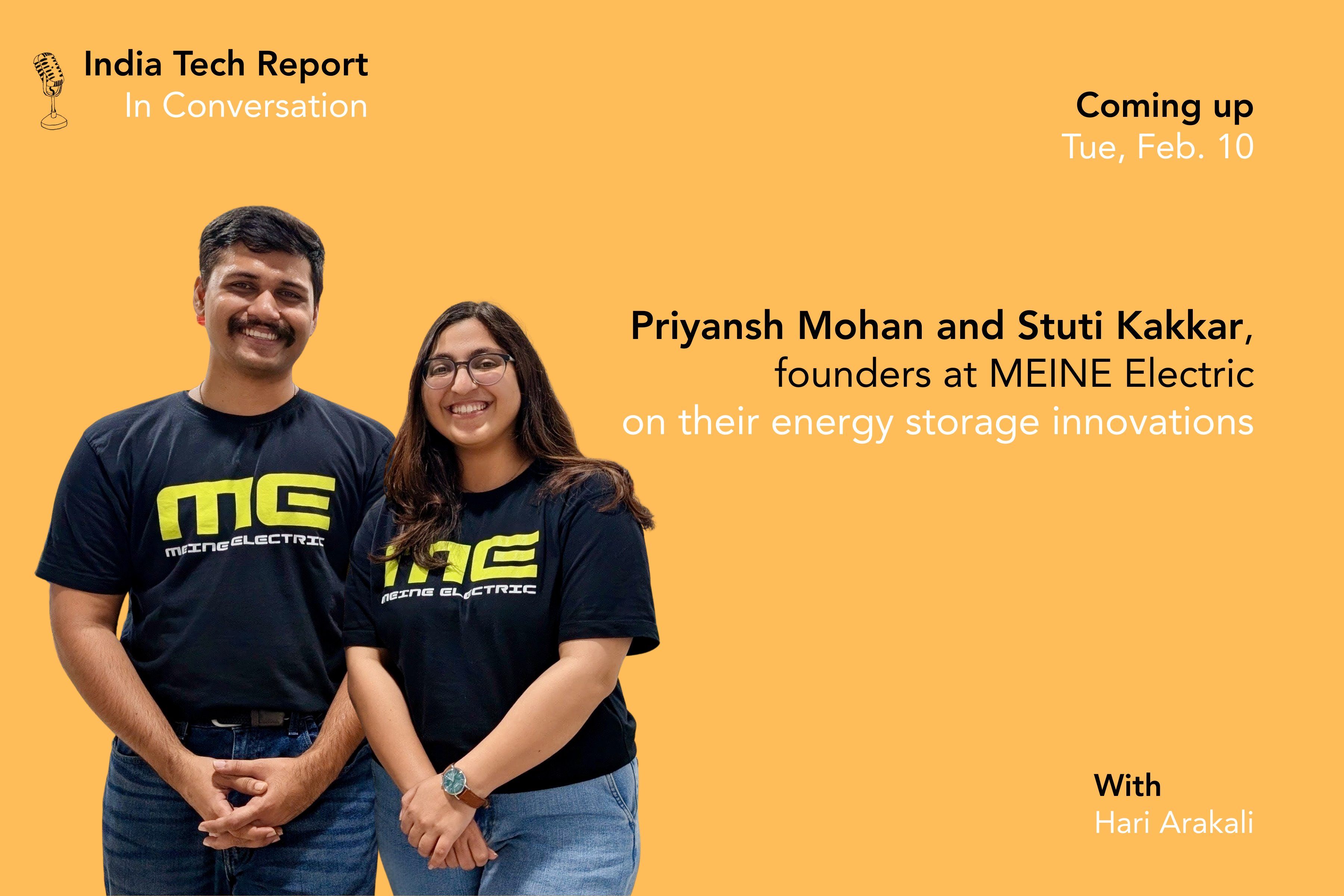
Coming up on Feb. 10, in my next episode of Conversations at India Tech Report, I speak with Priyansh Mohan and Stuti Kakkar, friends from school turned co-founders – at MEINE Electric, to talk about their innovations in developing iron-air batteries for longer duration storage.
By controlling the process of reversible rusting, the duo aims to provide energy storage for 16 to 24 hours at a fraction of current prices. Their approach uses abundant materials — iron, air, and water — to avoid the complicated supply chains associated with rarer metals.
In this episode, we get a peek into the engineering innovations behind their technology and some of the challenges that remain in the way of building deep tech companies from India. Backed by Rebalance, Antler, Venture Catalysts and gradCapital, Stuti and Priyansh have raised a pre-seed funding recently.
They are working to release a pilot-ready version of their first product as early as later this year.
You can catch the full conversation right here, or wherever you get your podcasts. Here’s a 90-second preview.
Generated image to illustrate deep tech startups. India has modified its policies to provide longer term support for such startups.
India has rewritten the rulebook for startups in the country, carving out a separate deep‑tech category with a longer recognition window and higher turnover ceiling in a move aimed at research‑heavy, capital‑intensive ventures.
In a gazette notification dated February 4, the Department for Promotion of Industry and Internal Trade (DPIIT) said deep‑tech startups recognised under the Startup India framework will be eligible for benefits for up to 20 years from incorporation, twice the 10‑year limit that continues to apply to other startups. The annual turnover cap for such entities has been set at Rs. 300 crore.
The notification replaces the 2019 definition of a startup and, for the first time, provides a formal policy definition of what counts as “deep tech”. DPIIT describes deep‑tech startups as entities building solutions rooted in new scientific or engineering knowledge, with high research‑and‑development intensity, ownership or creation of novel intellectual property, long development timelines and substantial technical uncertainty.
Sectors explicitly cited in government and industry commentary include artificial intelligence and associated infrastructure, semiconductors, space, biotechnology, new materials, energy and quantum technologies.
Governments from Washington to Brussels and Beijing have been racing to update startup and industrial‑policy regimes to court deep‑tech founders, whose capital needs and time horizons sit awkwardly with standard venture‑capital cycles. Europe has launched targeted deep‑tech funds, while America has used instruments such as the CHIPS and Science Act to back strategic technologies; China continues to marshal state support for advanced manufacturing and hard tech.
India has recently launched a research, development and innovation fund of Rs. 100,000 crore.
The move to extend recognition to 20 years and raise the turnover threshold is cast in Delhi as an attempt to signal that the government is prepared to match the longer gestation of frontier technologies with a more patient policy framework at the highest levels.
“This is a decisive and forward‑looking move by the government. By formally recognising deep‑tech startups and giving them a longer runway, India is aligning policy with the realities of science‑led innovation,” Vishesh Rajaram, founding partner at the well know deep tech VC firm Speciale Invest, said in an emailed statement.
“It sends a clear signal that the country is serious about building IP‑driven deep‑tech companies from India for the world—and gives founders and investors the confidence to commit long‑term capital to that journey,” Rajaram added.
Beyond timelines and turnover, the revised framework also tweaks the scope of who can qualify as a startup under the scheme. Cooperative societies are now eligible alongside companies and LLPs, broadening access to benefits, while regular startups retain a 10‑year recognition window and see their turnover cap raised from Rs. 100 crore to Rs. 200 crore.
DPIIT will continue to process applications through its portal, but deep‑tech ventures must furnish additional evidence of scientific novelty, R&D spend and IP creation to qualify for the extended treatment.
“India just gave deep tech a real policy home and BYT Capital welcomes DPIIT’s new Deep Tech Startup definition (4 Feb 2026), a timely step that aligns policy with the realities of frontier innovation,” Amit Chand, founder of BYT Capital, an early stage deep tech VC firm in Bengaluru, said in an emailed statement.
“By extending startup recognition for eligible deep‑tech ventures to 20 years and raising the turnover threshold to Rs. 300 crore, this policy doesn’t just add a label, it improves time horizons, capital efficiency, and investability for deep‑tech in India,” Chand said.
He added: “This is a meaningful step toward making India more ‘fundable’ for frontier innovation because policy timelines now look closer to deep‑tech timelines”.
In a recent episode of Conversations at India Tech Report, Jay Panchal, founder and CEO at Aule Space spoke about his young space-tech startup’s vision to help build India’s robot workforce in space.
Aule is starting on that journey with the aim of launching a fleet of “jetpacks” that will work as mission extension vehicles for geostationary satellites and offer other applications in the defense sector as well. You can find the full conversation at indiatechreport.in or wherever you get your podcasts.
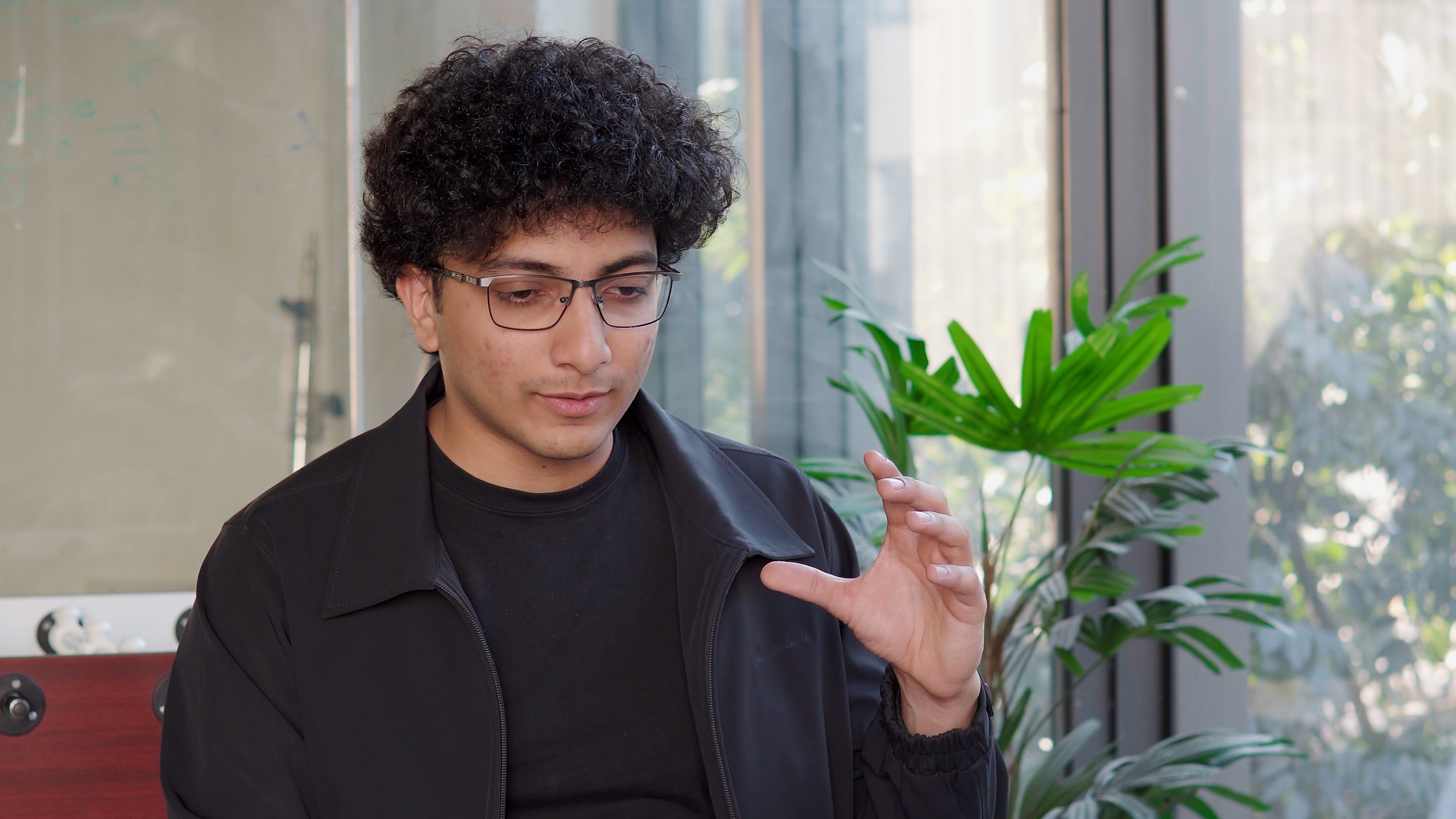
Here’s a quick point, with Jay talking about how he and his co-founders bring complementary skills to the table, their current team and immediate hiring needs – focused on core engineering.
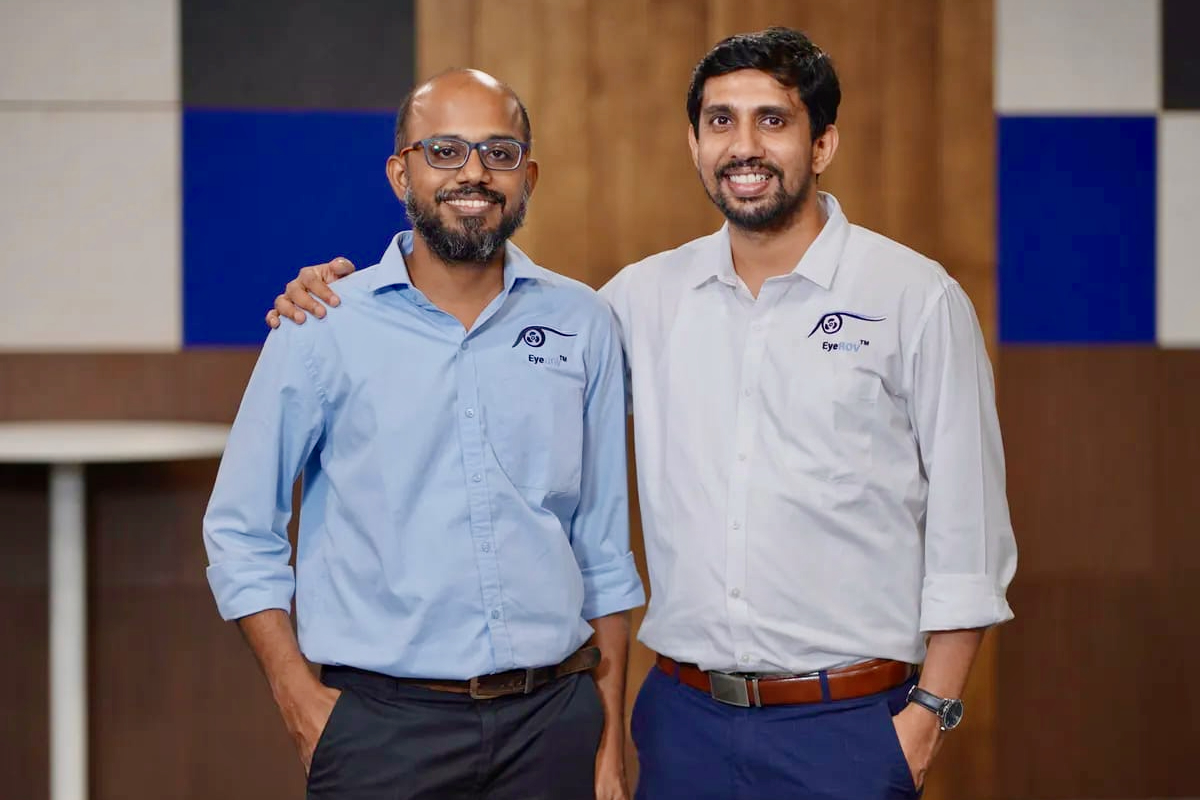
EyeROV Founders (L-R) Kannappa Palaniappan P (CTO) and Johns T. Mathai (CEO). Image source: Company. Editing by Hari Arakali.
For a start-up navigating the murky depths of the Indian Ocean, IROV Technologies (EyeROV) is beginning to see quite clearly. The Kochi-based marine robotics startup has raised Rs. 13 crore in pre-Series-A funding, co-led by AWE Funds and Unicorn India Ventures, according to a press release.
The money is intended to bolster research and development as EyeROV seeks to expand beyond its domestic shores into global markets.
Since its founding in 2017 by IIT alumni Johns T. Mathai (CEO) and Kannappa Palaniappan P (CTO), EyeROV has carved out a niche in the high-stakes world of underwater inspection. With a portfolio that includes a proprietary 10km long-tunnel inspection capability, the company has already completed over 150 projects for industrial heavyweights such as Maersk, ONGC, and Adani.
Its Robotics-as-a-Service model aims to replace high-risk manual diving with autonomous, sustainable electric systems, a shift underscored by a recent Rs. 47 crore order from the Indian Navy.
Indian startups such as EyeROV are developing products to win a share of the global market for maintenance of offshore assets which is seeing a shift from manual, hazardous operations to automated surveillance.
EyeROV estimates a $13 billion global addressable market for underwater infrastructure inspection. Deep-tech companies are increasingly viewed as essential for the long-term viability of the aging energy pipelines, subsea cables, and ports that underpin international trade.
“Some of the world’s most critical infrastructure such as energy pipelines, subsea cables, ports are offshore assets. They are all beneath the ocean’s surface and historically maintained through high-risk, manual, and expensive operations. We believe this is precisely where deep technology creates both outsized returns and meaningful impact,” Seema Chaturvedi, Founder and Managing Partner of AWE Funds, said in the press release.
The broader environment for Indian deep tech is warming, spurred by government grants and a burgeoning innovation ecosystem. For EyeROV, this round is a strategic precursor to a planned $10 million Series A, as it seeks to capture a larger share of the $800 million Indian market.
“With our recent Rs. 47 crore Indian Navy order and the surging demand for specialized inspections in the energy and infrastructure sectors, EyeROV has reached a clear inflection point,” CEO Mathai said in the press release. “This funding will accelerate our trajectory as we scale our technology and expand our footprint internationally.”
In a recent episode of Conversations at India Tech Report, Jay Panchal, founder and CEO at Aule Space spoke about his young space-tech startup’s vision to help build India’s robot workforce in space.
Aule is starting on that journey with the aim of launching a fleet of “jetpacks” that will work as mission extension vehicles for geostationary satellites and offer other applications in the defense sector as well.
You can find the full conversation at indiatechreport.in or wherever you get your podcasts.
Here’s a quick chapter on some of Jay’s important formative experiences that set him on the path to entrepreneurship in the space economy.