Perceptyne is a Hyderabad-based company building dexterous, dual-arm, intelligent robots for industrial automation, currently focused on automotive and electronics manufacturing lines.
The founders explain the gap they saw on real shop floors, where many assembly stations still rely on manual work because traditional approaches cannot handle unstructured inputs, fine force control, or frequent product changes.
The conversation goes into their vertically integrated hardware, including mobile configurations, and their PR-PhI “physical intelligence” software layer that orchestrates perception, control, and imitation-learning–based skills like visual servo, slip-free grasping, and force-based assembly.
You will also hear their take on the state of India’s robotics ecosystem, the evolution of robots as a combined hardware-and-software challenge, and how they are moving from pilots with global automotive and electronics manufacturers toward larger deployments. Perceptyne, which turns four this year, is backed by two well-known deep-tech VC firms, Yali Capital and Endiya Partners.
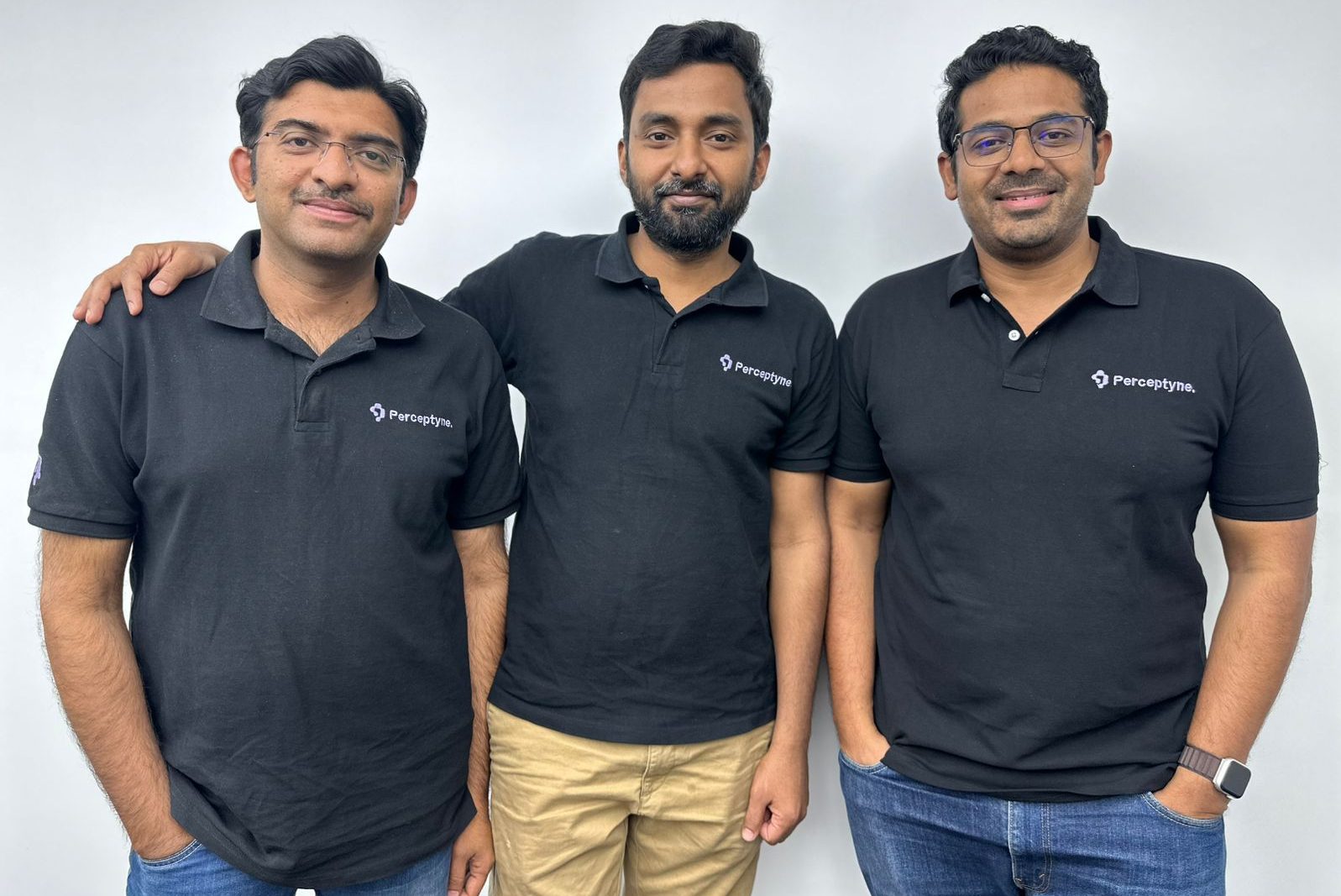
Founders of Perceptyne Robots, Mrutyunjaya N, Raviteja Chivukala and Jagga Raju N are building autonomous, dexterous robots and the physical AI stack needed.
Happy new year to all of you deep tech enthusiasts in India. An area in which 2026 is already shaping up to be one that will likely see advances, is robotics and automation and the AI needed for this, being called physical AI or even ’embodied AI’.
If you caught Boston Dynamics CSO Marc Theermann recently saying the company’s Atlas humanoid is “not designed for YouTube” but for the real world, what’s your view on that — premature or prophetic? Will 2026 show us?
Listen to the preview
To kick off my reports this year, I got a chance to chat with a dynamic entrepreneur trio building what they say will be autonomous and dexterous robots for the real world — at Perceptyne Robots.
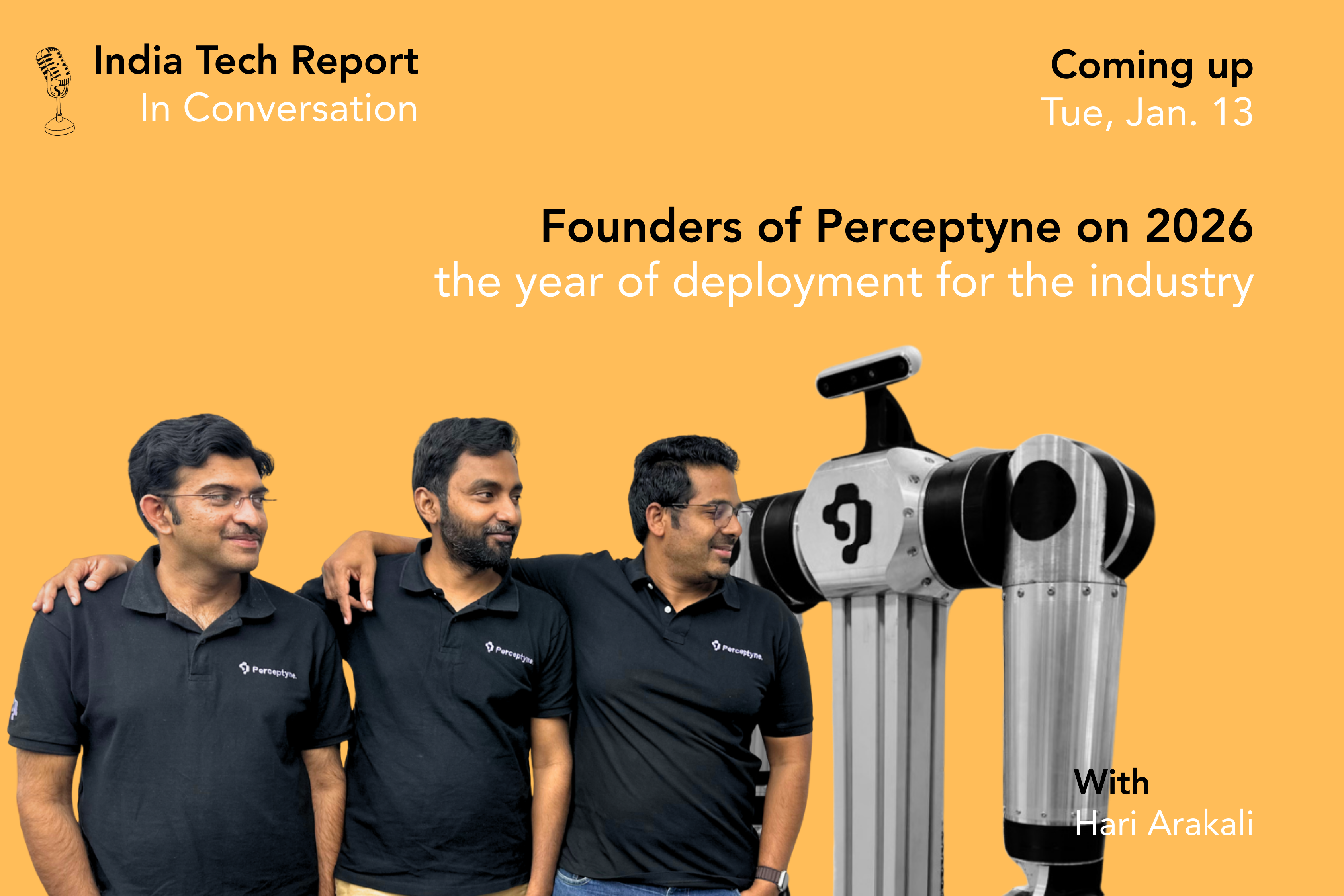
So, coming up on Tuesday, Jan. 13, this year’s first episode of India Tech Report: In Conversation, will feature Mrutyunjaya N, Raviteja Chivukala and Jagga Raju N, co-founders of this Hyderabad-based robotics and physical AI startup.
Their venture, which turns four this year, is backed a couple of well-known deep-tech VC firms, Yali Capital and Endiya Partners. Catch the full conversation right here, or wherever you get your podcasts. Here’s a less-than-a-minute preview.
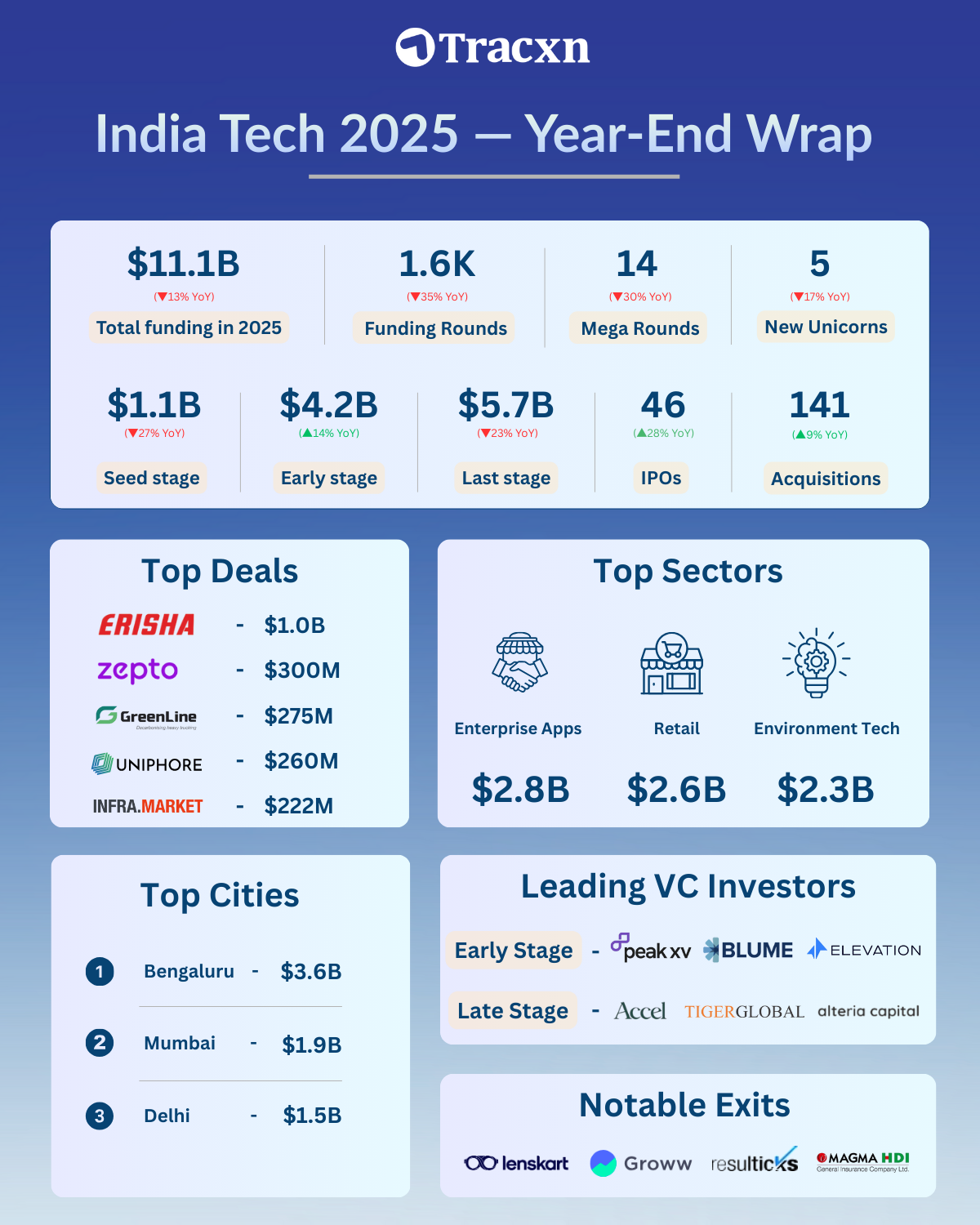
Happy new year, dear listeners and readers. I bet 2025 was an eventful year for you — it certainly was, for me. As we look ahead at 2026, here’s one more quick look back at how Indian tech startups fared in the year gone by.
This infographic is courtesy Tracxn, a leading data intelligence provider in India on private markets.
(00:20) Mobile robots market to nearly double by 2030
Global demand for mobile robots is set to surge, with the market projected to grow from $27.39 billion in 2025 to $52.11 billion by 2030, driven by AI, 5G, e-commerce, and labour shortages, while Asia-Pacific leads adoption and high costs, regulatory hurdles, and integration challenges remain important constraints.
(00:50) Hyundai debuts MobED autonomous robot platform at iREX 2025
Hyundai Motor Group has unveiled MobED, a production-ready autonomous mobility robot platform, at the iREX 2025 robotics show in Tokyo, positioning it as the company’s first mass-produced mobility robot for industrial and everyday applications, with Pro and Basic variants set for market launch in the first half of 2026.
(01:17) IFC backs Gujarat Fluorochemicals’ EV unit with $50 million
IFC will invest about $50 million in Gujarat Fluorochemicals’ EV venture GFCL EV Products to build India’s first fully integrated battery-materials plant, supporting local production of key inputs for electric vehicle and energy storage batteries and reducing import dependence while strengthening the country’s position in global clean-energy supply chains.
(01:46) Viavi, QNu Labs team up on quantum-safe network security
Viavi Solutions and QNu Labs, a quantum cybersecurity startup in India, have formed a strategic R&D partnership to develop test frameworks, standards, and reference architectures for quantum-safe network security, spanning post-quantum cryptography, quantum key distribution, quantum random number generator, and hybrid systems, with plans for a broader industry consortium to help operators and enterprises transition from classical to quantum-resilient infrastructures.
(02:20) Skylark Drones, WELL Labs ink MoU on data-led water intelligence
Skylark Drones has signed an MoU with Bengaluru-based WELL Labs to build data-driven water-resource intelligence platforms, according to a press release. The platforms will fuse large-scale drone-based mapping with hydrological science, supporting watershed management, flood resilience, and climate-linked water planning for governments and communities across India.
(02:46) Shastra VC launches SDEX deep-tech fellowship with $100,000 grants
Shastra VC has launched SDEX, Shastra Deep-Tech Excellence Fellowship, a 16–24-week programme to help researchers at IITs, IISc, NITs and other labs turn frontier technologies into venture-ready startups, with the first cohort set to pick up to 15 teams and provide each with equity-free funding and resources of up to $100,000 dollars.
(03:20) Chiratae launches Sonic DeepTech with cheques up to $2 million
Chiratae, a VC firm in Bengaluru, has launched the Sonic DeepTech programme to back early-stage Indian deep-tech startups with seed cheques of up to $2 million, promising 48-hour investment decisions, and access to domain experts, corporate partners, and portfolio founders to help teams move quickly from lab prototypes to market-ready products.
(03:45) ChemLex raises $45m for AI-driven autonomous drug discovery lab in Singapore
ChemLex, an AI-for-science startup, has raised 45 million dollars led by Granite Asia and is establishing its global headquarters and a 24/7 self-driving chemistry lab in Singapore to accelerate small-molecule drug discovery, supported by new technical hires and an MoU with Singapore’s Experimental Drug Development Centre.
(00:21) China’s Zhuque-3 reaches orbit but crashes on landing
Chinese rocketmaker Landspace’s stainless steel, methalox-fuelled Zhuque-3 reached orbit on its debut flight from Jiuquan, successfully deploying its expendable second stage before the reusable first stage failed during landing and exploded near the target zone. The company said the test still met key recovery objectives and noted Zhuque-3’s Falcon 9–class payload capability to low Earth orbit.
(00:53) RNA drug TY1 taps hidden DNA repair pathway
Scientists at Cedars-Sinai have created TY1, an RNA-based therapy that switches on a recently identified DNA repair pathway, enhancing the body’s ability to mend genetic damage and regenerate injured tissue. In preclinical studies, TY1 boosted repair processes without relying on traditional DNA-repair mechanisms, suggesting potential applications in treating cancer, age-related decline and degenerative diseases if future trials confirm its safety and efficacy.
(01:30) MIT’s light-based sensor aims to replace glucose finger pricks
MIT researchers have created a shoebox-sized Raman spectroscopy device that measures blood glucose through the skin, matching the accuracy of commercial continuous glucose monitors in an initial study on a healthy volunteer. The team has already built a cellphone-sized wearable prototype and plans larger clinical trials, with a long-term goal of a watch-like, noninvasive glucose monitor for diabetics.
(02:01) Planys raises Rs. 100 crore for global and defence push
Underwater robotics startup Planys Technologies has raised Rs. 100 crore in a round led by investors including Ashish Kacholia and Lashit Sanghvi, with participation from existing backers. The capital will support global scale-up of its underwater inspection systems and the launch of defence unit Planys Ark to develop indigenous unmanned underwater vehicles and set up a new production facility near Chennai.
(02:30) Activate launches $75m fund for early deep tech
Aakrit Vaish, co-founder of Haptik, and Pratyush Choudhury, former principal investor at Together, have unveiled Activate, a $75 million venture fund targeting India’s earliest-stage deep tech and AI startups, including teams at the ideation stage. The fund plans to write cheques of about $0.5–3 million, supported by a global LP network, and has already begun deploying capital into young AI-first companies.
(03:02) EU backs 40 women-led deep tech startups
EU-funded project Women TechEU has selected 40 women-led deep tech startups from 1,107 applicants in its fourth and final call, awarding each a EUR 75,000 non-dilutive grant plus tailored business support. Winners span 20 countries and focus mainly on AI, biotech and clean tech, with a follow-on initiative planned to continue support beyond 2026.
(03:35) IIT Madras incubator tops 500 deep-tech startups
IIT Madras Incubation Cell has incubated 511 deep-tech startups with a combined valuation of over Rs. 53,000 crore, creating more than 11,000 direct jobs and cementing its status as India’s largest deep-tech hub. In FY 2024–25, it onboarded 100+ startups under the “Startup Shatam” mission, with portfolio companies spanning space, mobility, climate-tech, semiconductors and frontier AI.
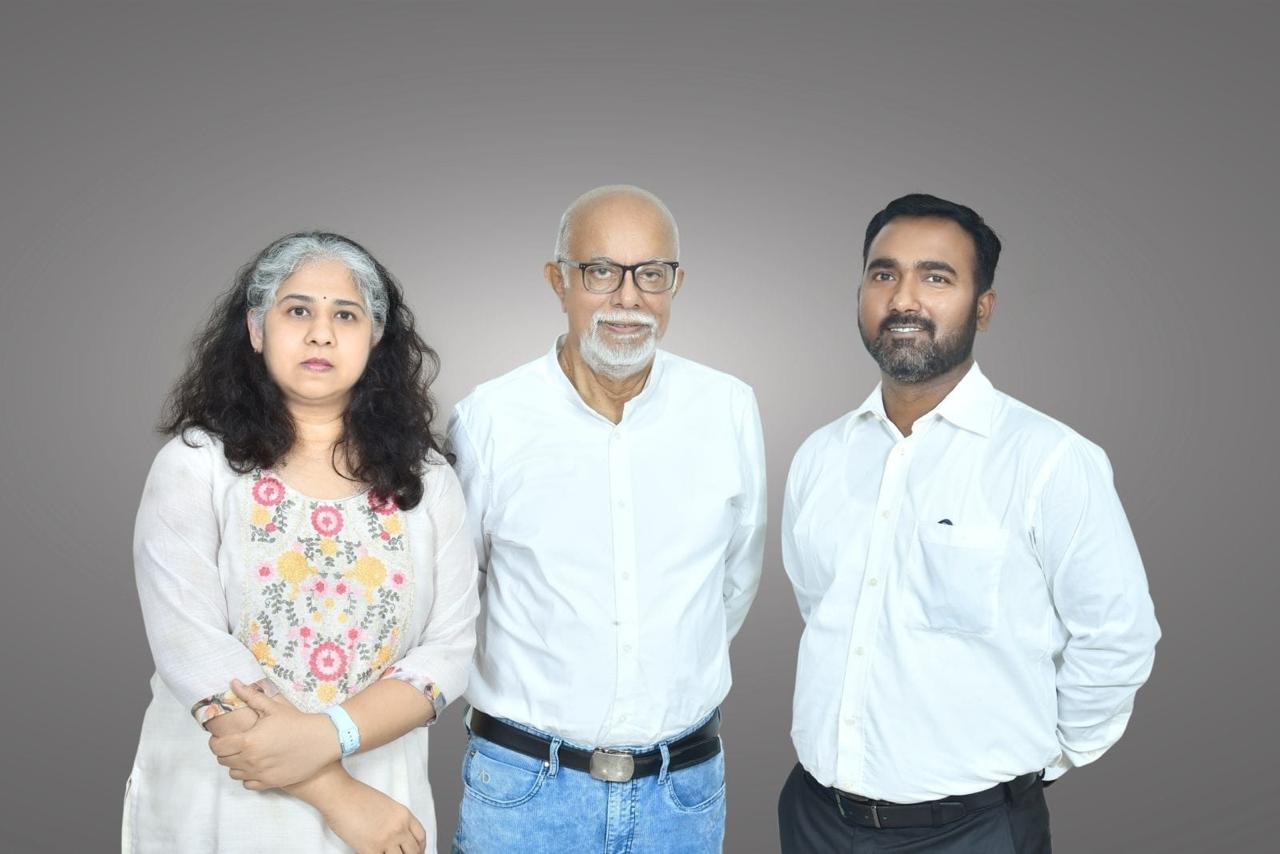
Janaki Venkatraman, Santanu Datta and Arindam Ghatak, co-founders of Biomoneta. Image source: company.
(00:20) IVCA forum urges more domestic capital for deep tech
The Indian Venture and Alternate Capital Association hosted its Domestic Institutional Investors & Exits Forum 2025 in New Delhi, spotlighting the role of local capital in deep tech and biotech. An MoU between IVCA and BIRAC aims to boost capacity building and investment awareness, as BIRAC’s Managing Director Dr. Jitendra Kumar urged institutional investors to back research-led startups moving from incubation to commercial scale.
(00:53) Rama Devi Lanka joins NITI Aayog frontier tech hub
Rama Devi Lanka has joined NITI Aayog’s Frontier Tech Hub to drive state-level engagement on AI, blockchain, drones and other emerging technologies. The former Telangana state emerging tech director will work with state governments to scale pilots, shape policy frameworks and strengthen innovation ecosystems, aiming to align frontier tech deployments with inclusive governance and public-impact use cases nationwide.
(01:22) Biomoneta wins US FDA nod for Avata Rx
Biomoneta, a Bengaluru startup, has secured US FDA approval for Avata Rx, its ZeBox-powered air-decontamination device, becoming the first Indian company cleared in this category. The system targets airborne pathogens in high-risk clinical and biotech environments, backed by independent validations including an IISc study on SARS-CoV-2. The milestone strengthens its global market entry and validates investor Beyond Next Ventures’ deep-science thesis.
(02:00) Moonrider raises $6m for EV tractor rollout
Moonrider, an electric tractor startup in Bengaluru, has raised $6 million in a Series A round led by deep-tech fund pi Ventures, with Singularity AMC, Advantedge Founders and Micelio Fund participating. The capital will fund commercial rollout of its fully homologated, road-ready electric tractors, which the company says match diesel tractors on upfront price while sharply lowering operating costs to improve farm economics.
(02:32) SynaXG raises over $20m for AI-RAN platform
Singapore deep-tech startup SynaXG has raised over $20 million in its first funding round, led by January Capital, Vertex Ventures and Qualgro. The company builds AI-powered radio access network (AI-RAN) technology for wireless infrastructure. The capital will be used to scale product development and engineering, and deepen partnerships with telecom operators and enterprise customers deploying next-generation network solutions.
Niobium raises $23m to advance FHE silicon
(03:03) US-based Niobium has raised more than $23 million in an oversubscribed follow-on round to accelerate its second-generation fully homomorphic encryption (FHE) hardware platform. The funding will support the shift from prototype to production-ready ASICs, hardware–software co-design and customer pilots. Existing backers Fusion Fund and Morgan Creek joined new investors including Blockchange Ventures, ADVentures, Korea Development Bank and JobsOhio Ventures.
(03:37) Korean team links desalination with hydrogen production
Researchers at Seoul National University have built a modular water-purification system that simultaneously produces clean water and hydrogen using ion concentration polarization across a single cation-exchange membrane. The finger-sized device removes salts and contaminants while generating hydrogen, recovering about 8–10 percent of input energy. Its compact, scalable design targets use in disaster zones, remote sites, military deployments and even space missions.