One could think of ‘Mitti’ — the Hindi word for soil — as representing the grounded foundation of a cooler future. And for us in India while rice that grows in our soil is a daily staple, its traditional cultivation is a hidden climate hazard. Rice cultivation worldwide is responsible for 10-12 percent of human-caused methane emissions. It also consumes staggering amounts of water.
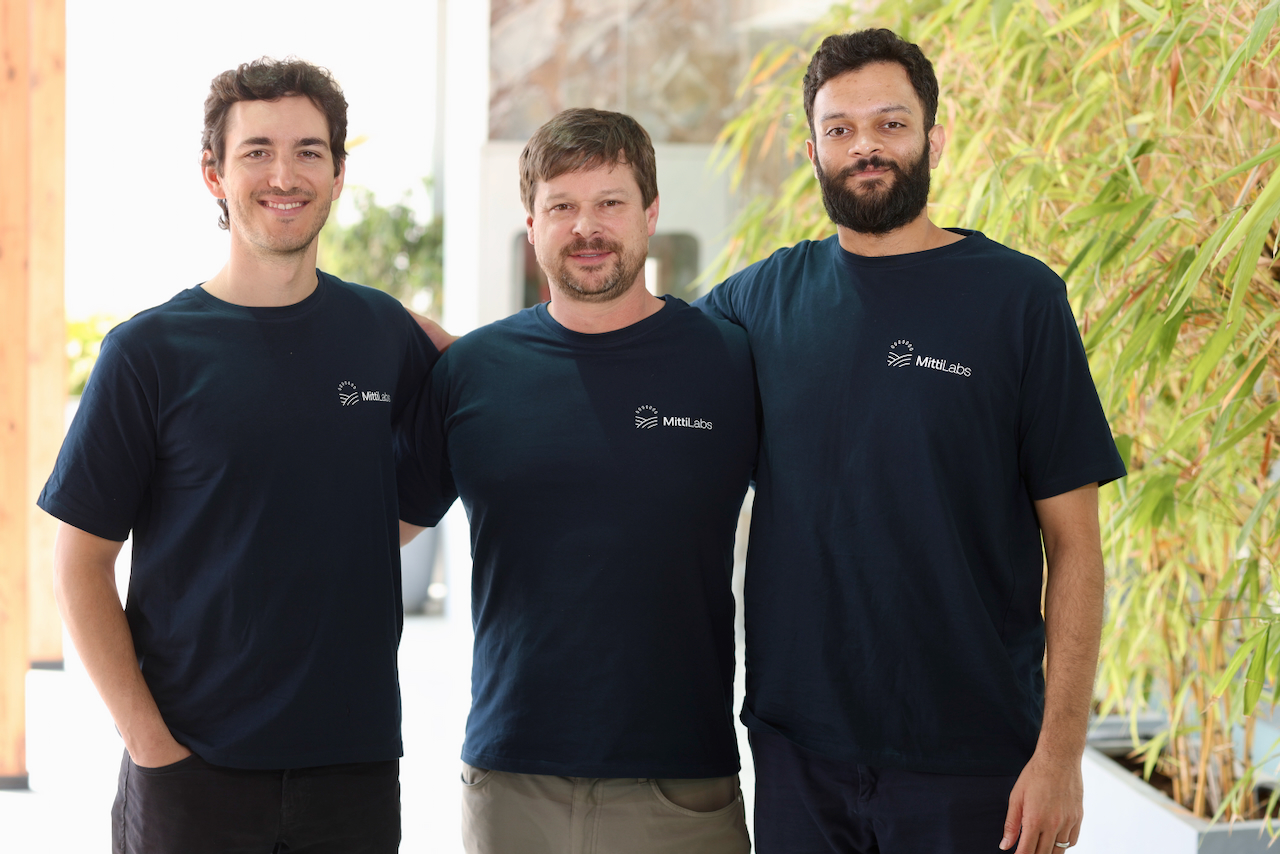
Coming up next on Conversations at India Tech Report, Devdut Dalal (Dev), Xavier Laguarta Soler (Xavi), and Nathan Torbick (Nate), co-founders of Mitti Labs talk about how they are turning rice farming into a powerful vehicle for climate action – specifically targeting methane emissions from rice fields.
Since launching in late 2023, this “full stack” climate-tech startup has scaled from an idea that Harvard alumni Dev and Xavi had to a VC-funded startup (investors include Lightspeed) touching some 70,000 small-holder farmers in India today. Mitti Labs is helping the farmers change how they water their rice crops in a manner that reduces methane emissions, cuts water use and even makes the crops hardier, the entrepreneurs say.
Nate, a distinguished scientist, adds the science and tech experience, helping Mitti Labs tap satellite remote sensing and data analytics to build a digital Monitoring, Reporting, and Verification (dMRV) system, to track methane reductions at the field level. By converting these environmental wins into high-quality carbon credits, Mitti Labs aims to provide direct financial incentives and free advisory services to the farmers.
Catch the episode on June 5, World Environment Day, right here, or wherever you get your podcasts. Here’s a preview with Xavi and Dev laying out their basic thesis.
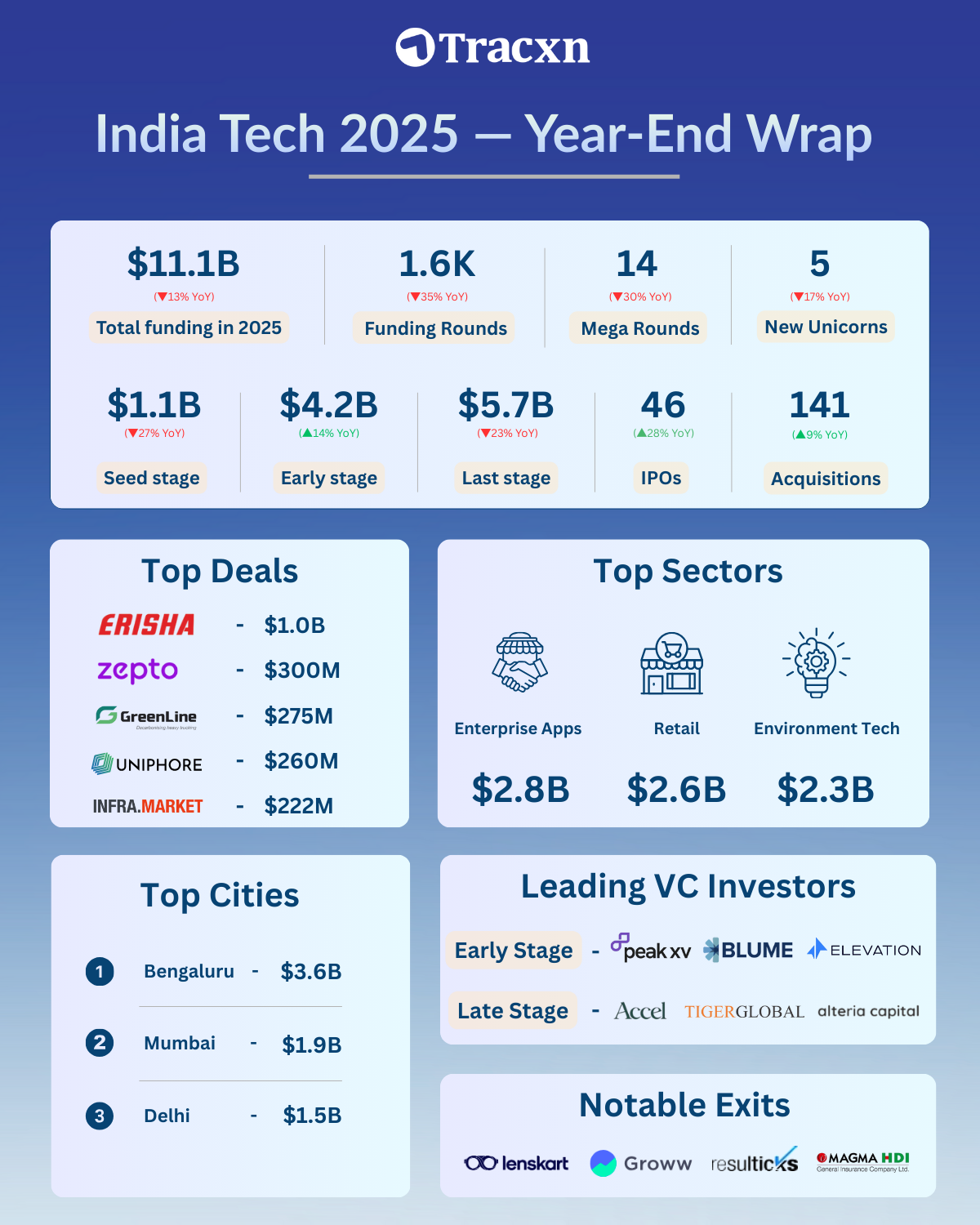
Happy new year, dear listeners and readers. I bet 2025 was an eventful year for you — it certainly was, for me. As we look ahead at 2026, here’s one more quick look back at how Indian tech startups fared in the year gone by.
This infographic is courtesy Tracxn, a leading data intelligence provider in India on private markets.
In this episode, Bhaktha Ram Keshavachar, founder and CEO of Chara Technologies, talks about a new funding round at his startup.
Chara, based in Bengaluru, specializes in building rare earth-free motors and matching controllers. That China, which has a near monopoly on the supply chain of rare earth minerals, has intensified its restrictions on their exports, is something of a tailwind for ventures like Chara.
In this briefing, Bhaktha covers the company’s Series A funding of Rs. 52 crore, or about $6 million, led by Arkam Ventures, with participation from Exfinity Venture Partners, Kalaari Capital, and IIMA Ventures, and how the money will help.
Plans include, ramping up sales, further investment in new technology and products, and a significant increase in motor production capacity.
Daily brief on deep tech and climate tech news from India and around the world.
Illustrative image. OpenAI and India’s Reliance are developing large AI data centres in the country.
India plans 20-year tax exemption, GST credits to boost data centres The Indian government may grant a 20-year tax exemption and GST credits to supercharge investment in domestic data centres, Moneycontrol reports. This policy aims to attract global hyperscale players, cut costs, and accelerate infrastructure for digital services, cloud computing, and AI. The move could transform India’s data centre landscape with incentives for long-term growth and sustainability.
Listen to the episode
Tata Technologies acquires Germany’s ESTEC for ₹750 crore to expand in Europe Tata Technologies has acquired German company ESTEC for ₹750 crore, enhancing its capabilities in advanced driver assistance systems (ADAS) and comfort electronics, Economic Times reports. The deal supports Tata Tech’s European growth strategy, strengthens its joint venture with BMW, and will immediately boost profitability. The acquisition comes without headcount cuts, with team expansions planned in Germany, Morocco, and India.
Indian scientists create foldable, eco-friendly aluminum battery for future devices Researchers at CeNS and IISc Bengaluru have developed a flexible, safe, and eco-friendly battery using aluminum and a water-based solution to replace lithium-ion batteries, according to a press release. Their innovation features a copper hexacyanoferrate cathode and molybdenum trioxide anode, delivering stable performance even while bent. The battery maintains over 96 percent power after 150 cycles and promises safer smartphones, EVs, and smart wearables.
QuiX Quantum raises €15m to build Europe’s first universal quantum computer QuiX Quantum, based in the Netherlands, secured €15 million in Series A funding to deliver its first-generation universal photonic quantum computer in 2026, Oost NL reports. Their system promises room-temperature scalability and enhanced capabilities for sectors like healthcare, IT, and advanced manufacturing. The funding strengthens Europe’s quantum tech ecosystem and aims for fault-tolerant quantum computing breakthroughs.
NUS Enterprise launches new VC partnerships and Stanford tie-up to boost startups NUS Enterprise has expanded its venture capital programme with two new co-investment partnerships totalling S$20 million, and began a S$2 million pilot collaboration with Stanford University, Business Times reports. The initiatives aim to connect NUS spin-off startups to global investment, reinvest profits in education, and strengthen deep-tech innovation. Students will gain hands-on experience tackling industry challenges with world-leading mentors.
Stargate Hydrogen, RDI sign MoU to boost Saudi green hydrogen innovation Stargate Hydrogen, in Estonia, has signed a Memorandum of Understanding with Saudi Arabia’s Research, Development, and Innovation Authority to accelerate green hydrogen innovation in the Kingdom, Hydrogen Central reports. The agreement includes setting up Stargate’s regional headquarters in Riyadh, collaborating with Saudi academic and manufacturing partners, and advancing local technology transfer, all supporting Saudi Vision 2030 and deep-tech sustainability goals.
CerraCap Ventures invests in Enginius.ai to advance secure AI for engineering CerraCap Ventures has backed Enginius.ai, an AI platform delivering bespoke solutions for regulated industries like aerospace and pharma, the firm said in a press release. Enginius integrates large language models with enterprise-grade security and specialized assistants for technical search, documentation, review, and simulation. The tools accelerate engineering workflow while ensuring compliance, accuracy and data security, supporting complex product development across sectors.
Cailabs secures €57m to scale photonics, ramp up ground station output French photonics startup Cailabs has raised €57 million in a funding round led by the European Investment Bank and top European investors to accelerate industrial scale-up, Silicon Canals reports. The investment will help produce up to 50 optical ground stations annually by 2027, expand international operations, and advance next-gen laser communications for space, defense, and commercial networks.
Byome Labs raises €3.6M for instant microbiome-based skincare solutions Byome Labs, a French deep-tech startup, has raised €3.6 million to industrialize production of its Byome Derma kits, enabling instant, point-of-sale skin microbiome testing for personalized recommendations, Silicon Canals reports. The technology offers AI-powered suggestions using antigenic strips and will be integrated as a white-label solution for brands, with international rollout planned for 2026 and expanded R&D hiring.
Supercritical names ex-BP executive Siobhan Clarke as chair to drive green hydrogen Supercritical, a UK-based innovator in high-pressure electrolyser technology for green hydrogen, has appointed Siobhan Clarke, former BP and Cisco executive, as Chair to lead its next growth phase, Fuel Cells Works reports. Clarke’s leadership comes as Supercritical prepares for a major pilot in 2027, targeting scalable, cost-effective hydrogen production for industry decarbonization.
Menlo Ventures promotes Deedy Das to partner after AI investing successes Menlo Ventures has promoted Deedy Das to Partner, recognizing his achievements in launching the $100M Anthology Fund with Anthropic and driving early-stage AI investments like Goodfire and OpenRouter, the VC firm, famous for its exits from Uber, Siri and Tumblr, said in a post on its website. Das, with prior roles at Facebook, Google, and Glean, is known for technical depth and influence in the AI community, co-authoring key LLM market analysis and gaining wide following among founders and engineers.
OpenAI chair Bret Taylor says AI is a bubble, but predicts lasting value
OpenAI board chair Bret Taylor, echoing CEO Sam Altman, believes the industry is in an AI bubble where many will lose money, similar to the dot-com era, TechCrunch reports. However, Taylor insists AI will transform the economy and generate massive future value, drawing parallels to how the internet drove progress after the bubble burst. He sees both risk and significant opportunity for innovation.
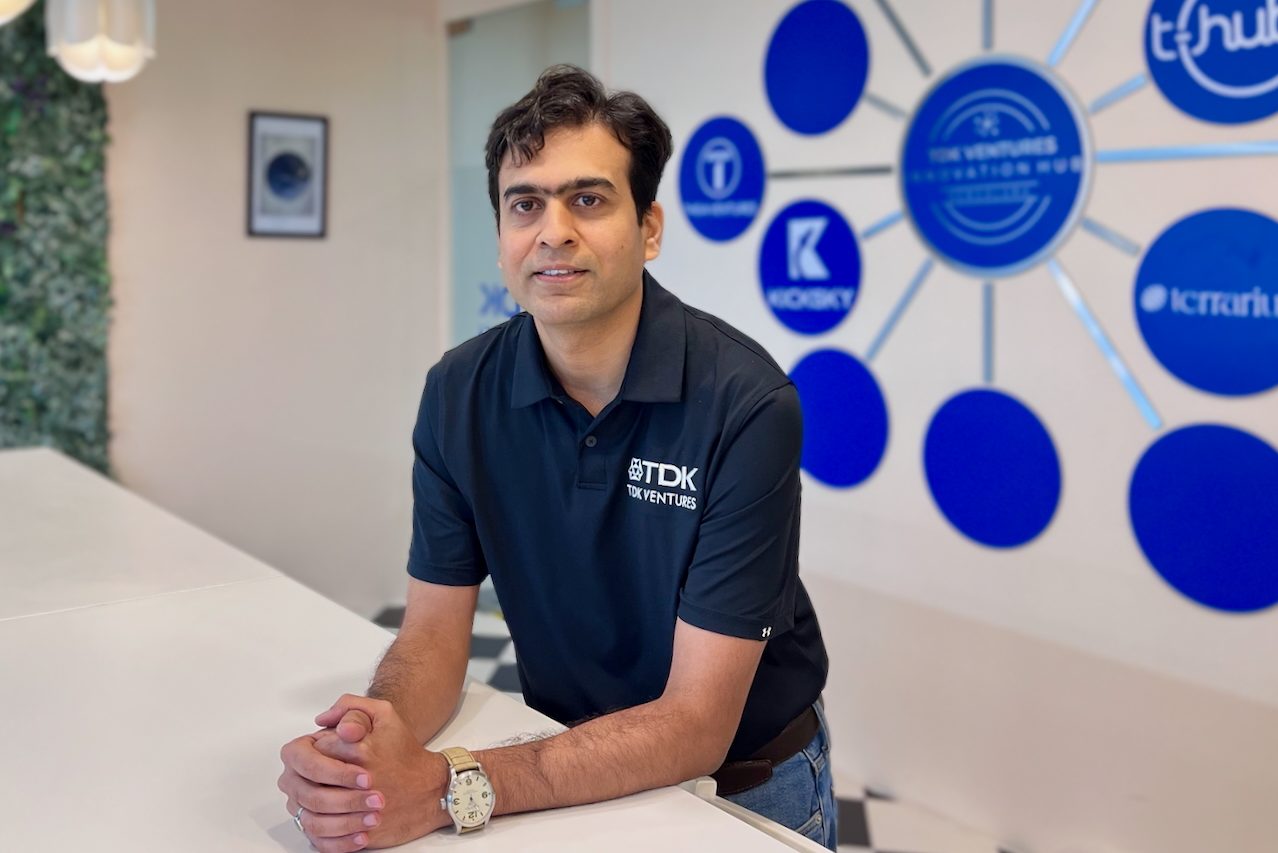
In this episode, Ravi Jain, an Investment Director at TDK Ventures, joins me for a wide-ranging discussion on the current state and trajectory of India’s deep tech ecosystem. Jain gives us a micro capsule on the history of TDK, developing technologies for sectors spanning automotive, energy storage, and power electronics, and the strategic rationale for launching its corporate venture arm in 2019.
He talks about TDK Ventures’ mandate to invest in startups poised to shape emerging markets and tomorrow’s standards, noting the recent expansion of the firm’s India operations, and a global portfolio that includes investments across sectors such as semiconductors, advanced materials, robotics, quantum technologies, AI, mobility, climate tech and clean energy and agri-tech.
Jain addresses macroeconomic drivers, including government policy, manufacturing incentives, and evolving founder ambitions, that position India for accelerated growth in deep tech. He explains the sector’s optimism despite talent and funding challenges, and highlights the increasing sophistication of Indian deep tech founders, their pragmatism, and the snowballing effect of policy and market maturation.
He also talks about TDK Ventures’ approach to hardware versus software startups, university-driven entrepreneurship, and the imperative for foundational work in AI. Jain also shares reflections from his own career, distilling practical advice for future deep tech entrepreneurs navigating India’s rapidly changing technology landscape.
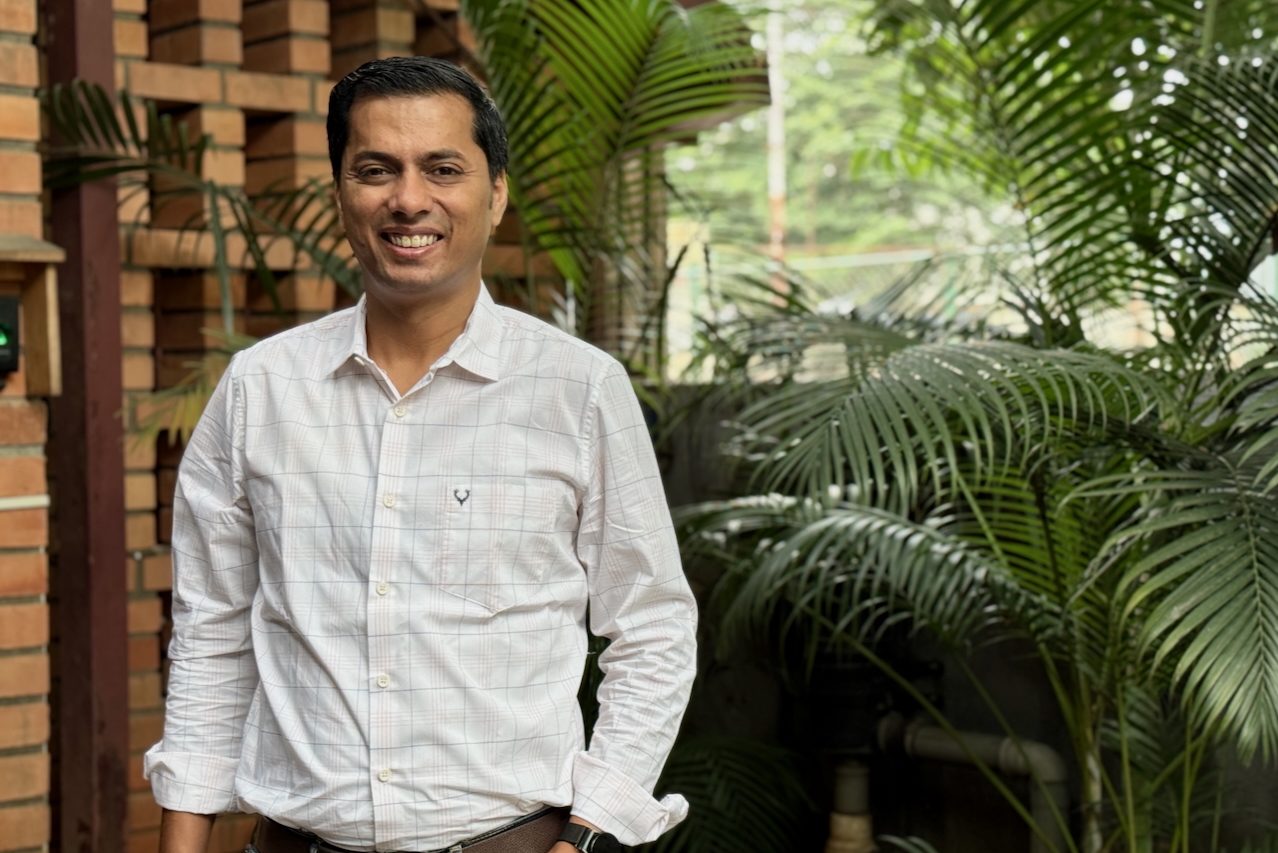
In a recent conversation with Arpit Agarwal, a partner at Blume Ventures, one of India’s best known early-stage, sector-agnostic investors, we spoke about the firm backing what he describes as frontier technologies, and a range of related topics – from India’s under-appreciated strengths to challenges of scale to Blume’s own priorities in the coming years.
As Blume prepares to announce the first close of its fifth fund, Arpit is also happy to debate why sector-agnostic funds may be better placed to invest in deep tech. Here are five takeaways from the conversation.
What VCs are watching in deep tech in India The recent India-Pakistan tensions have significantly boosted government interest and emergency purchases in defence technology, especially drones. However, India currently lacks sufficient cutting-edge domestic drone tech, leading to ongoing imports as warfare shifts toward drones, electronics, and space.
Although India may catch up within five years, defence technology remains a major investment focus for VCs.
Beyond defence, green hydrogen is an emerging sector: there’s a surge in startup activity and projections point to increased investment in the next three years as the field matures. Quantum computing is also on the radar, with both the government and private sector directing attention and substantial funding toward making India a global leader.
The broader electric vehicle ecosystem, particularly software and marketplaces, also presents investment opportunities as established verticals saturate. Overall, defence tech, green hydrogen, quantum computing, and evolving drone and electric vehicle segments stand out as investment opportunities in deep tech in India.
The entire Green Hydrogen supply chain is shaping up in India Hydrogen has long been used in industries such as refineries and blast furnaces, where it is typically produced and consumed on-site rather than stored or transported. The current innovation lies in the development of ‘green hydrogen,’ produced with renewable energy sources, which can be transported via pipelines or containers and used in generators or fuel cells for clean power.
Green hydrogen offers a fully clean energy chain, and has the potential to become economically viable as technology advances and costs decrease.
India is witnessing rapid progress along the entire green hydrogen value chain: startups are developing more efficient and durable electrolysers for hydrogen production; others are focused on new methods for hydrogen storage, such as metal hydrides; and additional companies are enabling the conversion of hydrogen into energy through fuel cells, internal combustion engines, and even hydrogen-based jet turbines.
All these activities reflect significant momentum in India’s emerging hydrogen ecosystem, making it an increasingly promising sector for clean energy investment and innovation.
India’s as yet untapped strengths versus China’s scale There are several ways in which India can compete effectively with China in deep tech manufacturing, despite China’s clear advantages in scale and cost efficiency. While China remains the global leader in manufacturing due to its extensive capabilities and massive economy, Indian companies have advantages in specific use cases.
For example, Indian robotics ventures are able to create price-performance optimized products by using cost-effective components from large-volume industries like automotive, which sometimes allows them to manufacture certain bots more cheaply than those made in China — especially if ultra-high precision is not essential.
International clients, especially in the US and Europe, are often more comfortable sourcing technology from India, given current geopolitical dynamics and concerns over dependence on Chinese suppliers. This gives Indian companies a market access edge. India also excels in software integration, an increasingly critical element even in hardware products.
Indian companies are considered more capable in integrating with large enterprise IT systems, supported by strengths in language, sales, and software customization. Ultimately, even if Indian products are cheaper to produce, companies can price them at par with global competitors, allowing for better profit margins while maintaining a competitive position in international markets.
Should deep tech founders seriously consider sector agnostic funds? While sector-specific venture funds might seem to have an advantage due to their deeper access and selection within a single domain, a sector-agnostic fund with sufficient access can actually achieve better returns across sectors.
The investment selection filters at Blume’s sector-agnostic fund are stricter for deep tech deals, resulting in higher-quality picks. Examples like Ethereal Machines and Ati Motors, which passed through rigorous selection alongside other top companies, illustrate this approach.
Over 14 years and more than 150 investments, Blume Ventures has invested in about 25 deep tech or climate tech companies, but these have generated significantly higher gross returns compared to the overall fund performance. Although deep tech investments are fewer, their quality and outcomes outperform those from hot or crowded sectors, as long as the fund maintains access to top opportunities.
Blume’s top priorities over the next 2-3 years Blume Ventures’ fund strategy has evolved over time. The first two funds were small by today’s standards — around $18 million and $50 million — functioning much like micro VC funds, with small, opportunistic checks and a willingness to experiment in their approach.
Beginning with Fund III, Blume shifted toward taking lead positions, making more concentrated bets, and increasing fund size, growing to $100 million for Fund III and about $280 million for Fund IV. Fund V is expected to be similar in size, focusing on fewer investments but larger check sizes per company, and maintaining more capital in reserve.
Currently, the primary focus is on generating exits, with the aim that 8 to 10 portfolio companies will reach IPO in the next three years — a key priority at this stage. Exits in deep tech tend to take longer; although Blume has exited companies such as Carbon Clean and is working on exiting GreyOrange, most deep tech exits are still some way off.