Tag: technology

  • China expands restrictions on rare earth mineral exports

    China expands restrictions on rare earth mineral exports

    Daily brief on deep tech and climate tech news from India and around the world.

    illustrative image of an automotive assembly line. China controls over 90 percent of the processing capacity of rare earth minerals needed in magnets that go into EVs. Its tightening restrictions are impacting global supply chains.

    China tightens rare earth export controls

    China has expanded its restrictions on rare earth exports to safeguard national security and interests, a move seen as Beijing strengthening its leverage in trade talks with the US. The new rules add five more rare-earth elements to the existing control list, bringing the total to 12, Reuters reports. Export licenses will now be required for the production technologies of these minerals and for their overseas use, including for military and semiconductor applications.

    China is seeking assurances from India that rare earth magnets supplied by it will only be used locally for civilian purposes, and also that they will not be exported to the US, Economic Times reports.

    Listen to the episode

    India targets 5MMT annual hydrogen output by 2030

    India’s Petroleum and Natural Gas Minister, Hardeep Singh Puri, said that the country’s “Hydrogen Age has begun,” with a target to produce 5 million metric tonnes of green hydrogen annually by 2030, ET Energyworld reports. This would account for 10% of the global market. A key project is the NTPC Green Hydrogen Hub near Visakhapatnam, which will be one of the country’s largest integrated green hydrogen facilities. The government’s National Green Hydrogen Mission has an outlay of Rs. 19,744 crore to help achieve these goals.

    Andhra Pradesh forms hydrogen advisory panel

    The Andhra Pradesh government has formed a high-level advisory committee to promote the green hydrogen initiative ‘Green Hydrogen Valley – Amaravati,’ The Hindu reports. The panel, co-chaired by Dr. V.K. Saraswat and Chief Secretary K. Vijayanand, will guide the state’s efforts in technology adoption, research, and infrastructure development. The goal is to make Andhra Pradesh India’s largest green hydrogen hub by 2030, contributing to the country’s sustainable hydrogen economy.

    Tokamak Energy and Gauss Fusion partner to advance fusion

    Tokamak Energy and Gauss Fusion have announced a strategic collaboration to accelerate the commercialization of fusion technology. The partnership will focus on advancing high temperature superconducting (HTS) magnets. This alliance brings together Tokamak Energy’s expertise in HTS technology with Gauss Fusion’s leadership in industrializing fusion energy. The companies aim to pool their industrial know-how to accelerate the path to the first generation of European fusion power plants.

    Aavishkaar Group launches defence and deep-tech fund

    Aavishkaar Group has partnered with Jamwant Ventures to launch the ‘Jamwant Ventures Fund 2’, India’s first veteran-led defence and deep-tech fund. The new fund, targeting a corpus of INR 500 crore, is the first initiative under Aavishkaar’s new ‘OneAavishkaar’ platform. The partnership aims to provide catalytic capital and strategic mentorship to indigenous startups, empowering them to drive innovation for national security.

    Newtral raises funds for global expansion

    Newtral Technologies, a climate-tech startup in Bengaluru, has raised $600,000 in funding from NOW Accelerate, Indian Startup Times reports. The capital will help Newtral expand its sustainability platform and prepare for a Series A funding round. As part of the partnership, NOW will provide venture-building resources and expertise to help Newtral scale its platform, which helps businesses measure, report, and reduce their emissions.
  • Theia Ventures $30 million clean energy fund gets BII backing

    Theia Ventures $30 million clean energy fund gets BII backing

    Daily brief on deep tech and climate tech news from India and around the world.

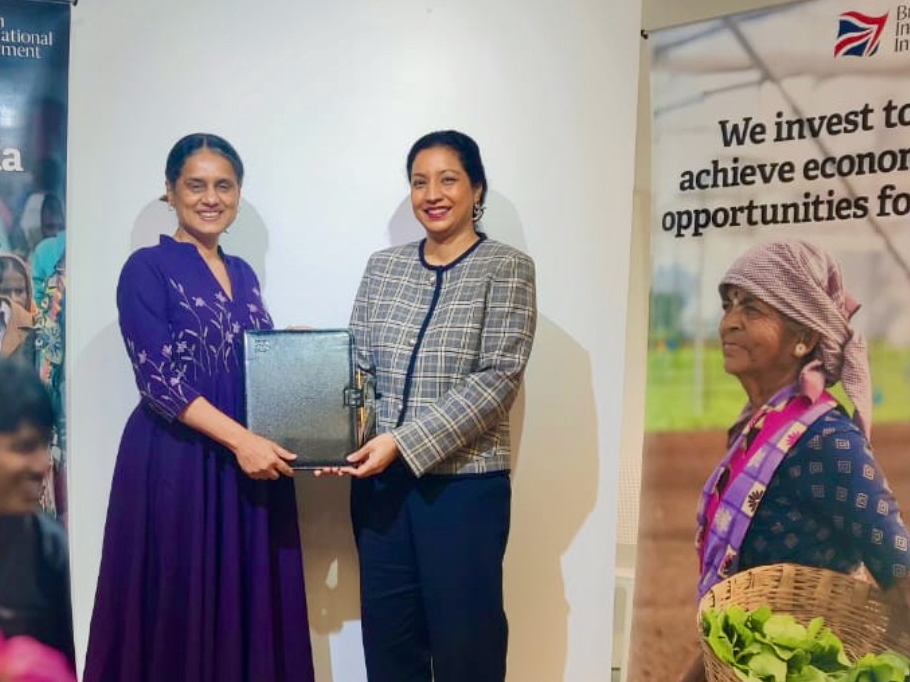
    Shilpa Kumar, MD, BII India, with Priya Shah , Founder, Theia Ventures. BII is backing Theia's $30 mln clean energy fund in India.
    Shilpa Kumar, MD, BII India, with Priya Shah , Founder, Theia Ventures. BII is backing Theia’s $30 million clean energy fund in India. Image source: press release.

    ABB sells robotics unit to SoftBank for $5.375 billion

    ABB has announced it will divest its Robotics division to SoftBank Group for $5.375 billion, a decision made as an alternative to spinning off the business, the company said in a press release. The move is expected to create immediate value for ABB shareholders and use the proceeds to improve its capital allocation. The transaction is expected to close in mid-to-late 2026.

    Listen to the episode

    Honeywell and LS Electric partner to innovate data center solutions

    Honeywell and LS Electric have announced a global partnership to develop and market hardware and software for data centers and battery energy storage systems, the companies said in a press release. The collaboration will create integrated power solutions to simplify management and improve efficiency, helping data centers avoid costly downtime. They will also create a new grid and building-aware battery energy storage system.

    Space Ocean signs deal to explore nuclear power for deep space

    Space Ocean Corp and Space Nuclear Power Corporation have signed a Letter of Intent to explore using advanced nuclear power systems for deep space missions, the companies said in a press release. The collaboration will test a 10-kilowatt nuclear reactor on Space Ocean’s ALV-N satellite. If successful, Space Nukes could become a primary supplier for Space Ocean’s future lunar and planetary missions.

    India’s space economy projected to reach $44 billion by 2033

    India’s space economy is projected to reach $44 billion by 2033, up from $8.4 billion in 2022, according to Union Minister Dr. Jitendra Singh, addressing the “Satcom” at the India Mobile Congress 2025, according to a press release from the department of space. Regulatory reforms and private sector participation have driven this growth, leading to over 300 space startups.

    The Minister noted that satellite communication will be critical for digital connectivity and financial inclusion in rural areas. India has commercially launched 433 foreign satellites, generating substantial revenue. The long-term roadmap includes establishing the Bharatiya Antariksh Station by 2035 and landing an Indian astronaut on the Moon by 2040.

    Theia Ventures secures funding to boost India’s clean energy transition

    Theia Ventures has achieved the first close of its new $30 million fund, with British International Investment as the anchor investor, the VC firm said in a post. The fund will support around 20 early-stage Indian startups focused on decarbonizing sectors like heavy industry and mobility. The firm, which has already begun deploying capital, will invest between $500,000 and $1 million per company.

  • India’s first S&T and innovation conclave, Eli Lilly’s $1 bln plan

    India’s first S&T and innovation conclave, Eli Lilly’s $1 bln plan

    Daily brief on deep tech and climate tech from India and around the world.

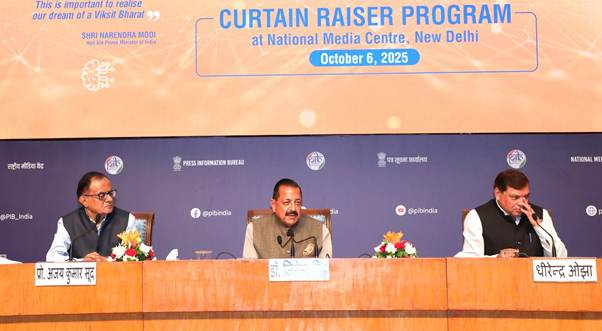
    India’s Science and Tech minister Dr. Jitendra Singh (centre) at the curtain raiser for the country’s first science, tech and innovation conclave.

    Minister Dr. Jitendra Singh launches Emerging Science, Technology & Innovation Conclave
    Union Minister Dr. Jitendra Singh launched a curtain-raiser for the Emerging Science, Technology & Innovation Conclave (ESTIC-2025), according to a ministry press release yesterday. The three-day conclave, to be held in Delhi starting Nov. 3, will focus on technologies including semiconductors, AI, quantum computing, biotech, space, and clean energy. It is designed to be a platform for young innovators, startups, and researchers to showcase their solutions and connect with industry leaders.

    Listen to the episode

    DPIIT and Thermo Fisher Scientific to support 500 biotech startups
    India’s Department for Promotion of Industry and Internal Trade (DPIIT) has partnered Thermo Fisher Scientific to launch the BioVerse Challenge, a national programme aimed at supporting 500 biotech startups in India over the next three years, according to a press release from the commerce ministry. The collaboration will provide mentorship, access to advanced R&D facilities, and investor connections. This initiative is a key step towards achieving India’s vision of building a $300 billion bioeconomy by 2030.

    Eli Lilly to invest over $1 billion in India manufacturing expansion
    US pharmaceutical company Eli Lilly will invest more than $1 billion to expand its manufacturing and supply capabilities in India, Reuters reports. The investment includes new contract manufacturing facilities and a new manufacturing and quality hub in Hyderabad. The company’s goal is to strengthen its global supply chain and leverage India’s skilled workforce to increase the availability of key medicines for conditions such as diabetes, obesity, and cancer.

    RoosterBio and Secretome Therapeutics complete large-scale production for clinical cell therapy
    RoosterBio and Secretome Therapeutics have successfully completed large-scale bioreactor production of STM-01, a cell therapy candidate for heart failure currently in clinical trials, the US companies said in a press release. This new process, which replaces a less efficient flask-based method, is designed to increase productivity and scalability, and will be transferred to Secretome’s contract manufacturer.

    California to create statewide strategy for quantum technology
    California has enacted a new law, Assembly Bill 940, to establish a statewide strategy for the quantum technology sector, Quantum Insider reports. Led by the Governor’s Office of Business and Economic Development (GO-Biz), the plan aims to attract investment, foster job growth, and coordinate public-private partnerships. The initiative, backed by $4 million in state funding for research, seeks to translate the state’s academic research into commercial applications, ensuring California’s global competitiveness in this transformative field.

    Firefly Aerospace acquires SciTec in $855 million deal
    Firefly Aerospace has acquired SciTec, a national security technology firm, for $855 million to enhance its space services, the two US companies said in a press release. SciTec’s defense software analytics and capabilities in missile warning, tracking, and intelligence will bolster Firefly’s offerings in the growing military-space sector. SciTec will operate as a unit of Firefly, which is now poised to strengthen its position as a major space technology provider, known for its small- to medium-lift launch vehicles, lunar landers, and orbital vehicles.

    Einride raises $100 million for autonomous freight deployments
    Einride, a startup in Sweden specializing in autonomous and electric freight technology, has secured $100 million in new funding, the company said in a press release. The capital will be used to accelerate the deployment of its self-driving trucks, advance its technology, and expand its customer base. The funding follows a year of significant growth for the company, including a doubling of its net sales and expansion into new markets.

  • Ganapathy Subramaniam on Yali’s deep tech startup bets in India — Part 1

    Ganapathy Subramaniam on Yali’s deep tech startup bets in India — Part 1

    In today’s episode, Ganapathy ‘Gani’ Subramaniam, founding managing partner of Yali Capital, a deep-tech VC firm in Bengaluru, joins me to discuss the firm’s debut fund, which had its final close about two months ago.

    At Rs. 893 crore (about $104 million), this is perhaps India’s biggest deep-tech-only fund currently, backed by Marquee names such as Qualcomm, India’s Department for Promotion of Industry and Internal Trade, Infosys Innovation Fund, The Tata Group, and Intel Corp. CEO Lip-Bu Tan, who’s an advisor to the fund.

    Gani’s career traces a journey from semiconductor design engineer, starting with Texas Instruments, to building his own block-level chip design startup Cosmic Circuits, which was later acquired by Cadence Design Systems, to VC investor through several years at Celesta Capital, a well-known multinational deep tech fund, before starting Yali.

    As many of you would know, Yali’s founding partners, Gani and Mathew Cyriac, partner Karthikeyan Madathil and CFO Sunil S Patil bring formidable industry experience to their endeavour – collectively over a century of experience in semiconductors, aerospace and of course VC and private equity.

    In this conversation, we cover Yali’s approach to deep tech in India, which includes investing not only in early stage startups but also, selectively, some advanced late stage ventures. Gani also gives us a quick overview of the investments they’ve already made.

    The conversation also offers some context on how Indian deep tech startups are navigating challenges of scale and commercialization, and why Yali Capital is betting on the next decade of deep tech innovation.

  • India data centre tax breaks, a new Menlo partner, and rumblings of an AI bubble

    India data centre tax breaks, a new Menlo partner, and rumblings of an AI bubble

    Daily brief on deep tech and climate tech news from India and around the world.

    Illustrative image. OpenAI and India's Reliance are developing large AI data centres in the country.
    Illustrative image. OpenAI and India’s Reliance are developing large AI data centres in the country.

    India plans 20-year tax exemption, GST credits to boost data centres
    The Indian government may grant a 20-year tax exemption and GST credits to supercharge investment in domestic data centres, Moneycontrol reports. This policy aims to attract global hyperscale players, cut costs, and accelerate infrastructure for digital services, cloud computing, and AI. The move could transform India’s data centre landscape with incentives for long-term growth and sustainability.

    Listen to the episode

    Tata Technologies acquires Germany’s ESTEC for 750 crore to expand in Europe
    Tata Technologies has acquired German company ESTEC for ₹750 crore, enhancing its capabilities in advanced driver assistance systems (ADAS) and comfort electronics, Economic Times reports. The deal supports Tata Tech’s European growth strategy, strengthens its joint venture with BMW, and will immediately boost profitability. The acquisition comes without headcount cuts, with team expansions planned in Germany, Morocco, and India.

    Indian scientists create foldable, eco-friendly aluminum battery for future devices
    Researchers at CeNS and IISc Bengaluru have developed a flexible, safe, and eco-friendly battery using aluminum and a water-based solution to replace lithium-ion batteries, according to a press release. Their innovation features a copper hexacyanoferrate cathode and molybdenum trioxide anode, delivering stable performance even while bent. The battery maintains over 96 percent power after 150 cycles and promises safer smartphones, EVs, and smart wearables.

    QuiX Quantum raises €15m to build Europe’s first universal quantum computer
    QuiX Quantum, based in the Netherlands, secured €15 million in Series A funding to deliver its first-generation universal photonic quantum computer in 2026, Oost NL reports. Their system promises room-temperature scalability and enhanced capabilities for sectors like healthcare, IT, and advanced manufacturing. The funding strengthens Europe’s quantum tech ecosystem and aims for fault-tolerant quantum computing breakthroughs.

    NUS Enterprise launches new VC partnerships and Stanford tie-up to boost startups
    NUS Enterprise has expanded its venture capital programme with two new co-investment partnerships totalling S$20 million, and began a S$2 million pilot collaboration with Stanford University, Business Times reports. The initiatives aim to connect NUS spin-off startups to global investment, reinvest profits in education, and strengthen deep-tech innovation. Students will gain hands-on experience tackling industry challenges with world-leading mentors.

    Stargate Hydrogen, RDI sign MoU to boost Saudi green hydrogen innovation
    Stargate Hydrogen, in Estonia, has signed a Memorandum of Understanding with Saudi Arabia’s Research, Development, and Innovation Authority to accelerate green hydrogen innovation in the Kingdom, Hydrogen Central reports. The agreement includes setting up Stargate’s regional headquarters in Riyadh, collaborating with Saudi academic and manufacturing partners, and advancing local technology transfer, all supporting Saudi Vision 2030 and deep-tech sustainability goals.

    CerraCap Ventures invests in Enginius.ai to advance secure AI for engineering
    CerraCap Ventures has backed Enginius.ai, an AI platform delivering bespoke solutions for regulated industries like aerospace and pharma, the firm said in a press release. Enginius integrates large language models with enterprise-grade security and specialized assistants for technical search, documentation, review, and simulation. The tools accelerate engineering workflow while ensuring compliance, accuracy and data security, supporting complex product development across sectors.

    Cailabs secures €57m to scale photonics, ramp up ground station output
    French photonics startup Cailabs has raised €57 million in a funding round led by the European Investment Bank and top European investors to accelerate industrial scale-up, Silicon Canals reports. The investment will help produce up to 50 optical ground stations annually by 2027, expand international operations, and advance next-gen laser communications for space, defense, and commercial networks.

    Byome Labs raises €3.6M for instant microbiome-based skincare solutions
    Byome Labs, a French deep-tech startup, has raised €3.6 million to industrialize production of its Byome Derma kits, enabling instant, point-of-sale skin microbiome testing for personalized recommendations, Silicon Canals reports. The technology offers AI-powered suggestions using antigenic strips and will be integrated as a white-label solution for brands, with international rollout planned for 2026 and expanded R&D hiring.

    Supercritical names ex-BP executive Siobhan Clarke as chair to drive green hydrogen
    Supercritical, a UK-based innovator in high-pressure electrolyser technology for green hydrogen, has appointed Siobhan Clarke, former BP and Cisco executive, as Chair to lead its next growth phase, Fuel Cells Works reports. Clarke’s leadership comes as Supercritical prepares for a major pilot in 2027, targeting scalable, cost-effective hydrogen production for industry decarbonization.

    Menlo Ventures promotes Deedy Das to partner after AI investing successes
    Menlo Ventures has promoted Deedy Das to Partner, recognizing his achievements in launching the $100M Anthology Fund with Anthropic and driving early-stage AI investments like Goodfire and OpenRouter, the VC firm, famous for its exits from Uber, Siri and Tumblr, said in a post on its website. Das, with prior roles at Facebook, Google, and Glean, is known for technical depth and influence in the AI community, co-authoring key LLM market analysis and gaining wide following among founders and engineers.

    OpenAI chair Bret Taylor says AI is a bubble, but predicts lasting value

    OpenAI board chair Bret Taylor, echoing CEO Sam Altman, believes the industry is in an AI bubble where many will lose money, similar to the dot-com era, TechCrunch reports. However, Taylor insists AI will transform the economy and generate massive future value, drawing parallels to how the internet drove progress after the bubble burst. He sees both risk and significant opportunity for innovation.

  • Engineer, operator, VC: Ravi Jain at TDK Ventures on India’s deep tech scene

    Engineer, operator, VC: Ravi Jain at TDK Ventures on India’s deep tech scene

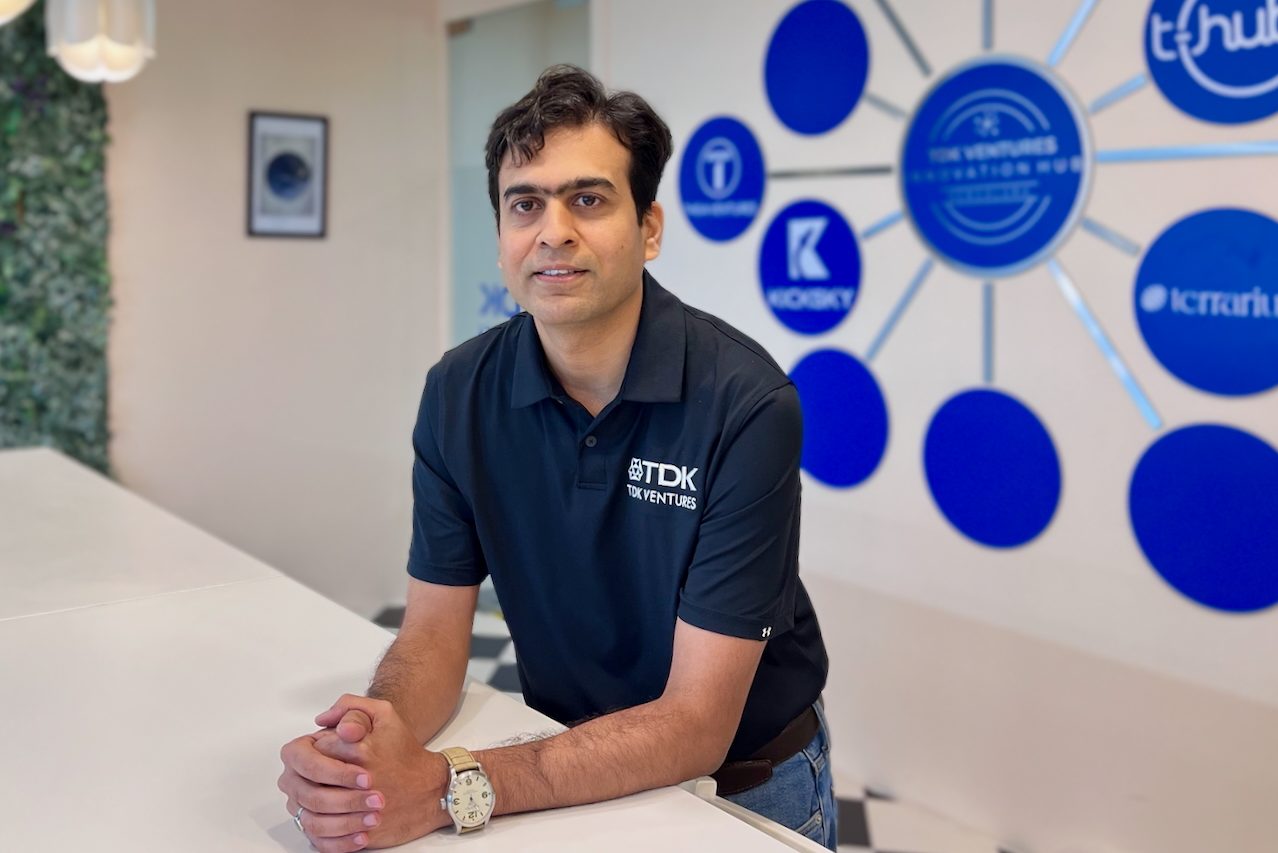
    In this episode, Ravi Jain, an Investment Director at TDK Ventures, joins me for a wide-ranging discussion on the current state and trajectory of India’s deep tech ecosystem. Jain gives us a micro capsule on the history of TDK, developing technologies for sectors spanning automotive, energy storage, and power electronics, and the strategic rationale for launching its corporate venture arm in 2019.

    He talks about TDK Ventures’ mandate to invest in startups poised to shape emerging markets and tomorrow’s standards, noting the recent expansion of the firm’s India operations, and a global portfolio that includes investments across sectors such as semiconductors, advanced materials, robotics, quantum technologies, AI, mobility, climate tech and clean energy and agri-tech.

    Jain addresses macroeconomic drivers, including government policy, manufacturing incentives, and evolving founder ambitions, that position India for accelerated growth in deep tech. He explains the sector’s optimism despite talent and funding challenges, and highlights the increasing sophistication of Indian deep tech founders, their pragmatism, and the snowballing effect of policy and market maturation.

    He also talks about TDK Ventures’ approach to hardware versus software startups, university-driven entrepreneurship, and the imperative for foundational work in AI. Jain also shares reflections from his own career, distilling practical advice for future deep tech entrepreneurs navigating India’s rapidly changing technology landscape.